 by
by 
For discerning international investors, the decision to buy a house in Oslo, Norway, represents more than a simple property acquisition; it is a strategic entry into a market defined by long-term stability and compelling growth potential. Oslo is not merely a place to live; it is a strategic asset, underpinned by a powerhouse economy and a quality of life few European capitals can rival. This makes it a cornerstone investment for any sophisticated global property portfolio.
Understanding The Oslo Property Market
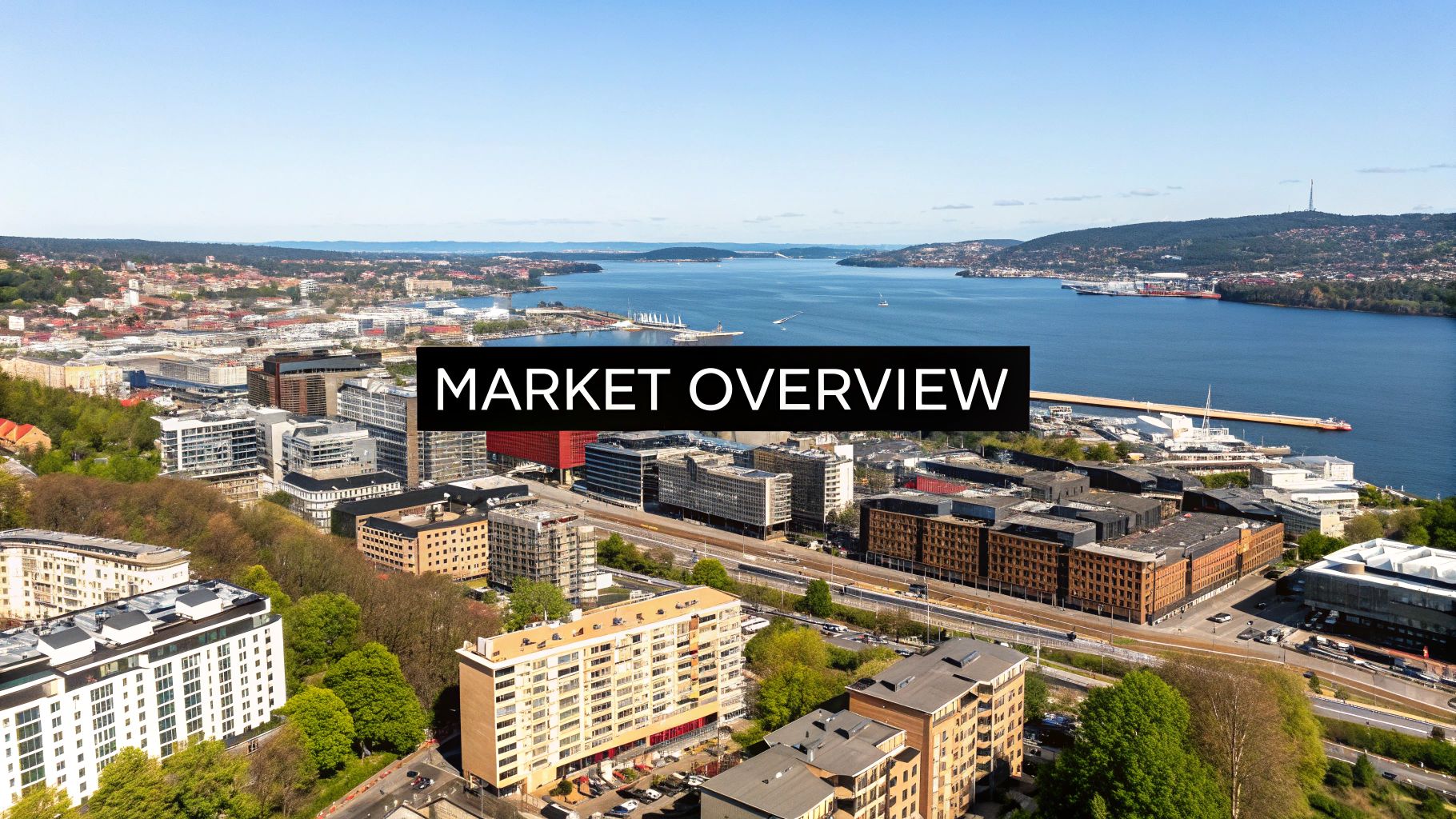
What distinguishes Oslo’s luxury property market from the rest of Norway is its definitive ‘capital city premium’. As the nation’s economic and cultural heart, Oslo functions as a magnet for talent, business, and capital, all of which directly fuel its real estate sector. Unlike more speculative markets, Oslo’s property values are founded on solid fundamentals, positioning it as a secure choice for significant investment.
The market sentiment here is consistently confident, driven by a textbook economic principle: high demand colliding with limited supply. Understanding this imbalance is the first step for any serious investor, as it is the core engine driving the steady appreciation of property values across the city.
Economic and Demographic Drivers
Oslo’s prosperity is no accident. The city is propelled by a diverse and remarkably resilient economy, with major players in technology, maritime industries, and green energy. This economic strength translates into high employment and rising incomes, which in turn maintains a vibrant and active property market.
However, the definitive story is the demographic boom. Oslo is one of Europe’s fastest-growing capitals, with some projections indicating a population surge of up to 30% by 2030. This constant influx of new residents, from both within Norway and internationally, places enormous pressure on the available housing stock. Demand consistently outstrips supply.
This dynamic creates a very clear investment case. For instance, recent figures show housing prices in Oslo have jumped by approximately 7.3%, with the average property now valued at around 7.2 million Norwegian kroner (NOK). This price growth is further intensified by strict zoning laws that cap new housing developments, particularly in the most sought-after central districts.
To provide a clearer picture, here are some of the key metrics that currently define Oslo’s property market.
Key Oslo Property Market Indicators
| Indicator | Recent Data | Key Takeaway for Investors |
|---|---|---|
| Average Price Growth | 7.3% year-on-year | Demonstrates strong, consistent appreciation driven by fundamental demand. |
| Average Property Value | Approx. 7.2M NOK | Reflects the ‘capital city premium’ and high entry point for prime real estate. |
| Projected Population Growth | Up to 30% by 2030 | Guarantees sustained, long-term pressure on housing supply. |
| Supply Constraints | Strict zoning laws | Limits new builds, protecting the value of existing properties. |
These figures are not just numbers on a page; they tell the story of a market with solid foundations and a clear trajectory for future growth, making it a reliable destination for capital.
“Oslo’s appeal to international investors is its powerful combination of long-term stability and quality of life, making it a cornerstone for any diversified European property portfolio.”
— Nick Marr, Founder of EuropeanProperty.com
Spotlight On Premier Neighbourhoods
For buyers looking to buy a house in Oslo, Norway, certain districts stand out for their prestige, lifestyle, and investment clout. Knowing the unique character of each is key to identifying the right fit for your portfolio.
- Frogner: Widely regarded as Oslo’s most prestigious residential postcode. Envision elegant 19th-century buildings, high-end boutiques, and some of the city’s finest restaurants. It offers a truly sophisticated urban ambiance, softened by the green expanse of the famous Frogner Park.
- Bygdøy: This peninsula is a peaceful, green retreat from the city’s energy. It is known for its grand villas, waterfront homes, and a cluster of Oslo’s best museums. It has a more suburban, family-oriented feel yet remains just a quick ferry ride from the centre.
- Holmenkollen: For ultimate luxury and exclusivity, look to the hills. Holmenkollen properties offer breathtaking views over the city and the fjord. It’s a haven for nature lovers and ski enthusiasts, with world-class facilities right on the doorstep.
Each of these neighbourhoods represents a different facet of Oslo’s high-end market, from chic city living to serene natural escapes. For those interested in the technical side of marketing properties online, understanding the Open Graph protocol can be a useful skill. Matching your investment to your lifestyle objectives begins with understanding what makes each of these prime locations tick.
How Foreign Buyers Can Navigate Norwegian Property Law
One of the greatest draws for international buyers considering a house in Oslo, Norway, is the market’s remarkable openness. Unlike many other prime European destinations, Norway places almost no restrictions on who can buy property. This creates a level playing field where you compete directly with locals, not against a mountain of red tape.
This welcoming approach signals a stable and secure investment climate, free from the usual complexities of cross-border transactions. However, while the door is wide open, navigating the process successfully requires a firm grasp of the local legal framework.
Engaging a qualified Norwegian solicitor (advokat) is not just advisable—it is essential. They act as your representative on the ground, protecting your interests and ensuring every legal detail is handled with precision. Their expertise is invaluable when it comes to the purchase contract and investigating the property’s legal history.
The Pillars of Property Registration
The Norwegian property system is designed for transparency and security, revolving around two key institutions. Understanding their functions is fundamental to ensuring your ownership is legally watertight.
- The Norwegian Mapping Authority (Kartverket): This is the government body that manages all property registration in Norway. Consider it the definitive source of truth for property boundaries, titles, and any encumbrances or restrictions attached to a property.
- The Land Registry (Grunnboken): This is the official public register, managed by the Kartverket, that holds all legal data about a specific property. A clean record in the Grunnboken is the gold standard for undisputed ownership.
Before you consider making an offer, your solicitor will conduct a deep dive into this registry. They will confirm the seller has the legal right to sell and uncover any mortgages or claims that could complicate your purchase.
Understanding the Purchase Contract and Due Diligence
The purchase contract, known as the kjøpekontrakt, is the binding legal document that formalises the transaction. It outlines every term, from the price and payment schedule to the handover date. Your solicitor’s role is to scrutinise this document to ensure the terms are fair and your interests are fully protected.
Due diligence extends far beyond checking the title. It involves verifying all pertinent details. What are the local zoning regulations? Can you build that extension you envisage? Are there any municipal development plans that might affect the property’s value? Your legal team will secure answers to these critical questions.
For discerning investors, due diligence is non-negotiable. It’s the process that transforms a promising opportunity into a secure, long-term asset. Verifying every detail, from land registry records to cooperative bylaws, is the hallmark of a sophisticated purchase.
If you are purchasing an apartment in a housing cooperative (borettslag), the process requires an additional layer of scrutiny. It includes investigating the cooperative’s finances and its internal regulations. You must be aware of any shared debt, upcoming major repairs, or restrictions on letting out your unit.
Closing Costs and Finalising the Transaction
Once your offer is accepted and due diligence is complete, it is time to finalise the finances. The main closing cost to anticipate is the stamp duty, or dokumentavgift. This is a one-off tax set at 2.5% of the property’s market value, paid to the state to officially register you as the new owner.
In addition to this, you will have your solicitor’s legal fees and a small registration fee for filing the title deed with the Land Registry. Your funds are typically wired to a secure client account held by the estate agent or solicitor. They then manage the final settlement (oppgjør), paying the seller and ensuring the title is officially transferred into your name.
Mastering these legal and financial steps is the key to a smooth and secure purchase in the Oslo market.
Securing Finance and Managing Your Investment

Inevitably, any discussion about how to buy a house in Oslo, Norway, turns to finance. For international buyers, understanding the local financial landscape is as critical as identifying the perfect property.
The good news is that Norway’s banking system is modern, sophisticated, and accessible to non-residents, provided you meet their criteria. Securing a mortgage is not just about demonstrating your net worth; it is about proving you can responsibly manage a Norwegian asset.
Mortgage Options for International Buyers
Norwegian banks are generally willing to lend to foreign nationals, but they are exceptionally thorough. Do not be surprised by the level of detail they require. Your first step will be obtaining a Norwegian D-number, which is a temporary identification number for foreigners. You will need this for almost any official or financial transaction in the country.
To secure mortgage approval as an international buyer, you will typically need to have the following in order:
- Proof of Stable Income: This must be robust and verifiable. The bank needs to see that you can comfortably service the mortgage on top of your existing global commitments.
- A Significant Deposit: While local buyers might secure financing with a smaller down payment, international investors should anticipate a loan-to-value (LTV) ratio of around 75%. This means you will need a deposit of at least 25% of the purchase price.
- A Norwegian Bank Account: This is non-negotiable. It is where the loan will be disbursed and how you will manage all ongoing property-related payments.
For high-net-worth individuals, I often recommend exploring private banking. These services are designed to handle complex international wealth profiles and can provide bespoke financing solutions that a standard high-street bank cannot match. They offer a level of discretion and a tailored approach that aligns with the needs of a global investor. If you’re looking to polish your financial presence, you might find useful tips on how to optimise your digital financial profile.
Analysing Ongoing Ownership Costs
The purchase price is merely the starting line. Any seasoned investor knows that you must forecast the total cost of ownership to gain a realistic picture of your return on investment.
Understanding the full spectrum of ownership costs is fundamental to strategic asset management. From municipal charges to potential rental taxes, a comprehensive financial overview prevents future surprises and ensures your Oslo property performs as expected.
Here are the key ongoing costs you need to budget for:
- Property Tax (Eiendomsskatt): This is a municipal tax, and the rate varies depending on which district of Oslo your property is in. It is calculated based on the property’s assessed value.
- Municipal Charges: These cover essentials like water, sewage, and rubbish collection.
- Insurance (Forsikring): Comprehensive building and contents insurance is an absolute must to protect your asset.
- Housing Cooperative Fees (Felleskostnader): If you buy an apartment in a borettslag (housing cooperative), these monthly fees cover the upkeep of common areas, shared building debt, and other communal expenses.
Investment Potential and Rental Market Dynamics
For buyers looking to generate income, Oslo’s rental market is consistently strong, fuelled by steady demand from professionals, students, and a large expatriate community. Rental yields can be attractive, but they vary dramatically from one district to another.
Prime central areas like Frogner might offer lower initial yields but tend to deliver stronger long-term capital appreciation. Conversely, up-and-coming districts could provide a better monthly cash flow.
Recent data reveals a highly active and resilient property market. While price growth in Oslo has been more modest compared to cities like Stavanger, transaction volumes have jumped by 7.3% year-over-year. Furthermore, the average time to sell a home has dropped to just 42 days, which points to a liquid market with high investor confidence.
Mastering the Oslo Property Search and Bidding Process
To succeed in Oslo’s fast-moving property market, a blend of digital proficiency and an intuitive feel for local customs is required. Transactions move incredibly quickly here. For anyone looking to buy a house in Oslo, Norway, being prepared is not just an advantage—it is essential.
Your property search will almost certainly begin online, where Finn.no is the undisputed leader for property listings in Norway. However, for international investors seeking a more curated selection of premium homes, platforms like EuropeanProperty.com cut through the noise. They offer a focused view of high-end opportunities that align with an investor’s criteria.
The Role of Real Estate Agents
In Norway, the real estate agent, or eiendomsmegler, almost always represents the seller. Their primary duty is to secure the best price and terms for their client. This is a crucial detail for any international buyer to grasp from the outset.
While you can proceed independently, engaging a dedicated buyer’s agent is a smart, strategic move for any serious investor. A buyer’s agent works exclusively for you. They provide unbiased advice, source properties that meet your specific requirements, and advocate on your behalf during negotiations. Their local market insight is priceless and can easily be the difference between a good deal and a great one.
The Norwegian Bidding Round: An Intense Process
The most unique—and often startling—part of buying property in Oslo is the bidding round, or budrunde. Forget the slow, protracted negotiations you may be accustomed to. The Norwegian process is a fast, high-stakes event that is legally binding from the moment you place your first bid.
It typically unfolds over a few frantic hours, usually the day after the public viewing (visning). Bids are submitted in writing, often via SMS or email, and every bidder is updated on competing offers in real time. This total transparency creates a fiercely competitive atmosphere where you must think and act decisively.
“The Norwegian budrunde is a true test of an investor’s resolve and preparation. Having your financing unequivocally pre-approved is non-negotiable. Entering a bidding war without it is like showing up to a race without a car—you simply cannot compete effectively.”
— An insight from EuropeanProperty.com’s market analysts
Strategic Preparation for the Bidding War
Winning a budrunde comes down to one thing: preparation. Here is precisely what you need to have arranged before you even consider placing a bid.
- Secure Pre-Approved Financing: This is paramount. A written financing confirmation (finansieringsbevis) from your bank is your entry ticket. Sellers and their agents will not even consider a bid without it.
- Define Your Absolute Maximum: Before the bidding frenzy commences, decide on the highest price you are willing to pay and commit to it. The psychological pressure of a bidding war makes it incredibly easy to make emotional, overpriced decisions.
- Review the Salgsoppgave Thoroughly: The sales prospectus (salgsoppgave) is your essential guide. It contains every critical detail about the property, from technical reports and its legal status to information about the housing cooperative, if applicable. Review this document meticulously with your advisor before the viewing.
Freehold vs. Cooperative: Understanding Your Ownership
When you buy a house in Oslo, Norway, you will encounter two main types of ownership. Each has very different implications, particularly for international buyers.
- Selveier (Freehold): This is ownership in its purest form. You own the property outright, along with a share of the land it stands on. It provides the most freedom for activities like renovations or letting out the property, making it a favourite for investors who want full control.
- Borettslag (Cooperative): Here, you buy shares in a housing cooperative, which in turn grants you the exclusive right to live in a specific flat. You do not own the physical unit itself. Cooperatives have their own rules and can come with significant restrictions, such as the rett til forkjøp (right of first refusal), which allows existing members to step in and purchase the apartment at your accepted bid price.
It is vital to understand the financials and rules of a borettslag. Investigating the cooperative’s accounts to check for shared debt (fellesgjeld) and any major maintenance projects planned for the future is a key part of your due diligence. These factors have a direct impact on your monthly fees (felleskostnader) and the long-term health of your investment.
Finalising Your Purchase With Proper Due Diligence
Your bid has been accepted. The frantic pace of the budrunde is over, but this is not the time to relax. Now the real work begins—transforming that winning bid into a secure, long-term asset. While your solicitor handles the standard legal checks, sophisticated investors know to dig deeper to fully protect their interests when they buy a house in Oslo, Norway. This phase is all about ensuring total transparency before any contracts are signed.
The first port of call is the technical inspection. Every property’s sales prospectus includes a technical report, known as a boligsalgsrapport or tilstandsrapport. Do not merely skim this document. It is a detailed assessment of the property’s condition, from the roof and plumbing to the electrical systems. This is your opportunity to uncover hidden defects or future costs that were not apparent during your viewing.
Analysing Cooperative Health and Financials
If you are buying into a housing cooperative (borettslag), your due diligence extends beyond the four walls of your apartment. You must investigate the financial health of the entire cooperative. Obtain the borettslag‘s financial statements and the minutes from their annual general meetings. These documents are a goldmine of information, offering a clear window into the cooperative’s management, financial stability, and any significant projects on the horizon.
Keep an eye out for red flags. Issues like low reserve funds, a high level of shared debt (fellesgjeld), or discussions about major upcoming renovations like new roofing or façade work are crucial to identify. These projects almost always lead to an increase in your monthly fees (felleskostnader), which directly impacts your investment returns. A well-managed co-op with healthy finances is a far more predictable and stable investment.
The image below provides a quick visual comparison of what to expect from different property types across Oslo.
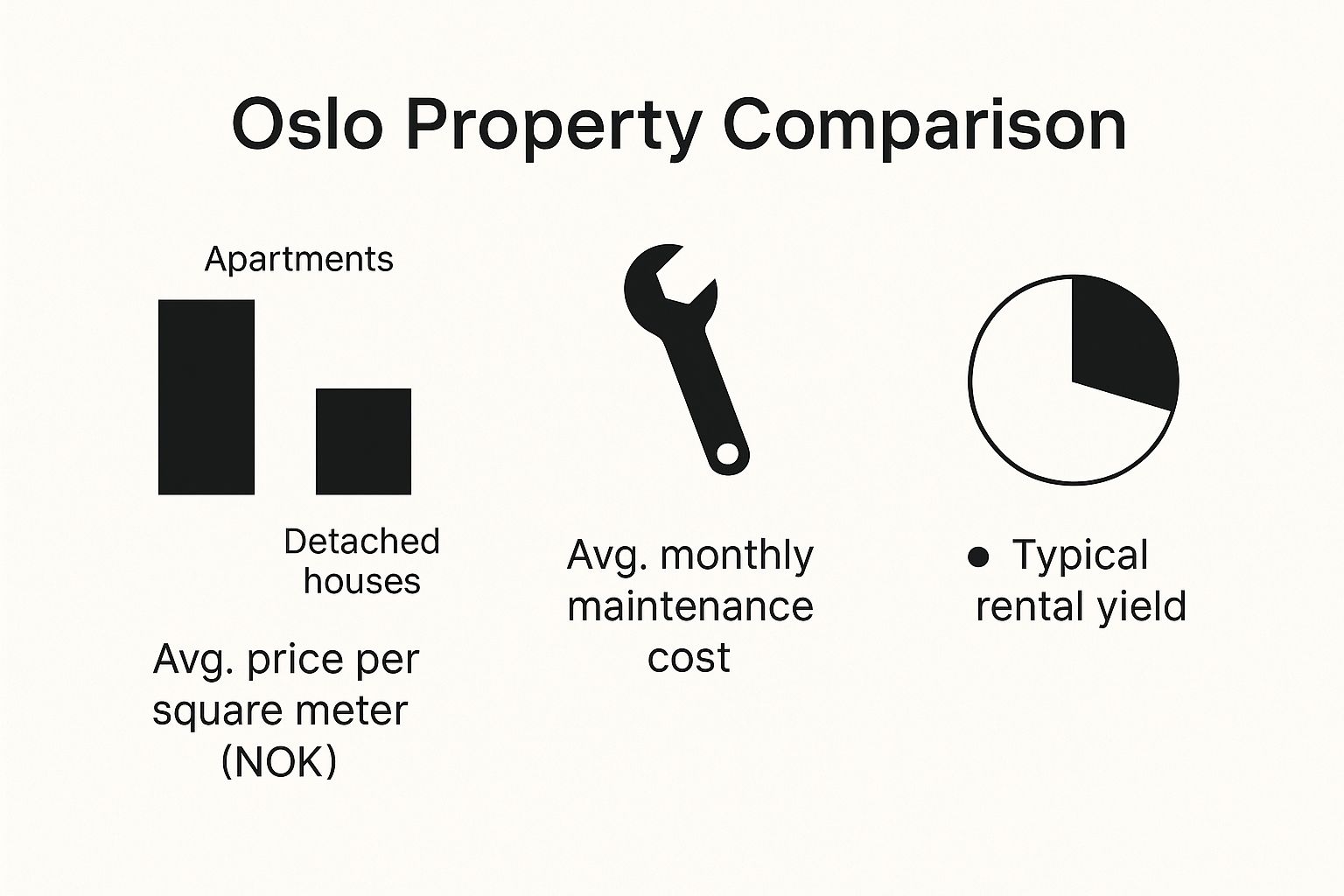
As you can see, the trade-offs are clear. Detached homes carry a higher price tag, while apartments often come with more predictable maintenance costs and can offer very competitive rental yields.
Before we move on, it’s worth understanding the two main ownership models in Norway, as they have different implications for your investment.
Property Type Comparison Selveier vs Borettslag
Choosing between a freehold (Selveier) and a cooperative (Borettslag) property is one of the most significant decisions you will make. Each has its own set of rules, costs, and benefits that can affect everything from your monthly expenses to your freedom to renovate.
| Feature | Selveier (Freehold) | Borettslag (Cooperative) |
|---|---|---|
| Ownership | You own the property outright, including the land it’s on. | You own a share in the cooperative, giving you the right to occupy a specific unit. |
| Flexibility | High. More freedom to renovate, alter, and rent out your property. | Lower. Subject to the cooperative’s rules on renovations, subletting, and even pet ownership. |
| Upfront Cost | Generally higher purchase price. | Generally lower purchase price, but comes with shared debt (fellesgjeld). |
| Monthly Costs | You are responsible for all maintenance, insurance, and municipal taxes. | You pay a monthly fee (felleskostnader) covering shared debt, maintenance, and building insurance. |
| Shared Debt | None. | Yes, the fellesgjeld. This can increase if the co-op takes on new loans for major repairs. |
| Best For | Investors seeking maximum control, long-term appreciation, and rental freedom. | Buyers looking for a lower entry price and more predictable shared maintenance costs. |
Ultimately, a Selveier offers more independence, but a well-managed Borettslag provides a simpler, more communal living experience with fewer individual responsibilities. Your choice depends entirely on your personal risk tolerance and investment objectives.
The Final Steps to Ownership
Once you are satisfied with your due diligence, it is time to sign the final purchase contract, or kjøpekontrakt. This is the legally binding agreement that locks in all the terms of the sale. Immediately after signing, you will need to transfer the deposit—usually 10% of the purchase price—into a secure client account managed by the estate agent or your solicitor.
The final settlement, known as oppgjør, is when the funds are transferred. On a pre-agreed date, you will transfer the remaining balance. As soon as the full payment is confirmed, the agent handles the official handover, and you will receive the keys to your new Oslo home.
The time between an accepted bid and receiving the keys isn’t just a waiting period—it’s an active, critical phase of verification. This is your final opportunity to ensure every single detail is correct and that your capital is being deployed into a sound, problem-free asset.
This entire process, from the accepted bid to the final handover, typically takes a few weeks. It allows sufficient time for all legal and financial paperwork to be completed properly. If you want a more general overview of the home-buying journey, a good first-time house buying checklist can be very helpful. And to see what official documents look like, you can view an example of a property map document here.
By approaching this final stage with diligence and attention to detail, you ensure your Oslo property journey concludes successfully, with your investment secure and your ownership officially recorded.
Your Questions on Buying Property in Oslo Answered
When looking to buy a house in a new country, questions are inevitable. For anyone considering an investment in Oslo, Norway, obtaining clear, straightforward answers is the first step. Here is a breakdown of the most common queries we receive from international buyers and property professionals.
Can a Foreigner Buy a House in Oslo, Norway?
Yes, absolutely. Norway has one of the most open and welcoming property markets in Europe. There are almost no restrictions preventing foreign nationals, including those from outside the EU, from purchasing residential real estate.
You do not need to be a resident or hold a Norwegian passport to own a home, which is a major advantage for global investors. The entire process is transparent, placing you on an equal footing with local buyers. The only real requirements are standard identity checks and obtaining a Norwegian D-number (a temporary ID number) for tax and official registration.
Do I Need a Norwegian Bank Account?
While not legally required to make an offer, it is a practical necessity. A Norwegian bank account is crucial for the final stages, including transferring the purchase price, paying the settlement fees (oppgjør), and handling ongoing costs like property taxes or cooperative fees (felleskostnader).
Most banks will ask for a D-number before they will open an account for you. My advice? Initiate this process as early as possible. It smooths out the entire transaction and demonstrates to sellers that you are a serious and prepared buyer.
Are There Restrictions on Renting Out My Oslo Property?
This is a critical question, and the answer depends on the type of ownership.
- Selveier (Freehold): If you buy a freehold property, you are in control. You have almost total freedom to let it out for short or long periods, provided you adhere to local tenancy regulations. This makes Selveier properties the top choice for pure investment plays.
- Borettslag (Cooperative): Owning a share in a cooperative is a different matter. The co-op’s board must approve any subletting, and it is often capped at a specific term, such as three years. Some co-ops even prohibit short-term rentals altogether.
Expert Tip: Always obtain a copy of the cooperative’s bylaws (vedtekter) and review them carefully during your due diligence. It is the only way to understand the rental rules before you are legally committed.
What Are the Primary Tax Implications for Foreign Owners?
As a non-resident owner, you will be liable for a few Norwegian taxes. Here are the main ones:
- Stamp Duty (Dokumentavgift): This is a one-off tax set at 2.5% of the property’s market value. It only applies to freehold (Selveier) properties—cooperative apartments are exempt, which represents a significant saving.
- Property Tax (Eiendomsskatt): An annual municipal tax calculated on your property’s assessed value. The exact rate can vary depending on the district in Oslo.
- Capital Gains Tax: If you sell for a profit, that gain is generally taxable. The good news is that you can be exempt if you have owned the property for over a year and have used it as your primary residence for at least 12 of the 24 months preceding the sale.
- Wealth Tax: Norway imposes a wealth tax that applies to both residents and non-residents who own assets in the country. Your Oslo property’s value will be included in this calculation.
I cannot stress this enough: consult a tax advisor who is an expert in both Norwegian and your home country’s tax systems. They can help you navigate bilateral tax treaties and understand your full liability.
Does Buying Property in Oslo Lead to Residency or a Visa?
In short, no. Buying a home in Norway does not provide an automatic path to residency or a ‘golden visa’. Unlike some other European nations, Norway bases its residency permits on factors like employment, education, or family connections, not on real estate investments.
Owning a property in Oslo can certainly strengthen an application by demonstrating strong ties to the country, but it will not secure a residence permit on its own.
Why Is Competition So High for Central Oslo Properties?
It all comes down to a classic supply and demand imbalance, but with a few unique Norwegian characteristics. Over 80% of Norway’s population lives in urban centres, and Oslo is the undisputed economic and cultural magnet. The city’s population is projected to grow by a massive 30% by 2030, which continues to fuel intense housing demand.
At the same time, new construction is extremely limited, especially in the most sought-after central districts where stringent zoning laws protect historic buildings and restrict development. This scarcity is what drives the fierce bidding wars and underpins the long-term value of prime Oslo real estate. You can learn more about how these forces shape the market in Investropa.com’s deep dive into Oslo’s real estate trends.
At EuropeanProperty.com, we connect discerning buyers with Europe’s finest luxury properties. Explore our curated portfolio of homes for sale across the continent.
👉 Discover your next European property investment today
About EuropeanProperty.com
EuropeanProperty.com is Europe’s longest-running luxury real estate platform, online since 1999. It connects luxury real estate agents, developers, and homeowners with high-net-worth buyers and international investors.
Looking for expert mortgage guidance? Get luxury property mortgage advice here:
👉 https://europeanproperty.com/luxury-overseas-mortgages/
Explore more overseas homes for sale at our global partner site:
👉 https://homesgofast.com/overseas-property/