

To buy a villa in France is to do more than just acquire real estate; it is an investment in a lifestyle that blends historic charm with modern luxury. From the sun-drenched glamour of the Côte d’Azur to the tranquil, lavender-scented hills of Provence, the French property market offers a rare combination of stability, value, and timeless appeal for discerning international buyers.
Why the French Villa Market Beckons
The decision to buy a villa in France goes far beyond a simple transaction. It is about embracing a culture, a cuisine, and a quality of life that has captivated global investors for generations. Unlike more volatile markets, French real estate—especially in prime locations—has shown remarkable resilience and consistent long-term appreciation.
This enduring appeal is built on a few key pillars:
- A Stable and Secure Legal Framework: The French property buying process is overseen by a state-appointed notaire. This gives both the buyer and seller a high degree of security, ensuring every legal detail is meticulously handled.
- Diverse Lifestyle Offerings: France truly caters to every taste. Whether you are after the vibrant social scene of Saint-Tropez, the rustic elegance of a Dordogne farmhouse, or the alpine majesty of a chalet in Megève, the perfect setting is waiting for you.
- Strong International Demand: The country remains a top destination for high-net-worth individuals, which ensures a robust and liquid market for luxury properties. This consistent demand underpins property values, making it a sound choice for portfolio diversification.
Current Market Dynamics and Opportunities
If you have been watching the market, you will know that recent indicators point to a compelling window of opportunity. After a period of adjustment, the French property market is showing clear signs of renewed energy.
“France’s allure isn’t just in its beauty, but in its stability. For serious investors, it offers a proven track record of value preservation and lifestyle returns that few other global markets can match,” notes Nick Marr, founder of EuropeanProperty.com.
The numbers back this up. Market analysis reveals that transaction volumes rose by 12% in the first half of the year compared to the same period previously. This resurgence is supported by stabilised mortgage rates and targeted tax incentives designed to boost buyer confidence.
For UK buyers, in particular, favourable financing conditions and market shifts have made a French villa purchase more accessible than it has been for some time. You can dive deeper into the trends with a detailed French property market analysis for summer 2025. This is an environment where smart, strategic acquisitions can be made. You can find cheap houses for for sale in France at Homesgofast.com
A Glimpse into Prime Villa Locations
Getting to know the regional nuances is fundamental to making a successful investment. Each of France’s celebrated regions offers a distinct character and property profile.
To help you start your search, here is a quick snapshot of the most sought-after areas for international buyers looking to buy a villa in France.
Prime French Regions for Villa Buyers at a Glance
This table gives you a feel for what to expect in the country’s most popular destinations, from the lifestyle on offer to the architectural style and typical price point.
| Region | Primary Appeal | Typical Villa Style | Average Price Point |
|---|---|---|---|
| Côte d’Azur | Glamour, yachting, coastal living | Modernist sea-view estates, Belle Époque mansions | Premium |
| Provence | Rustic charm, vineyards, tranquil countryside | Stone mas (farmhouses), elegant bastides | High |
| Dordogne | History, gastronomy, rural landscapes | Converted farmhouses, manor houses, châteaux | Mid-to-High |
| French Alps | Skiing, alpine sports, year-round activities | Luxury chalets, modern mountain homes | High |
Whether you see yourself sipping rosé on a terrace overlooking the Mediterranean or curled up by a fire in a cosy alpine chalet, understanding these key differences is the first step towards finding your perfect French home.
Mastering The French Property Purchase Process
For anyone looking to buy a villa in France, the legal process can seem a bit daunting, especially if you’re coming from a different system. But here is the good news: it is one of the most structured and secure processes in the world, designed to protect both buyer and seller. Once you understand the key milestones, it is less of a maze and more of a clear path to owning your dream home.
The journey kicks off when you find your perfect villa and make a formal offer, known as the offre d’achat. Once that is accepted, things move quickly to the most crucial stage: signing the preliminary sales agreement.
The Compromis de Vente: The Binding Agreement
Unlike in the UK or US where deals can fall apart late in the game, the French system locks things in early. The compromis de vente is a legally binding preliminary contract. It lays out everything—the agreed price, the property details, and any conditional clauses (clauses suspensives). These are your safety nets, typically for things like securing a mortgage or getting a clean bill of health from a property survey.
Once you sign, you will pay a deposit, usually between 5-10% of the purchase price. This money does not go to the seller. Instead, it is held safely in an escrow account (compte séquestre) managed by a public official called the notaire.
Here is a key protection for buyers: after signing, you get a mandatory 10-day cooling-off period. You can walk away for any reason at all during this time and get your deposit back in full, no questions asked. The seller, however, does not get this luxury. Once they sign, they are committed.
The Role of the Notaire
The notaire is the linchpin of every French property transaction. They are a public official appointed by the Ministry of Justice, and they act as an impartial legal expert for both the buyer and the seller. Their job is to make sure the entire sale is legal, transparent, and correctly executed.
The notaire handles a lot of the heavy lifting:
- Conducting all the necessary due diligence, like title searches and checking planning permissions.
- Preparing and filing all the official legal documents.
- Calculating and collecting the various taxes and fees on behalf of the state.
- Overseeing the final signing of the deed, which officially makes you the owner.
The seller usually chooses a notaire, but as the buyer, you have the right to appoint your own at no extra cost. The fee is simply split between the two offices. Having your own notaire can offer extra peace of mind, especially if it is a complicated purchase. For a deeper dive into this, check out our guide to buying luxury property in France.
From Due Diligence to Final Signature
The period between signing the compromis de vente and the final deed (Acte de Vente) usually takes a few months. This is when all the important background work happens. Your surveyor will inspect the property, your bank will finalise your mortgage, and the notaire will handle all the legal checks.
This infographic gives you a simple look at how to evaluate the market before you even get to this stage.
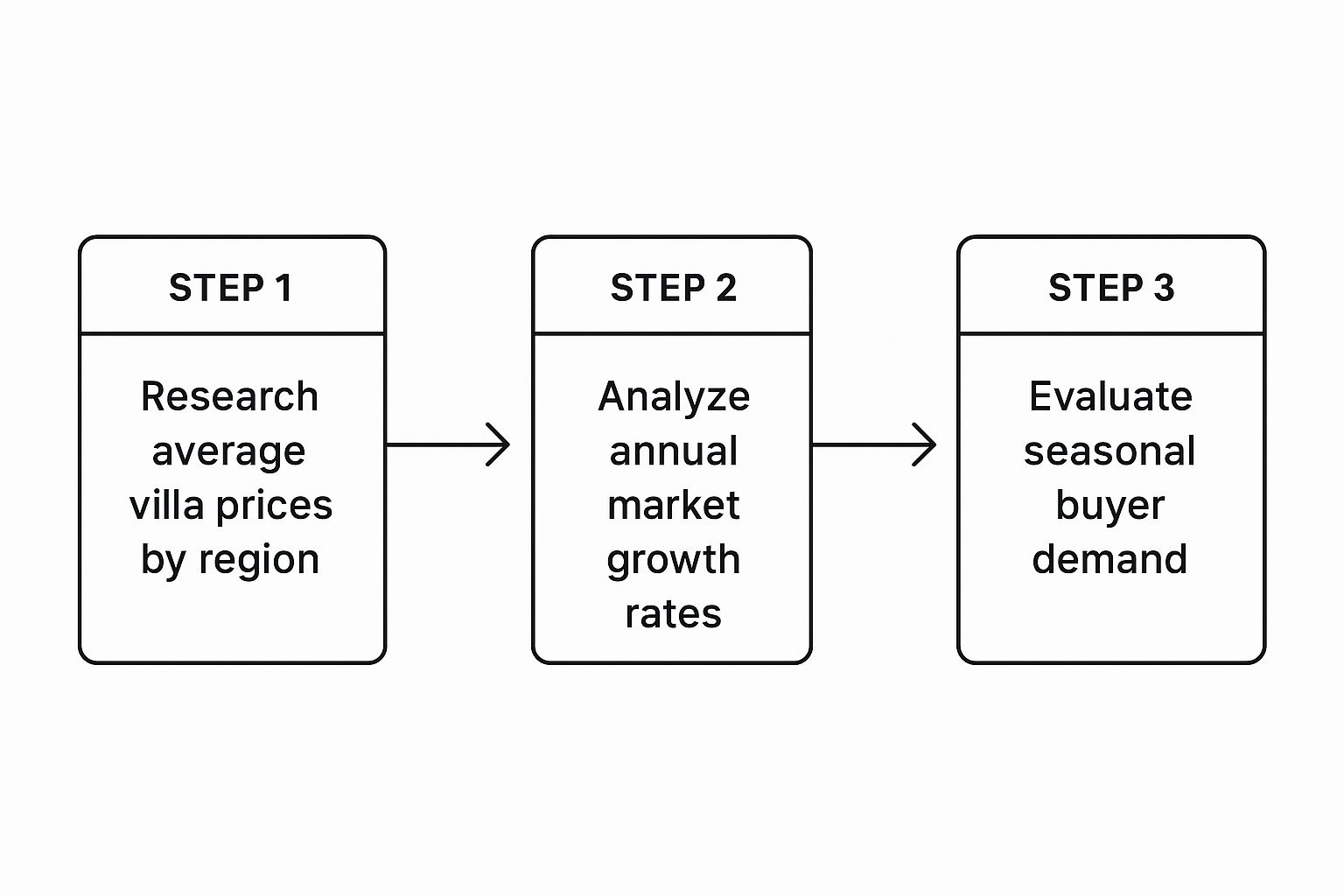
As you can see, it is all about layering regional price data with market trends and buyer demand to find those genuine investment hotspots.
The whole process comes to a head with the signing of the Acte de Vente. You will meet at the notaire’s office, transfer the final balance, and the seller will hand over the keys. At that moment, the villa is officially yours.
Navigating the French purchase process requires patience and precision. The structured, notaire-led system is one of the safest in the world, but buyers must be prepared for its methodical pace. Understanding each step removes uncertainty and builds confidence.
One last critical tip for international buyers: do not forget about currency exchange. Wild swings in exchange rates can dramatically change the final price you pay in your home currency. It is smart to use a foreign exchange specialist. They can help you lock in a favourable rate well in advance, giving you cost certainty and potentially saving you thousands compared to a high-street bank.
Navigating French Property Taxes and Legal Structures
Buying a villa in France is thrilling, but a successful purchase hinges on getting to grips with the financial and legal realities. It is not just about the sticker price; a series of taxes and fees will shape your total investment and ongoing costs. Mastering these details isn’t just admin—it is a crucial strategy for any savvy buyer.

The biggest cost you will face upfront is the frais de notaire. This is a catch-all charge that bundles various taxes with the notaire’s own professional fees. For resale properties, this typically lands somewhere between 7-8% of the purchase price, a hefty sum you need to budget for from day one.
While people call them ‘notary fees’, the notaire’s actual take-home is a tiny slice of the pie. The vast majority is transfer tax that goes straight to the state. For a complete picture, it is worth digging into the hidden costs of buying property in Europe.
Annual Property Taxes
Once the keys are in your hand, your attention shifts to the yearly taxes. Two main levies will land on your doormat:
- Taxe Foncière: This is the core property and land tax. It is paid by whoever owns the property on the 1st of January each year. The amount can vary wildly depending on your villa’s location and its ‘theoretical rental value’, a figure set by the local authorities.
- Taxe d’Habitation: This used to be a residence tax for everyone, but it has now been scrapped for main homes. Crucially for international buyers, however, it still applies to second homes. If you are buying a holiday villa, this tax is very much on your radar.
Always get a clear breakdown of these annual costs for any property you are serious about.
Understanding the Wealth Tax
If you have significant assets, you absolutely must be aware of France’s property wealth tax, the Impôt sur la Fortune Immobilière (IFI). This tax kicks in if the net value of your worldwide real estate tops €1.3 million. It is levied on the household, not just on the French property in isolation.
The IFI is a progressive tax, starting at 0.5% for assets just over the threshold and climbing to 1.5%. You need professional advice to understand your exposure and explore legitimate ways to mitigate it before you sign anything.
Choosing The Right Ownership Structure
How you legally own your French villa has massive knock-on effects for tax, inheritance, and general management down the line. For international buyers, it usually boils down to two main options: owning it directly or setting up a dedicated property company.
En Indivision (Direct Joint Ownership) is the most straightforward path for co-buyers, like a married couple. Each person simply owns a percentage of the property. While it is easy to set up, it can throw a spanner in the works for inheritance. French succession law can automatically pass a deceased owner’s share to their children, not necessarily their surviving partner.
A Société Civile Immobilière (SCI) is a much more flexible, sophisticated option. Essentially, you create a private French company purely to own and manage real estate. You and your co-buyers own shares in the SCI, and the SCI owns the villa. This setup offers some powerful benefits:
- Smarter Inheritance Planning: An SCI lets you sidestep France’s rigid succession rules, making it far easier to pass shares to your chosen heirs smoothly.
- Asset Protection: It helps to create a clear separation between your personal wealth and the property itself.
- Simplified Group Ownership: It is the perfect vehicle for multiple family members or a group of friends investing together, as all the rules are laid out in the company’s articles.
The choice between en indivision and an SCI is deeply personal. It depends on your family situation, your finances, and what you want to happen to the property in the future. Do not guess. Hiring a specialist international tax advisor and a French avocat (lawyer) is absolutely essential to protect your investment for years to come.
Finding Your Perfect Villa Location in France
In French real estate, the old saying ‘location, location, location’ isn’t just a cliché; it is the absolute foundation of your investment and future lifestyle. The decision of where to buy a villa in France is every bit as important as the property itself. From the high-octane glamour of the Mediterranean coast to the quiet, rolling landscapes of the interior, France offers a spectacular variety of settings, each with its own distinct personality.
Choosing the right region is all about matching your personal dreams with the hard realities of the market. Do you see yourself hosting glamorous parties for the international jet set, or do you picture quiet mornings wandering through ancient olive groves? Your answer will point you to the perfect corner of France.
The Côte d’Azur: A Magnet for Global Capital
For decades, the French Riviera has been the undisputed capital of luxury and glamour. This legendary stretch of coastline, from the famous Croisette in Cannes to the exclusive beaches of Saint-Tropez, is the very pinnacle of Mediterranean living. The lifestyle here is vibrant and social, revolving around yachting, world-class restaurants, and a packed social calendar.
The architecture is just as impressive, showing off a mix of opulent styles. You will find stately Belle Époque mansions alongside cutting-edge contemporary villas, complete with infinity pools that seem to melt into the sea. This is a market driven by prestige, and it is kept afloat by relentless international demand.
The French Riviera remains a top destination for international villa buyers, with investors from abroad making up 30% of all property purchases in the area. British buyers are a big part of this, along with Germans and Swiss nationals. The Riviera saw over €9 billion in real estate deals last year alone, with a huge number of luxury properties selling for over €5 million.
Provence: The Soul of Southern France
Head inland from the coast, and you will find yourself in Provence. This is a land of rolling lavender fields, sun-drenched vineyards, and charming hilltop villages that have inspired artists for centuries. Life here moves at a slower, more thoughtful pace, deeply connected to the rhythm of the seasons. The Luberon valley, with its iconic villages like Gordes and Ménerbes, offers the quintessential Provençal experience.
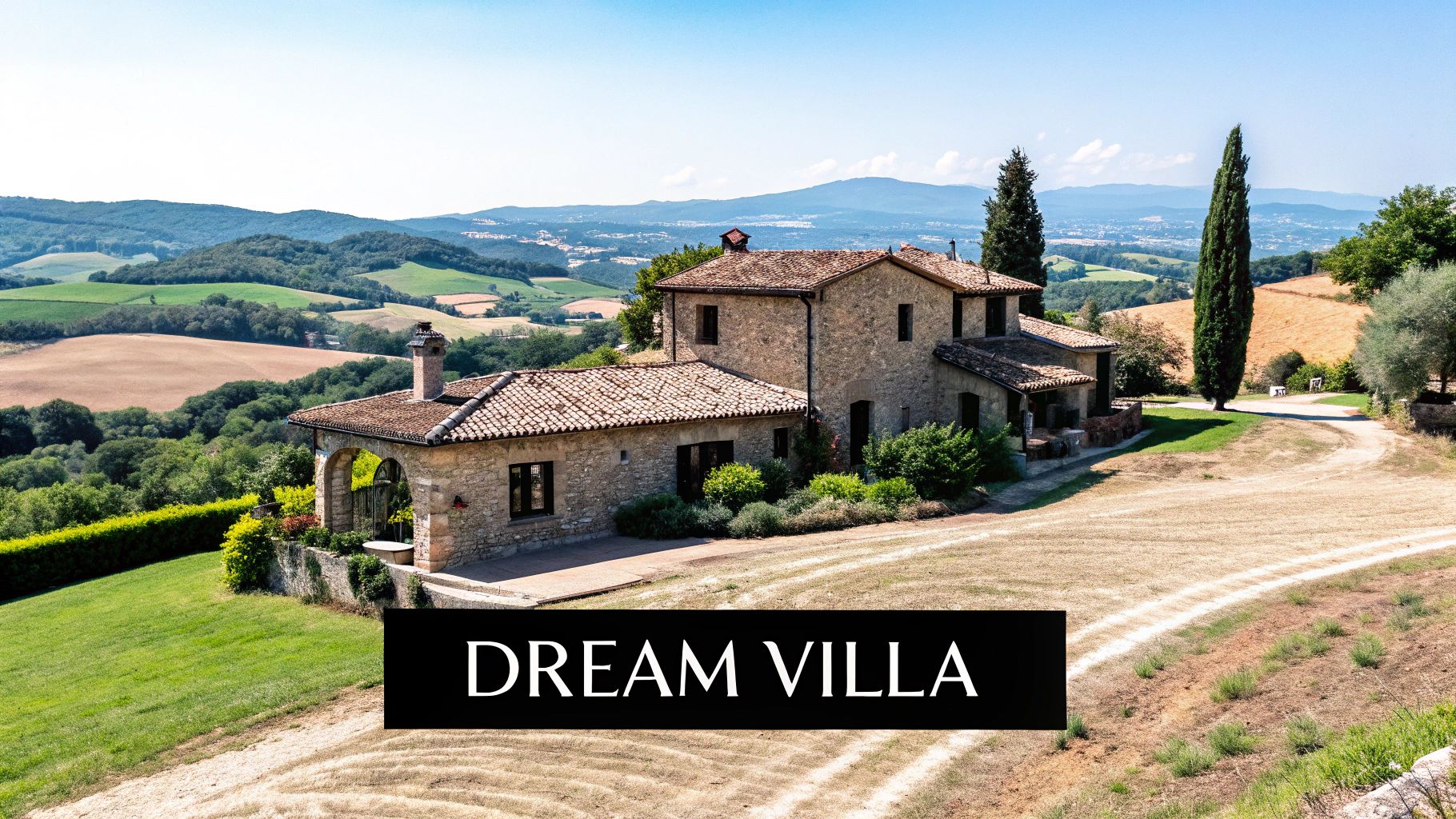
The properties here mirror the landscape’s rustic elegance. Think beautifully restored stone farmhouses (mas) and grand country estates (bastides), often nestled within acres of private land. To buy a villa in France in this region is to invest in peace, privacy, and a genuine connection to French country life. The market is strong, attracting buyers who want a quiet retreat without giving up sophistication. For a wider view of the market, you can explore various real estate industry resources.
The Dordogne: Historic Charm and Gastronomic Delights
If you are drawn to history and incredible food, the Dordogne valley in southwest France is an enchanting option. This region, often called Périgord, is a rich tapestry of medieval castles, prehistoric caves, and lush river valleys. Life here centres on bustling farmers’ markets and some of the country’s best food traditions, including truffles and foie gras.
“The location you choose dictates everything—your daily life, your social circle, and the long-term performance of your asset. The Côte d’Azur offers glamour and liquidity, while Provence offers timeless, soulful charm. The right choice is the one that speaks to both your head and your heart.”
The architectural style is unique, featuring golden-stone farmhouses, elegant manor houses (manoirs), and even historic châteaux. The Dordogne offers fantastic value compared to the coastal hotspots, attracting buyers who prioritise space, history, and a more understated kind of luxury.
Choosing between these iconic French regions can be tough, especially when you compare them to other European hotspots. For a different perspective, our analysis of French homes for sale versus Spanish properties offers some great insights for international buyers. In the end, the perfect location is where your lifestyle dreams and investment goals come together perfectly.
Life After the Purchase: Managing Your French Home

Getting the keys to your French villa is a fantastic moment, but it is the start of a new chapter, not the end of the story. The move from buyer to owner comes with a whole new set of practicalities, especially if you are managing the property from another country. To make it a seamless experience, you need a solid plan for the day-to-day running of your new home.
The first few days are all about getting established. This means tackling a few local administrative tasks which, while not complicated, need your attention straight away. Nailing these fundamentals from the get-go will save you headaches down the line and let you actually enjoy your investment.
Immediate Post-Purchase Priorities
First things first: get the utility accounts transferred into your name. This covers electricity (électricité), water (eau), and gas (gaz), plus sorting out your phone and internet. Your estate agent or notaire can usually give you the contact details for the local providers, which makes the whole process much simpler.
Next up, and this is non-negotiable, is getting the right insurance. French law insists you have assurance habitation, a comprehensive policy that covers civil liability, fire, water damage, and theft. But for a luxury villa, a standard policy just will not cut it. It is smart to find a specialist insurer who gets the needs of high-value properties, including proper cover for things like art, antiques, and those sprawling grounds.
Finally, opening a French bank account is a must. It makes paying bills, local taxes, and any staff you hire incredibly straightforward. Having a local account streamlines all the financial admin, making it far easier to manage, even when you are not in the country.
Property Management Solutions
For most international owners who buy a villa in France, good property management is the secret to peace of mind. You simply cannot leave a valuable property unattended for long stretches. The right management setup protects your asset, keeps it maintained, and can even help it generate an income.
You have got a few options, depending on how hands-on you want to be:
- Local Caretaker (Gardien): For bigger estates, a live-in or local caretaker is a brilliant solution. They can handle daily security, look after the grounds, and sort out minor repairs, giving you a constant presence on-site.
- Property Management Company: If you want a completely hands-off approach, a professional agency is the way to go. They manage everything from regular inspections and maintenance to handling holiday rentals, dealing with guests, and making sure you are compliant with letting laws.
- À la Carte Services: Some owners prefer to stay in control and hire individual services as needed. This could mean finding your own gardener, a pool maintenance company, and a cleaning service, which you either manage directly or through a trusted local contact.
“Many of our clients who buy a villa in France underestimate the ongoing logistics. Investing in a reliable property manager isn’t an expense; it’s a strategy to protect the value of your asset and, more importantly, your time,” says Nick Marr of EuropeanProperty.com.
Navigating Residency Rules for Non-EU Owners
If you are a non-EU citizen—and that includes Brits post-Brexit—you absolutely have to understand the residency rules. You cannot just come and go for as long as you like. Your time in France is dictated by the Schengen Area regulations.
The standard allowance is the 90/180-day rule. This lets you stay for up to 90 days within any rolling 180-day period across all Schengen countries combined. It is fine for holidays, but if you want to stay longer, you will need a visa.
For those planning to spend more significant chunks of time at their villa, you must apply for a Long-Stay Visa (visa de long séjour). This has to be done from the French consulate in your home country before you travel. There are different types, including visitor visas for those who can prove they are financially self-sufficient. This process requires a lot of paperwork and careful preparation, so getting advice from an immigration specialist is a very good idea to make sure it goes smoothly.
Common Questions About Buying a Villa in France
Stepping into the French property market for the first time is bound to raise a few questions, especially if you’re buying from abroad. We get asked the same things time and again, so here are some clear, straightforward answers to help you move forward with confidence as you buy a villa in France.
Can UK Citizens Still Buy Property in France?
Yes, absolutely. There are zero restrictions on British citizens purchasing property in France. From a legal standpoint, the process is exactly the same as for any other non-EU resident.
The real change since Brexit is how long you can stay. As a UK national, you are now limited to a maximum of 90 days within any 180-day period in the Schengen Area. Simple as that.
If you are dreaming of longer stays at your new villa, you will need to apply for a long-stay visa. It is a process you must start from your home country before you travel, and honestly, getting an immigration specialist involved is a very smart move.
What Is the Biggest Difference Between Buying in France and the UK?
It all comes down to the legal side of things, specifically the role of the notaire. In France, the notaire isn’t your solicitor; they are a state-appointed public official who works impartially for both buyer and seller. Their one job is to make sure the sale is 100% compliant with French law.
This is a world away from the UK system, where you and the seller each hire your own solicitors to fight your respective corners.
Another key difference is the compromis de vente. This is the initial sales contract, and it becomes legally binding on both sides far earlier than in the UK. Once that is signed, there is much more certainty for everyone involved.
Should I Use an SCI to Purchase My Villa?
An SCI (Société Civile Immobilière) is basically a private French company set up just to hold and manage property. For many international buyers, it is a brilliant ownership structure, but it is not for everyone.
So, why would you?
- Easier Inheritance: An SCI lets you sidestep France’s strict succession laws. This makes passing the property to your chosen heirs much simpler and can help trim future inheritance tax bills.
- Simpler Co-Ownership: If you’re buying with family or partners, an SCI neatly defines everyone’s stake through shares, avoiding future disagreements.
- Asset Protection: It creates a clean legal divide between your personal finances and the property itself.
The downside? There are administrative costs and legal hoops to jump through to set up and run an SCI. It is definitely not a one-size-fits-all solution.
Deciding on an SCI is a major strategic call. It depends entirely on your finances, family situation, and what you plan to do with the villa long-term. You absolutely must get expert legal and tax advice before going down this road.
What Are the Main Costs Besides the Purchase Price?
When budgeting to buy a villa in France, do not just focus on the asking price. As a safe bet, you should set aside an extra 10% of the property’s value to cover all the buying costs.
The biggest chunk of this is the frais de notaire (often called notary fees). This is a single payment that bundles together various transfer taxes and the notaire’s own fees. For a resale property, expect this to be around 7-8% of the purchase price.
Other costs to remember:
- Estate Agent Fees: These can be anywhere from 5-10%. Critically, you need to ask if they are included in the advertised price or added on top.
- Annual Taxes: You will be paying the taxe foncière (land tax) every year. If it is a second home, you will also have the taxe d’habitation (residence tax).
- Wealth Tax (IFI): If your total net property assets worldwide tip over €1.3 million, you could be liable for France’s Impôt sur la Fortune Immobilière.
Getting a handle on these expenses right at the start means no nasty financial surprises later on.
Luxury Property France
- Luxury Nice Property
- Luxury Property For Sale Cannes
- Luxury Real Estate Saint Tropez
- Luxury Paris Homes For Sale
About EuropeanProperty.com
EuropeanProperty.com is Europe’s longest-running luxury real estate platform, online since 1999. It connects luxury real estate agents, developers, and homeowners with high-net-worth buyers and international investors.
Looking for expert mortgage guidance? Get luxury property mortgage advice here:
👉 https://europeanproperty.com/luxury-overseas-mortgages/
Explore more overseas homes for sale at our global partner site:
👉 https://homesgofast.com/overseas-property/