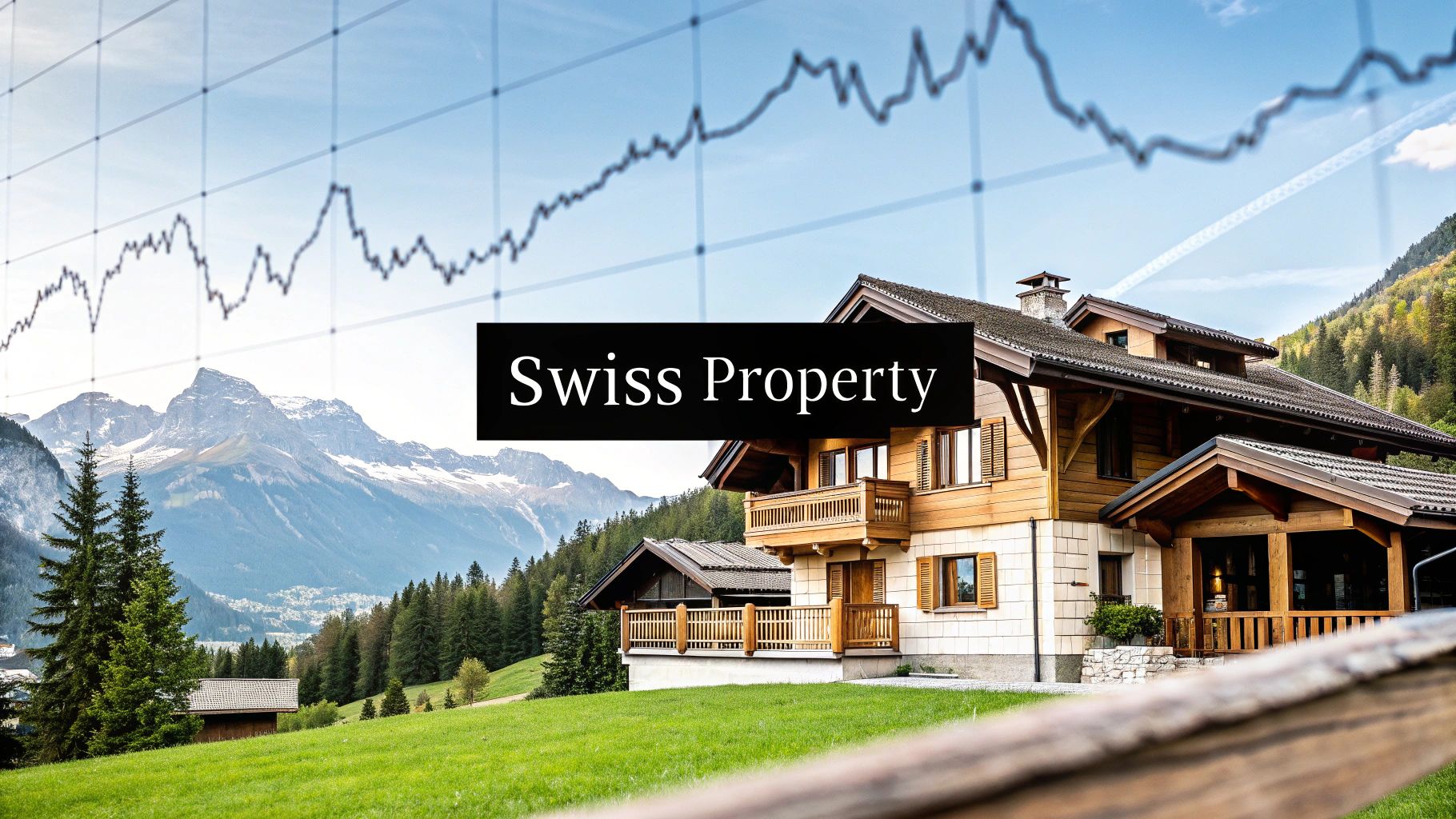
It’s no secret that house prices in Switzerland are some of the highest in Europe. This isn’t a market for flipping properties; it’s a place where capital goes to be protected. For international investors, Switzerland represents unparalleled economic stability and a quality of life that keeps property values strong and steady.
Understanding the Swiss Property Market
Think of the Swiss property market less like a stock exchange and more like a safe-deposit box. It doesn’t offer the adrenaline rush of rapid, speculative gains found elsewhere. Instead, its main appeal is its incredible resilience against the economic storms that can rock other countries. This stability is precisely what draws high-net-worth individuals from around the world.
So, what’s the secret? It’s a mix of powerful factors that work together to keep valuations high. A robust economy, consistently low unemployment, and an exceptional standard of living create a constant demand for homes. At the same time, supply is kept in check by strict zoning laws and the simple fact that you can’t build on a mountain. This natural tension between high demand and limited supply is the engine that supports property values over the long term.
A Market of Steady Growth
You won’t see the dramatic booms and busts here that make headlines in other markets. Swiss real estate is known for moderate but remarkably reliable appreciation. For investors tired of volatility, this slow-and-steady growth is a huge plus.
The numbers back this up. According to the Swiss National Bank, prices for single-family homes saw a 0.9% year-over-year increase in December 2024. Sure, that’s a bit cooler than the long-term average of around 2.4% annual growth since 1971, but it highlights the market’s current phase of stability. It’s a world away from the chaotic 26.2% growth seen back in March 1973, showing just how much the market has matured towards predictability. If you’re curious, you can explore more historical data on Swiss house prices and growth rates to get the full picture.
Swiss Property Market Key Indicators
For a quick snapshot, here are the essential metrics that define the Swiss real estate market for any potential investor.
| Metric | Recent Data or Status |
|---|---|
| Price Growth (Y-o-Y) | 0.9% for single-family homes (as of Dec 2024) |
| Long-Term Avg. Growth | ~2.4% annually since 1971 |
| Supply Dynamics | Tightly controlled due to zoning laws and geography |
| Foreign Buyer Rules | Heavily restricted by the ‘Lex Koller’ legislation |
| Key Economic Drivers | Strong Swiss Franc (CHF), low interest rates, high demand |
| Market Sentiment | Stable, favouring long-term capital preservation |
This table shows a market that values security over speculation—a key takeaway for anyone considering an investment.
Key Themes for Investors
To successfully navigate this unique landscape, you need to understand a few core concepts, which we’ll dive into throughout this guide:
- Regional Price Disparities: Prices in Zurich are a world apart from those in an Alpine village or a Ticino lakeside town.
- The Legal Framework for Foreigners: Buying as a non-resident is complicated. The ‘Lex Koller’ law is the biggest hurdle you’ll face.
- Economic Underpinnings: The strength of the Swiss Franc and the direction of interest rates have a massive impact on property values.
Getting a handle on these elements is the first step to making a smart investment in one of the world’s most secure property markets.
Looking at the Bigger Picture: Why Swiss Property Prices Keep Climbing
To really get a handle on Swiss property values today, you need to look past the month-to-month noise and see the market’s long-term story. Swiss real estate has a famous reputation for being incredibly resilient. It’s weathered global economic storms time and again with remarkable stability, which is exactly why sharp investors see it as a safe harbour for their capital, totally different from more unpredictable assets.
When you zoom out, the data tells a story not of wild, speculative bubbles, but of steady, reliable growth. This isn’t an accident. The market is propped up by some unique structural factors that create a deep and lasting demand for high-quality homes. If you’re serious about investing here, understanding these fundamentals is non-negotiable.
The Unstoppable Rise of the Price Index
One of the clearest signs of this long-term strength is the Residential House Price Index. This isn’t just a line on a graph; it’s a story of decades of upward momentum, proving the market’s ability to grow consistently. The index, which averaged 113.29 points between 1970 and 2025, shot up to an all-time high of 198.18 points in the first quarter of 2025. That’s a powerful illustration of how house prices in Switzerland don’t just bounce back from downturns—they push past them to set new records.
And the momentum hasn’t stopped. Prices climbed another 4.13% in March 2025 compared to the previous period, a clear sign of the market’s strength even with global economic jitters. For an investor, that long-term chart is all the proof you need of the market’s fundamental health. You can explore the historical data behind the Swiss housing index to see this impressive journey for yourself.
A Nation of Renters by Choice
Here’s one of the most important—and often overlooked—reasons why Swiss house prices stay so high: very few people actually own their homes. As of December 2023, the homeownership rate was just 42.6%. Think about that. The vast majority of the population are renters.
This creates a massive, constant demand for rental properties, sure, but it does something even more important for the sales market. It means the number of people who could potentially buy a home is always far greater than the number of properties actually for sale. It’s a classic supply-and-demand imbalance that puts a solid floor under property values across the country.
The low homeownership rate is the bedrock of the Swiss market’s stability. It guarantees persistent demand for a limited supply of homes for sale, shielding prices from the kind of dramatic crashes you see in markets where everyone owns.
Why Buying Costs More Than Renting (and Why That’s a Good Thing)
Another key metric to watch is Switzerland’s price-to-rent ratio, which hit 126.85 in March 2025. In simple terms, this means that buying a property is significantly more expensive than renting one. That might sound like a negative, but it’s actually a sign of the market’s premium, stable nature.
The high cost of entry acts as a filter. It ensures that only serious, well-funded buyers can get into the market, which pushes out short-term speculators and encourages long-term ownership. This high barrier helps keep prices disciplined and prevents the kind of overheating that leads to property bubbles. For an investor, this ratio signals a mature, stable market where value is respected and protected. If you’re looking to get better at reading these kinds of signals, it’s worth exploring some broader strategies for analyzing market trends.
A Tale of Diverse Cantons and Regions
To understand house prices in Switzerland, you have to realise the country isn’t one single market. It’s a collection of distinct, hyper-localised markets, each marching to the beat of its own drum. An apartment overlooking Lake Geneva commands a price driven by completely different forces than a chalet tucked away in the Engadin valley.
For the discerning investor, this regional diversity is where the opportunity lies. Each canton offers its own character, lifestyle, and investment logic. To navigate it, you need to look past national averages and drill down into the specific communes that attract global capital.
This infographic gives you a panoramic view of how property values differ across Switzerland’s key regions, setting the stage for a deeper dive.
The data paints a clear picture: there’s a massive premium on properties in the major urban centres and world-renowned tourist hotspots compared to the more rural cantons.
Zurich: The Economic Powerhouse
As Switzerland’s largest city and a global financial hub, Zurich’s property market is fuelled by corporate demand and a high concentration of affluent professionals. This creates a relentless appetite for premium property, from slick city-centre penthouses to grand villas along the “Gold Coast” of Lake Zurich.
The lifestyle here is fast-paced and business-focused, yet it offers an exceptionally high quality of life with pristine nature just a stone’s throw away. For investors, Zurich represents a blue-chip asset in an already secure market. The constant flow of international talent keeps the high-end rental market buzzing, ensuring strong yields and long-term capital growth.
Geneva: The Diplomatic Hub
Geneva’s property market is just as robust, but its drivers are different. As the European headquarters of the United Nations and home to hundreds of international organisations, the city attracts a steady stream of diplomats, executives, and NGO staff.
This creates a unique rental dynamic, especially for high-end apartments and family homes in exclusive communes like Cologny or Vandoeuvres. While the transient nature of its residents might suggest volatility, the opposite is true. The constant rotation of well-funded international tenants means demand for premium rentals remains consistently high, keeping property values firm.
“Geneva and Zurich are pillars of the Swiss property market,” notes Nick Marr, founder of EuropeanProperty.com. “While both are premium markets, their underlying demand drivers are different. Zurich is corporate finance, while Geneva is international diplomacy. Understanding this distinction is key to aligning an investment with your long-term goals.”
St. Moritz and Gstaad: The Alpine Elite
Leaving the cities for the Alps, we enter a world where exclusivity and lifestyle are the primary currencies. Resorts like St. Moritz and Gstaad aren’t just holiday destinations; they are global brands synonymous with luxury, privacy, and old-world glamour. Property here is a trophy asset.
The investment case in these alpine playgrounds is less about rental yield and more about capital preservation and personal enjoyment. Demand is driven by a finite group of global high-net-worth individuals seeking a secure and prestigious mountain retreat. Strict building regulations, particularly the ‘Lex Weber’ law limiting second homes, severely restrict new supply.
This enforced scarcity is a powerful mechanism that props up property values, making these locations some of the most resilient real estate markets in the world. Buying here is as much a lifestyle decision as it is a financial one, offering access to an exclusive community and a world-class leisure environment. For those looking to explore prime Swiss real estate, a detailed search of properties for sale in Switzerland can reveal the unique offerings in each of these distinct regions.
So, what’s really propping up Swiss property prices, making them so consistently eye-watering? To get to the heart of what makes Swiss real estate so valuable, you have to look past the obvious economic headlines. It’s a finely tuned machine where strong economic policy, iron-clad legal rules, and even cultural attitudes all work together.
The result? One of the most stable, bullet-proof property markets on the planet.
These forces aren’t working in isolation—they feed into each other, creating a formidable defence against the kind of volatility you see in other global property markets. Let’s break down exactly what makes this elite market tick.
The Swiss Franc: A Financial Fortress
At the very core of Switzerland’s stability is the Swiss Franc (CHF), famously one of the world’s go-to safe-haven currencies. When global markets get choppy, investors run for the safety of the CHF, trusting its stability and the steady hand of the Swiss National Bank.
This enduring strength has a massive knock-on effect on property values. A strong franc basically acts as a wealth shield for anyone holding Swiss assets. This makes real estate an incredibly attractive place for international investors to park their capital, protecting it from inflation and weaker currencies elsewhere.
In short, buying a home in Switzerland isn’t just an investment in bricks and mortar; it’s a direct investment in one of the world’s most trusted currencies.
Persistently Low Interest Rates
Another huge factor has been Switzerland’s long history of low—and sometimes even negative—interest rates. For decades, borrowing money has been exceptionally cheap, a deliberate policy of the Swiss National Bank.
This has a two-pronged effect on the housing market:
- It makes mortgages much more affordable for local buyers, which keeps domestic demand consistently high.
- It crushes the returns on safer investments like government bonds, forcing capital to look for better yields elsewhere—and real estate is a prime target.
While rates have been rising globally, the historical affordability of borrowing in Switzerland has been a constant tailwind for property prices, fuelling steady, long-term growth.
“Switzerland’s unwavering political and economic stability acts as the ultimate bedrock for its long-term investment appeal. This isn’t a market driven by short-term trends; it’s a multi-generational store of wealth, and that fundamental security is what high-net-worth buyers are truly purchasing.”
– Nick Marr, founder of EuropeanProperty.com
Strict Zoning Laws: A Deliberately Controlled Supply
Perhaps the most powerful force shaping house prices in Switzerland is the country’s famously tight legal control over who can buy property and what can be built. Two laws, in particular, create a perfect storm of managed supply and disciplined demand.
Lex Koller
This federal law places severe limits on non-resident foreigners buying residential property. Think of it as a powerful gatekeeper, stopping floods of speculative foreign money from pouring in and creating unsustainable price bubbles. By controlling who can buy, Lex Koller ensures the market stays orderly and is driven primarily by people who actually live and work in the country. If you want to dive deeper, our guide on how to navigate the purchase process in Switzerland breaks it down further.
Lex Weber
Passed back in 2012, this initiative slammed the brakes on building new second homes. It applies to any community where holiday homes already make up 20% or more of the housing stock. This had a dramatic impact on popular tourist hotspots and Alpine resorts like St. Moritz and Gstaad, essentially freezing new development of holiday properties. This artificial cap on supply makes existing homes in these prime locations even more exclusive and, therefore, more valuable over time.
When you put these three pillars together—a rock-solid currency, cheap financing, and tight legal controls—you get a market dynamic unlike any other. It’s an environment where high demand is constantly chasing a deliberately limited supply, providing a powerful and lasting foundation for Swiss house prices.
Navigating the Purchase Process for Foreign Buyers
For international investors, buying a slice of Switzerland can feel like navigating a fortress. The process appears deliberately complex, walled off by a mix of federal laws and local cantonal rules.
But it’s not impossible. With the right guidance, what seems like a maze becomes a clear, step-by-step journey designed to protect everyone involved—buyer, seller, and the market itself. Understanding this path is the first step toward securing a foothold in one of the world’s most stable property markets.
Understanding Lex Koller Restrictions
The biggest hurdle for any foreign buyer is a piece of federal law known as ‘Lex Koller’. Think of it as the gatekeeper to the Swiss property market. Its main job is to stop foreign capital from overheating the domestic housing scene.
This law dictates who can buy, what they can buy, and where. While you can generally purchase commercial property without issue, buying a home for yourself is a different story and is tightly controlled.
Lex Koller isn’t a blanket ban; it’s a filtration system. It ensures that foreign investment in residential property is channelled into designated tourist areas, preserving the primary housing stock for local residents and maintaining market stability.
So, what does this mean in practice? Typically, a non-resident buyer can purchase one holiday home in a designated tourist zone. These properties often come with a size cap, usually around 200 square metres of net living area.
Forget about buying a primary residence in a major hub like Zurich or Geneva unless you already hold a specific residence permit, like a B or C permit. Those areas are kept for residents.
The Step-by-Step Acquisition Process
Once you’ve found a property that you’re legally allowed to buy, the formal process kicks off. It’s a highly structured affair designed for transparency and legal certainty, with a public notary acting as the impartial referee at the centre of it all.
Here’s a simplified roadmap of what to expect:
- Reservation Agreement: You and the seller sign a preliminary contract. You’ll then pay a reservation deposit to show you’re serious.
- Permit Application: This is the crucial part for non-residents. The notary submits an application to the cantonal authorities to get the green light under Lex Koller. Be patient—this can take several weeks or even a few months.
- Drafting the Deed of Sale: Once the permit is approved, the notary gets to work preparing the official deed of sale. This document lays out every single term and condition of the deal.
- Execution and Registration: With the notary present, both parties sign the deed. The notary then registers the sale with the cantonal Land Registry, and just like that, the property is officially yours.
The Role of the Public Notary
In Switzerland, the public notary isn’t just someone who stamps documents. They are a neutral, state-appointed official who oversees the entire transaction from start to finish. Their duty is to ensure everything is above board and legally sound, protecting both you and the seller.
The notary handles everything from verifying the property’s legal status and drafting the deed to managing the money and registering the new owner. Their impartiality is the bedrock of the Swiss property system, and it provides immense peace of mind.
Analysing Transaction Costs
The sticker price isn’t the final price. You’ll need to budget for transaction costs, which can swing quite a bit depending on the canton. As a rule of thumb, set aside an extra 2.5% to 5% of the property’s value.
These costs are mainly broken down into three parts:
- Property Transfer Tax: This is usually the biggest chunk. It varies wildly by canton, from 0% in some places to over 3% in others.
- Notary Fees: This covers the notary’s extensive work and typically costs between 0.2% and 1% of the purchase price.
- Land Registry Fees: A modest fee, usually around 0.25%, to officially record your name as the new owner in the public land register.
Getting a clear picture of these costs upfront is essential for solid financial planning. For a deeper dive, check out our guide covering how much money is needed to buy a house in Switzerland.
Investment Outlook and Future Market Trends
Looking beyond the current stability of the Swiss property market, a few key trends are starting to shape what comes next. For investors and anyone with skin in the game, spotting these shifts is the difference between simply preserving capital and achieving long-term growth. The days of effortless appreciation are fading, making way for a more thoughtful landscape where strategic decisions will win out.
The market isn’t in turmoil, but it is recalibrating. Its core strengths—a rock-solid economy, political stability, and tightly controlled housing supply—are all still there. But new forces are at play, and understanding them is crucial if you want to make smart moves on house prices in Switzerland.
The Rise of Sustainable and Energy-Efficient Homes
One of the biggest changes we’re seeing is the demand for sustainable properties. This is being pushed from two sides: government incentives are making it attractive, and buyers themselves are prioritising green features. Homes with high energy-efficiency ratings, solar panels, and eco-friendly building materials are now commanding a real premium.
This isn’t just about ethics; it’s a straightforward financial calculation. A property with lower running costs and a smaller carbon footprint is now seen as a more valuable, future-proof asset. As energy regulations inevitably get stricter, older, less efficient homes might need a serious cash injection to stay competitive. This is creating a clear value gap between certified green homes and everything else.
How Remote Work is Reshaping Property Values
The massive shift to flexible working is another powerful force changing the market’s geography. High-earning professionals are no longer chained to a daily commute, so they’re looking far beyond the traditional hotspots of Zurich and Geneva. This has ignited demand in well-connected suburban and even rural areas that offer more space, a better quality of life, and frankly, more reasonable prices.
This trend is unlocking value in places previously considered secondary markets. Cantons with great infrastructure, stunning natural scenery, and decent transport links are suddenly on everyone’s radar. For investors, this is a golden opportunity to find locations with strong growth potential that haven’t yet hit the peak valuations of the big cities. The trick is to find that sweet spot between accessibility and the lifestyle perks that remote workers now demand.
“The Swiss market’s future will be defined by sustainability and lifestyle shifts. Investors who recognise the premium placed on energy efficiency and the new geography of demand created by remote work will be best positioned for capital growth in the coming decade.”
The Impact of Future Monetary Policy
Finally, you can’t talk about the future without mentioning monetary policy. While Switzerland has long benefited from incredibly low interest rates, any moves by the Swiss National Bank to tackle inflation or react to global economic shifts will hit mortgage affordability hard. That, in turn, directly affects property demand.
Any tightening of lending rules or a sustained period of rate hikes could cool down price growth, especially in the mainstream market. The luxury segment, however, tends to be more insulated from these pressures, as high-net-worth buyers are far less reliant on financing. Anyone serious about investing needs to keep a close eye on signals from the central bank, as they will be a huge factor in the market’s momentum. It’s a key part of the bigger picture when buying property in Europe, where every country moves to the beat of its own economic drum.
Common Questions from International Investors
Dipping your toes into the Swiss property market often brings up a few recurring questions, especially for buyers based abroad. Let’s tackle some of the most common queries we get about house prices in Switzerland and the finer points of actually buying a home.
Can a Foreigner Buy Any Property?
In short, no. Switzerland has some of the strictest rules in Europe for non-resident buyers, governed by a law known as ‘Lex Koller’.
Generally, you’re limited to purchasing a holiday home in a designated tourist area. Even then, there are often restrictions, like a size limit of around 200 square metres. Forget about snapping up a primary residence in Zurich or Geneva—those are typically reserved for Swiss residents or individuals with specific permits.
Commercial property, however, is a different story and doesn’t fall under these rules.
What Are the Typical Closing Costs?
This is a big one, as the costs can vary quite a bit from one canton to another. As a rule of thumb, budget for somewhere between 2.5% and 5% of the property’s purchase price.
This total figure is usually broken down into a few key fees:
- Property Transfer Tax: The biggest variable, this can range from 0% in some cantons to as high as 3.3% in others.
- Notary Fees: You’ll typically pay between 0.2% and 1% for the legal paperwork.
- Land Registry Fees: This is a smaller fee, usually around 0.25%, to officially register your ownership.
It’s absolutely essential to get a clear breakdown of the specific rates for the canton you’re buying in. For a broader look, check out these 7 things to consider when buying a property in Europe.
Is Swiss Property a Liquid Investment?
While Swiss real estate is famously secure—think of it as a vault for your capital—it is definitely not a liquid asset.
The market has a naturally low turnover, transaction costs are high, and the buying process is formal and can often be quite lengthy. It’s best viewed as a long-term strategy for wealth preservation, not a vehicle for quick, speculative profits.
About EuropeanProperty.com
EuropeanProperty.com is Europe’s longest-running luxury real estate platform, online since 1999. It connects luxury real estate agents, developers, and homeowners with high-net-worth buyers and international investors.
Looking for expert mortgage guidance? Get luxury property mortgage advice here:
👉 https://europeanproperty.com/luxury-overseas-mortgages/
Explore more overseas homes for sale at our global partner site:
👉 https://homesgofast.com/overseas-property/