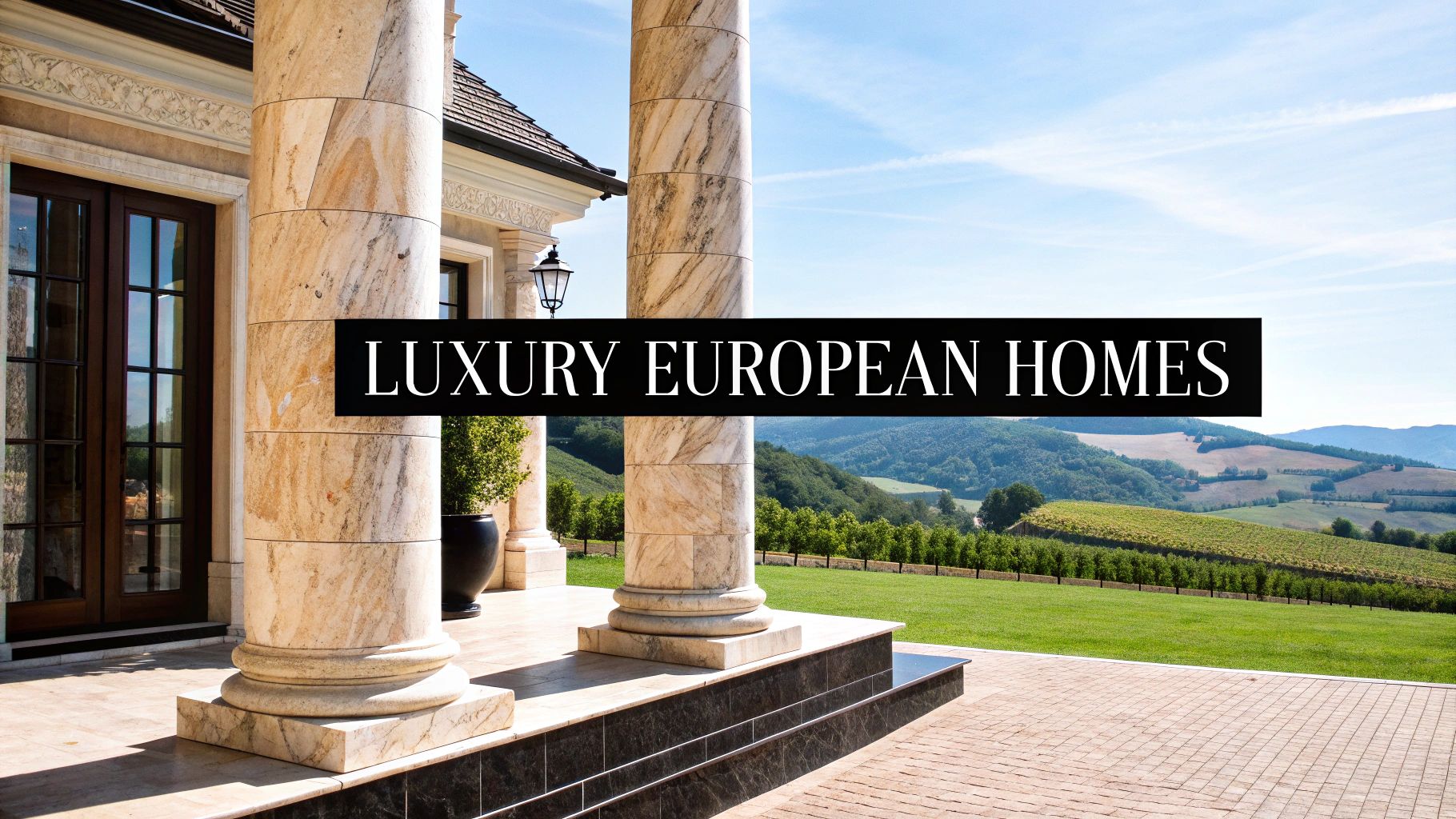
Investing in luxury European real estate is about more than just a financial transaction. It is an acquisition of a lifestyle, a piece of cultural history, and a legacy asset that few other investments can match. For high-net-worth buyers, it offers a powerful combination of stability, sophistication, and personal enjoyment.
The Timeless Appeal of European Luxury Property
The allure of luxury property in Europe is deeply rooted in its unique blend of heritage and modern living. Unlike prime real estate in other parts of the world, a European address often comes with centuries of history. Think of a 17th-century Parisian apartment overlooking the Place des Vosges or a sprawling Tuscan farmhouse set amidst ancient olive groves. This inherent historical value provides a foundational stability that insulates the market from fleeting trends.
But it’s not just about history. The continent’s most desirable properties are defined by their ability to weave modern sophistication into this timeless elegance. Today’s discerning buyers aren’t just looking for opulent finishes; they’re demanding a complete lifestyle.
Defining Modern European Luxury
The very concept of "luxury" has evolved. While a prime location and architectural grandeur are still non-negotiable, the new definition includes a much broader set of criteria that cater to a more holistic way of living. These expectations are actively shaping Europe's most exclusive markets.
Here’s what defines luxury today:
- Integrated Wellness: A home is now a personal sanctuary. Amenities like private gyms, yoga studios, saunas, and advanced air and water filtration systems are becoming standard expectations.
- Seamless Indoor-Outdoor Living: Expansive terraces, infinity pools with panoramic views, and meticulously landscaped private gardens are no longer just nice-to-haves. They are essential components of a modern luxury home.
- Privacy and Security: In an increasingly connected world, the ultimate luxury is the ability to disconnect. Gated entrances, extensive private grounds, and sophisticated yet discreet security systems are fundamental requirements.
- Sustainable Design: There’s a growing demand for eco-conscious features. This includes everything from energy-efficient systems and sustainable building materials to biophilic designs that foster a deeper connection with the natural environment.
This shift reflects a desire for properties that offer not just status, but genuine comfort, security, and well-being. The most sought-after homes are private retreats, fully equipped for work, relaxation, and entertainment.
"Investors are looking for legacy assets—properties that offer not just financial returns but also enrich their lives. A historic château in the Loire Valley or a waterfront villa in Mallorca is an investment in a lifestyle that can be enjoyed for generations." – Nick Marr, EuropeanProperty.com
Ultimately, buying luxury European real estate is a strategic move to acquire an asset class renowned for its resilience and enduring appeal. It's about securing a foothold in a market that prioritises quality, heritage, and an unparalleled quality of life.
Understanding the Current Luxury Property Market
To truly grasp the dynamics of luxury European real estate, one must look beyond general market reports. The prime property world operates on its own set of principles, influenced less by typical economic fluctuations and more by the core values of high-net-worth individuals. Currently, several powerful forces are reshaping buyer priorities and capital flows.
A significant driver is the sustained 'flight to quality'. This concept is straightforward: affluent investors are prioritising stability, security, and exclusivity above all else. In a world where other assets can feel unpredictable, blue-chip European property is regarded as a solid, tangible store of wealth. This insulates top-tier markets from the volatility seen elsewhere, fostering a remarkably resilient investment environment.
The Evolution of New Luxury
The very definition of a luxury home has been redefined. It is no longer merely a display of wealth. Ostentatious opulence has been replaced by a quieter, more sophisticated appreciation for homes that genuinely enhance well-being and offer a superior quality of life. This ‘new luxury’ is less about outward grandeur and more about creating a personal sanctuary.
This shift is evident in the amenities now considered non-negotiable:
- Wellness Sanctuaries: Home gyms, yoga studios, saunas, and advanced air and water purification systems are no longer perks; they are expected.
- Expansive Private Spaces: Secluded gardens, infinity pools, and sprawling terraces that blur the line between indoor and outdoor living are essential for privacy and relaxation.
- Nature Integration: Biophilic design—the architectural practice of weaving in natural light, materials, and views—is in high demand for its calming, restorative effect.
These features demonstrate a clear move towards homes that function as private, all-in-one retreats, perfectly configured for work, leisure, and family life. For a deeper analysis, explore our detailed guide on key trends and investment hotspots in the European luxury property market for 2025.
Key Economic Indicators and Buyer Confidence
While the luxury sector is robust, it is not entirely immune to economic realities. Interest rate changes, currency strength, and geopolitical stability all influence an investor’s decision-making process. That said, clients in the prime market are often cash buyers or are less sensitive to lending costs, meaning lifestyle drivers frequently supersede purely financial considerations.
"We are seeing a clear and consistent demand for turnkey properties in established prime locations. Buyers at this level want certainty. They are looking for legacy assets in politically stable regions with a proven track record of value preservation. Markets like the Swiss Alps, the French Riviera, and prime coastal Spain continue to attract significant capital for this very reason."
– Nick Marr, Founder of EuropeanProperty.com
This confidence is underpinned by a simple fact: there is a finite supply of truly exceptional properties. One cannot simply construct more historic Parisian apartments or frontline villas in Mallorca. This inherent scarcity supports the long-term value of luxury European real estate, ensuring it remains a sought-after asset for discerning international buyers.
The Impact of Lifestyle Shifts on Prime Property Values
The lifestyle adjustments of recent years have proven enduring. The freedom to work remotely has untethered many high-net-worth individuals from major cities, which in turn has fuelled demand in secondary luxury markets celebrated for their outstanding quality of life.
Consider these shifts:
- Rise of Co-Primary Residences: Instead of a single primary home and a separate holiday property, buyers are establishing multiple "primary" bases in different countries, spending significant time in each.
- Focus on Accessibility: Proximity to private jet terminals, leading international schools, and world-class medical facilities has become a critical factor when selecting a location.
- Demand for Space: The desire for more personal space—both indoors and outdoors—remains a powerful driver, pushing up the value of properties with large grounds and generous floor plans.
These are not fleeting trends; they represent a fundamental reconsideration of how and where the world's wealthiest individuals choose to live. Consequently, properties that cater to this new model of flexible, wellness-focused living are commanding the highest prices in today's market.
Where Are High-Net-Worth Investors Buying Now?
Astute capital always gravitates towards the optimal blend of opportunity, stability, and lifestyle. While established markets like London and Paris retain their perennial appeal, the map for luxury European real estate is constantly being redrawn. New hotspots are emerging, capturing the attention of savvy investors seeking the perfect synthesis of value and quality of life.
Today's high-end buyer analyses the bigger picture. It is no longer solely about a beautiful villa with a sea view. They are asking practical questions: How close is the nearest private jet terminal? What is the calibre of the international schools? And what are the local tax advantages? These factors are now as crucial as the property’s architecture.
This chart illustrates the significant price differences per square metre across three of Europe's most sought-after luxury markets.
As you can see, Monaco remains in a league of its own, cementing its status as a global benchmark for exclusivity. London and Paris, while still firmly in the prime category, represent a more accessible tier for serious investors.
Enduring Blue-Chip Destinations
Certain locations possess a timeless allure. They are the blue-chip stocks of the property world, consistently attracting investment regardless of wider market conditions.
- The French Riviera, France: The Côte d'Azur is the epitome of glamour. It is a perennial favourite for those seeking waterfront villas and chic penthouses. Its unique appeal lies in its ability to offer the vibrant social scenes of Saint-Tropez and Cannes alongside the quiet seclusion of private estates tucked away in the hills.
- Tuscany, Italy: For buyers who value heritage and authenticity above all else, Tuscany is the definitive choice. Think historic farmhouses (casali) and grand villas surrounded by vineyards. This is more than a property purchase; it is an investment in a slower, more refined way of life, steeped in culture and world-class gastronomy.
- The Swiss Alps, Switzerland: Offering unmatched privacy, security, and year-round appeal, resorts like Gstaad, St. Moritz, and Verbier are in a class of their own. Investors buy here for the world-class skiing in winter and serene hiking in summer, all within a famously stable economic and political environment.
The Rise of Lifestyle-Led Markets
It’s not all about the traditional heavyweights. A new breed of market is gaining serious traction by focusing on an exceptional quality of life, often enhanced by attractive residency programmes.
Portugal's Algarve region is a prime example. It has brilliantly transformed itself from a holiday hotspot into a top-tier residential destination for discerning international buyers. The formula for its success? A combination of championship golf courses, a superb year-round climate, and a surprisingly sophisticated culinary scene. Furthermore, with Faro airport nearby, it is incredibly accessible.
"The modern luxury buyer is purchasing a lifestyle, not just a property. They are asking: 'How will this home enhance my life and the lives of my family?' This is why regions that offer a complete package—security, wellness, culture, and connectivity—are seeing the most significant growth in demand." – Nick Marr, EuropeanProperty.com
Prime London also continues to demonstrate its resilience. Despite market shifts, its status as a global hub for education, culture, and finance keeps it firmly on the radar for international investors.
Recent figures corroborate this. By mid-2025, the UK housing market was showing real strength, with buyer demand up 11% year-on-year and agreed sales climbing by 8%. This confidence, bolstered by stabilising interest rates, is expected to drive around 1.1 million transactions in 2025, proving the market's enduring stability.
To give you a clearer idea of how these prime markets stack up, here’s a quick comparative overview.
Comparative Overview of Prime European Luxury Markets
This table provides a snapshot comparison of key attributes for high-net-worth individuals considering property investment across Europe's top destinations.
| Region | Primary Property Type | Key Lifestyle Appeal | Investment Outlook |
|---|---|---|---|
| French Riviera | Waterfront villas, penthouses | Glamour, yachting, social scene | Stable, high-demand |
| Tuscany, Italy | Historic villas, farmhouses | Culture, gastronomy, tranquillity | Strong, heritage-driven value |
| Swiss Alps | Luxury chalets, apartments | Privacy, skiing, year-round nature | Extremely stable, safe haven |
| Algarve, Portugal | Modern villas, golf estates | Golf, climate, wellness | Strong growth, lifestyle-driven |
Each of these destinations offers a unique proposition, catering to different priorities, from the vibrant energy of the Riviera to the peaceful seclusion of the Swiss Alps.
Emerging Opportunities and Niche Markets
Beyond the well-trodden path, smart investors are also focusing on niche markets with unique character and fantastic growth potential. The Balearic Islands, especially Mallorca and Ibiza, continue to attract buyers with their irresistible mix of rustic charm and high-octane luxury. Modern architectural villas with breathtaking sea views are the prize here.
Another area gaining attention is the Greek Cyclades. Islands like Mykonos and Paros offer a distinct brand of minimalist, barefoot luxury. The iconic whitewashed villas, blending seamlessly into the landscape, attract a clientele that values style, privacy, and simplicity.
If you’re ready to explore the possibilities, you can browse our exclusive portfolio of luxury homes in Europe. It’s the perfect way to compare what each of these incredible destinations has to offer. Ultimately, the right investment is the one that perfectly aligns your financial goals with your vision for a life well-lived.
The Future of Luxury Living in Europe
The definition of a "luxury" home is evolving rapidly. As we look ahead, the most sought-after properties in Europe will not be defined solely by a prestigious postcode or sheer square footage. They will be judged on their intelligence, their conscience, and their contribution to well-being.
The future of luxury European real estate is being built on three solid pillars: sustainability, technology, and wellness. These are not passing trends; they represent a fundamental shift in what affluent buyers now demand from a premier home. It is a move away from pure material comfort towards a living environment that is both restorative and responsible.
The Rise of Sustainable Sophistication
In the luxury sector, sustainability has transcended its status as a mere buzzword. It is now a clear hallmark of quality and forward-thinking design. Discerning buyers are no longer just asking for ‘green homes’—they are expecting them. They want properties that blend environmental responsibility with superior comfort and genuine long-term value. This isn't about sacrificing luxury; it’s about elevating it.
This is manifesting in several key ways:
- Eco-Conscious Materials: Sourcing local, reclaimed, and non-toxic materials is becoming the new standard. Think reclaimed timber from a historic French château or locally quarried stone that slashes the carbon footprint of transport.
- Energy Efficiency: Geothermal heating, solar panels, and state-of-the-art insulation are no longer add-ons. They are being integrated into the architectural DNA of new builds, offering energy autonomy and significant cost savings over time.
- Biophilic Design: This is all about connecting the home's inhabitants more closely with nature. Features like living walls, expansive glass panels framing natural landscapes, and serene indoor courtyards are being used to create an atmosphere that calms and restores.
Seamless Integration of Smart Technology
In a true luxury home, technology should be felt, not seen. The goal is not to fill a property with the latest gadgets but to create a responsive environment where technology works quietly in the background to simplify and secure daily life. It is all about seamless, intuitive control that enhances convenience without ever compromising the home's aesthetic.
State-of-the-art security is, naturally, a top priority. Buyers expect sophisticated systems that go far beyond a simple alarm. We are talking about biometric access controls, intelligent perimeter monitoring that can detect threats, and secure, encrypted networks to protect personal data. For many, this peace of mind is the ultimate luxury.
The most intelligent homes are those where the technology anticipates your needs without you having to ask. It’s about creating an effortless living experience, from lighting that adjusts to your circadian rhythm to security you can monitor from anywhere in the world.
Wellness as the Ultimate Amenity
Perhaps the most significant shift of all is the focus on personal health and well-being. A luxury home is now expected to be a private sanctuary—a place to truly recharge and restore body and mind. This has sparked a huge surge in demand for properties with dedicated wellness facilities that rival those of an exclusive resort.
These amenities are quickly becoming the new baseline in the luxury European real estate market:
- Private Spas and Fitness Centres: Fully equipped home gyms, yoga studios, saunas, and steam rooms are now considered essentials, not extras.
- Advanced Purification Systems: High-end air and water filtration systems that remove pollutants are increasingly in demand.
- Restorative Spaces: Homes are being designed with dedicated areas for mental clarity, like quiet meditation rooms or reading nooks with uninterrupted views of nature.
This focus on wellness demonstrates a deeper understanding that true luxury is not about what you own, but about your quality of life. The market is responding in kind, with developers and architects placing health at the centre of their designs.
Interestingly, this evolution is occurring against a backdrop of varied market dynamics across Europe. For example, while the UK luxury real estate market saw a 4.7% national price rise in 2024, growth was stronger in northern regions compared to the traditionally expensive south. This type of regional variation is often shaped by wider economic factors, like mortgage rates, which influence buyer confidence at different price points. For a closer look at these market forces, you can explore the top real estate trends shaping the UK market.
Navigating the Purchase for International Buyers
Acquiring a luxury property in Europe as an international investor is a sophisticated process that differs significantly from domestic transactions. It demands precision, expert counsel, and a clear understanding of local protocols. Transforming the vision of a Tuscan villa or Parisian apartment into a reality requires a structured, step-by-step approach, from initial due diligence to the final transfer of keys. Executed correctly, a complex deal becomes a confident, successful investment.
The real work begins long before an offer is made. The first priority is to assemble a local team of experts. This step is non-negotiable. Your inner circle should include a reputable estate agent who specialises in the luxury market, an independent lawyer seasoned in cross-border property transactions, and a knowledgeable local tax advisor. These professionals will navigate regional complexities and safeguard your interests.
Understanding Diverse Legal Frameworks
One of the greatest challenges for foreign buyers is navigating Europe’s mosaic of legal systems. Broadly, the continent is divided between countries that use common law (like the UK) and those that operate under civil law or the Napoleonic code (e.g., France, Spain, and Italy). This distinction is not merely technical; it fundamentally shapes how a property transaction unfolds.
- Common Law Systems: In jurisdictions like the UK, the contract is paramount. The terms agreed upon in writing between buyer and seller hold the most weight. The process is contingent on your solicitor conducting extensive due diligence before contracts are formally exchanged.
- Civil Law Systems: Here, the process is more formal and state-supervised. A public notary is the central, impartial figure who drafts the deed of sale and ensures all legal requirements are met. Their involvement provides an additional layer of security but also necessitates adherence to a more rigid procedure.
For any international buyer, grasping core legal concepts is vital. A good starting point is understanding what a deed entails, as this is the document that formally transfers ownership of the property to you.
Structuring the Acquisition
How you choose to acquire the property is a major strategic decision with significant long-term financial implications. Should you purchase it in your personal name, through a family trust, or via a dedicated company? There is no single correct answer—the optimal structure depends on your personal circumstances, your tax residency, and your long-term plans for the asset.
This is where your local tax advisor proves invaluable. They will guide you through the complexities of inheritance tax, capital gains, and annual property taxes, helping you structure the purchase in the most efficient manner. This is an absolutely critical step to protect your asset for future generations and ensure its optimal performance.
Securing Financing and Residency
While many high-net-worth buyers prefer cash transactions, financing should not be dismissed as an option. Specialised mortgages for non-residents are readily available, and lenders in Europe’s prime markets are well-versed in working with international clients. Securing a mortgage pre-approval early in the process is a strategic move. It demonstrates to sellers that you are a serious contender and can expedite proceedings once you find the right property.
Furthermore, many European countries offer 'Golden Visa' or residency-by-investment programmes. These schemes can grant residency rights—and sometimes a path to citizenship—in return for a significant real estate investment. For buyers seeking greater freedom to travel and live within the EU, this can be a highly attractive benefit that accompanies ownership of luxury European real estate. We cover these options in detail across our platform, and you can learn more about luxury real estate options here.
"The smoothest transactions are always the best prepared. For our international clients, we emphasise the importance of having your legal and financial structures in place before you even begin viewing properties. This foresight transforms the buying process from a stressful negotiation into the exciting acquisition it should be."
– Nick Marr, Founder of EuropeanProperty.com
Maximising Your European Real Estate Investment
Investing in luxury European real estate is not merely about acquiring an asset; it is about securing a lifestyle and building a legacy. The journey from identifying a prime market to holding the keys is invariably complex. However, every successful purchase ultimately hinges on one crucial factor: ensuring the property aligns perfectly with your long-term objectives.
Whether your goal is wealth preservation, portfolio diversification, or simply finding the perfect family sanctuary, clarity of purpose is your greatest asset.
The European market is not a monolithic entity. It is a vibrant tapestry of diverse opportunities, each with its own unique character. A chic Parisian pied-à-terre and a sprawling Tuscan estate serve entirely different purposes. True success lies in looking beyond glossy brochures to understand how a property will genuinely enhance your life and your financial position.
A Forward-Looking Strategy
The most astute investors always consider factors beyond the property's four walls. They evaluate the local infrastructure, the region’s political stability, and its genuine potential for growth. It is also worth remembering that strategic upgrades can significantly enhance your return. Considering specific property enhancements that add value from the outset is a professional approach.
"True value in this market is found at the intersection of lifestyle and legacy. The right property isn't just a sound financial decision; it's the key to a life well-lived. Our role is to help clients find that perfect alignment."
– Nick Marr, Founder of EuropeanProperty.com
Ultimately, a luxury European real estate investment is a statement of confidence in quality, heritage, and a sophisticated approach to building wealth. By combining meticulous research with a clear vision, you ensure your purchase is more than just a transaction—it becomes a rewarding legacy. Your European property journey awaits, and the opportunities have never been more compelling.
Your Questions Answered: Buying Luxury Property in Europe
Entering the luxury European real estate market invariably raises questions. It is, after all, a significant undertaking. Here are straightforward, expert answers to the most common queries we receive from international buyers, designed to provide clarity and confidence.
What Are the Typical Purchase Costs Besides the Property Price?
This is a critical consideration. Beyond the agreed-upon price for the home, you must budget for additional costs. A reliable rule of thumb is to set aside between 7% and 15% of the property's value, though this figure varies considerably between countries.
So, what do these costs cover? The main expenses typically include:
- Property Transfer Tax: This is almost always the largest single expense.
- Notary Fees: In most of mainland Europe (such as France and Spain), a notary is a legal requirement.
- Legal Fees: For your own independent solicitor to conduct due diligence and protect your interests.
- Registration Fees: The official fee to record your ownership on the property deeds at the land registry.
- Estate Agent Commission: Depending on local custom, this may be paid by the seller, or sometimes split between both parties.
Always request a detailed cost breakdown from your local advisor at the very beginning of the process. No one appreciates financial surprises.
What Is the Role of a Notary in European Transactions?
If you are buying in a civil law country—which includes most of mainland Europe—you will work with a public notary. Known as a notaire in France, a notaio in Italy, or a notario in Spain, this is not just another lawyer. They are government-appointed legal professionals who act as a neutral third party.
Their role is to ensure the entire transaction is legally sound and transparent. The notary will verify the identities of all parties, check the property's legal status, and ensure all necessary taxes are paid before officially registering the sale. It is a system that adds a strong layer of security to the process, but it is quite different from the solicitor-led approach found in common law countries like the UK.
Are There Restrictions on Foreign Ownership of Property in Europe?
For the most part, Europe is incredibly welcoming to foreign buyers. If you are an EU or EEA national, you can purchase property across member states without issue. For non-EU buyers, the most popular markets—such as Spain, Portugal, France, and Italy—are also very open for business.
That said, some countries do have specific regulations. These often apply to agricultural land or properties in areas deemed strategically important. Switzerland, for example, has famously strict laws (Lex Koller) that limit property acquisition by non-residents. The key is to verify the specific regulations for your nationality and your chosen location early on.
"Many non-EU investors are surprised by how open Europe's prime markets are. The key is understanding the local nuances. A good agent will clarify these points from the outset, ensuring there are no barriers to a smooth purchase."
– Nick Marr, Founder of EuropeanProperty.com
Ready to take the next step in your property journey? Explore exclusive listings and connect with our network of elite agents at EuropeanProperty.com.
About EuropeanProperty.com
EuropeanProperty.com is Europe’s longest-running luxury real estate platform, online since 1999. It connects luxury real estate agents, developers, and homeowners with high-net-worth buyers and international investors.
Looking for expert mortgage guidance? Get luxury property mortgage advice here:
👉 https://europeanproperty.com/luxury-overseas-mortgages/
Explore more overseas homes for sale at our global partner site:
👉 https://homesgofast.com/overseas-property/