

 by
by 
Acquiring property abroad is far more than a simple purchase—it is a sophisticated strategic move, blending astute wealth management with profound lifestyle ambition. For the discerning international buyer or seasoned investor eyeing Europe’s prime markets, success is not a matter of chance; it is the result of a disciplined, strategic approach that treats the acquisition as a serious business venture, not a holiday whim.
This guide provides a robust framework for navigating the complexities of international real estate with confidence. It is designed to cut through the noise, empowering you to make calculated decisions that align with your long-term financial and personal objectives.
A Strategic Framework for International Property Acquisition
The entire process hinges on several core pillars. Mastering these ensures you are not merely buying a property, but making a sound investment that enhances your portfolio and secures a valuable legacy asset.
- Define Your ‘Why’ with Precision: What is the primary objective of this acquisition? Is it a pure investment vehicle for rental yield and capital appreciation? A private family retreat? Or a hybrid asset designed to deliver both financial returns and personal enjoyment? Your answer will fundamentally shape every subsequent decision, from location and property type to the optimal ownership structure.
- Conduct In-Depth Market Analysis: This transcends a cursory online search for “best places to buy property in Europe.” True analysis requires a deep dive into micro-market dynamics—understanding the drivers of value on a specific street or within a particular private enclave. It means evaluating upcoming infrastructure projects, assessing the stability of the regional economy, and identifying genuine long-term growth catalysts.
- Master the Legal and Tax Landscape: This is arguably the most critical pillar. Property laws, ownership regulations, and tax implications vary dramatically between jurisdictions. A thorough, upfront understanding of these complexities is essential to avoid costly future complications.
- Assemble Your A-Team: No successful international property acquisition occurs in a vacuum. Your most valuable asset is not the villa or apartment, but the trusted, on-the-ground team of professionals you assemble—a specialised bilingual lawyer with expertise in foreign ownership, a reputable agent with a proven track record in the luxury sector, and a sophisticated tax advisor.
“Many buyers focus solely on the property itself,” notes Nick Marr, founder of EuropeanProperty.com. “But the most successful investors spend equal time on due diligence and building their local professional network. Your team on the ground is what turns a good purchase into a great long-term investment.”
Of course, the purchase is merely the beginning. The true test of a successful acquisition is ensuring the asset performs optimally over time. For investors focused on maximising returns, it’s vital to explore how to make your property investment a success.
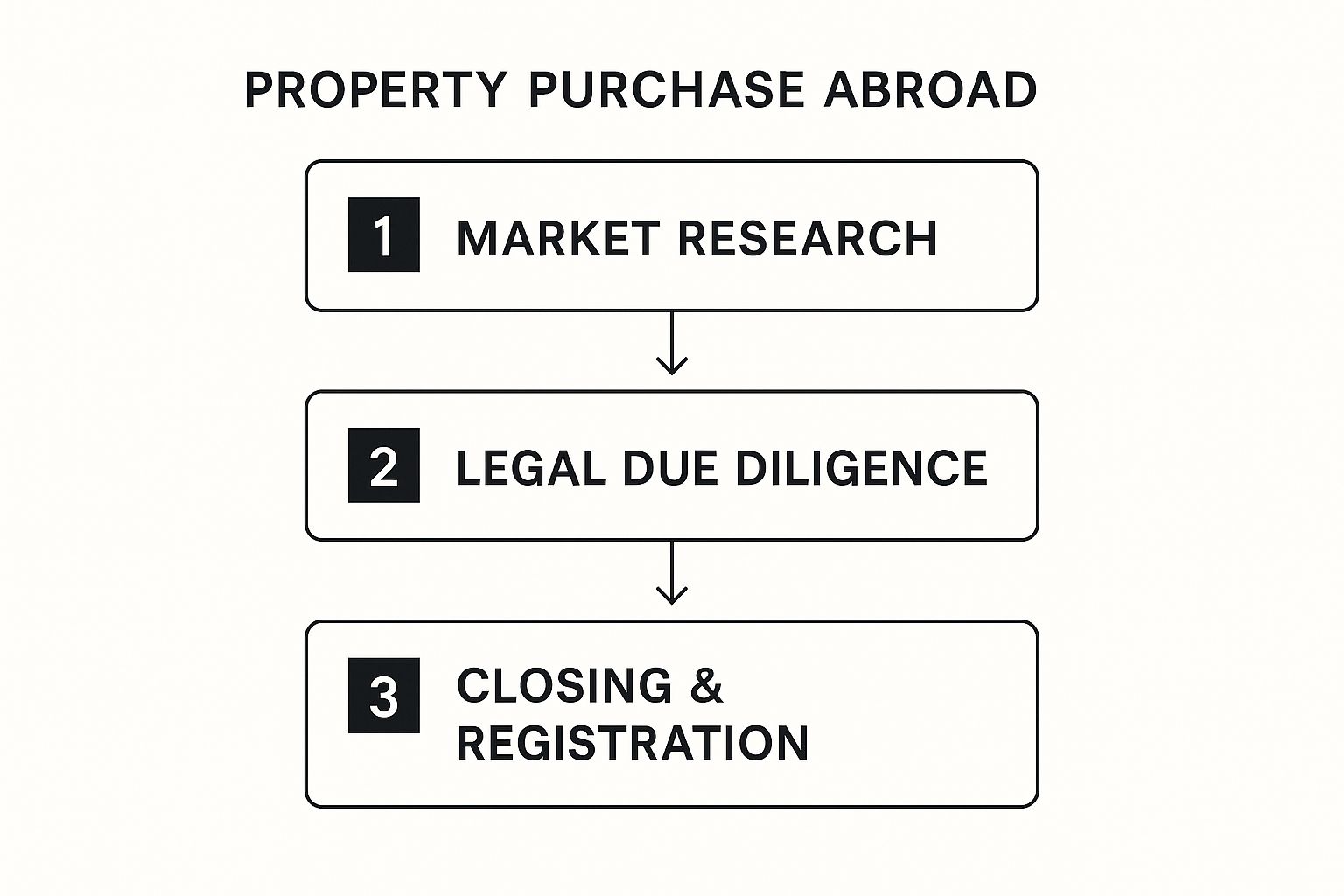
To bring this together, here is a high-level overview of the key stages. Consider this your roadmap from initial concept to holding the keys.
Key Stages of International Property Acquisition
This table outlines the critical phases you’ll encounter when buying property abroad. Each stage demands a clear objective and meticulous attention to detail.
| Phase | Objective | Key Considerations |
|---|---|---|
| 1. Planning & Strategy | Define clear investment goals and financial parameters. | Investment vs. lifestyle, target countries, financial readiness, risk tolerance. |
| 2. Market Research | Identify and analyse high-potential markets. | Economic stability, property laws, rental demand, infrastructure growth, luxury amenities. |
| 3. Professional Team Assembly | Build your local network of elite advisors. | Source a bilingual lawyer, reputable estate agent, and cross-border tax advisor. |
| 4. Property Search & Viewings | Identify and vet properties that meet your strict criteria. | Online portals, in-person visits, virtual tours, neighbourhood due diligence. |
| 5. Legal & Technical Due Diligence | Forensically verify the property’s legal and physical state. | Title search, surveys, building permits, outstanding debts, zoning compliance. |
| 6. Financing & Offer Strategy | Secure funding and structure a compelling formal offer. | Mortgage pre-approval, deposit requirements, negotiation tactics, currency strategy. |
| 7. Legal Closing & Transfer | Finalise the purchase and secure legal ownership. | Signing the final deed (escritura, acte de vente), paying all relevant taxes and fees, registering the property. |
| 8. Post-Acquisition Management | Optimise and manage your new asset effectively. | Property management, ongoing tax compliance, insurance, utility setup. |
Navigating these stages methodically transforms a complex process into a series of manageable, strategic steps, paving the way for a smooth acquisition and a valuable new asset in your global portfolio.
Identifying Prime European Property Markets

Before considering property specifics, an investor must first pinpoint the right location. This is an exercise that goes far beyond identifying a scenic spot on a map; it involves a rigorous analysis of the fundamental drivers that underpin long-term value in Europe’s most desirable real estate markets.
While established luxury hotspots like the French Riviera or Italy’s Lake Como offer proven stability and prestige, emerging enclaves in Portugal’s Algarve or undervalued corners of Tuscany can present compelling growth opportunities. The art lies in balancing established prestige with future potential.
Analysing Market Fundamentals
A premier market is defined by more than its aesthetics. Intelligent investors scrutinise a specific set of indicators to gauge a location’s true health and potential. These are the non-negotiables that distinguish a fleeting trend from a sustainable, long-term investment.
Here’s what truly matters:
- Political and Economic Stability: A stable government and a robust economic forecast are paramount. Prioritise countries with a strong rule of law and positive long-term outlooks from credible institutions like the OECD or the Financial Times.
- Infrastructure Investment: Look for tangible signs of progress. New high-speed rail links, airport expansions, and digital infrastructure upgrades are powerful catalysts for future growth, enhancing accessibility and desirability.
- Lifestyle and Amenity Appeal: The global elite gravitate towards locations offering world-class golf courses, Michelin-starred gastronomy, exclusive marinas, and a vibrant cultural scene. These are not mere perks; they are essential magnets for high-net-worth individuals.
- Rental Market Strength: Even for personal-use properties, a strong, high-yield rental market provides crucial flexibility and serves as a barometer of the location’s intrinsic appeal.
Experienced investors look beyond national trends, focusing instead on micro-markets. A city may be thriving, but a single neighbourhood could offer superior value or a more sought-after lifestyle. This granular focus is a hallmark of intelligent property acquisition.
Beyond the Obvious Hotspots
While traditional markets offer a sense of security, the greatest opportunities often materialise in regions undergoing a renaissance. Consider the trajectory of Lisbon, which transitioned from a charming European capital to a major technology and lifestyle hub, triggering significant property value appreciation. Spotting these markets early requires foresight.
Nick Marr, founder of EuropeanProperty.com, advises, “Look for markets where lifestyle appeal is intersecting with new infrastructure. When a beautiful, historically rich area suddenly becomes easier to reach or live in year-round, that’s often the precursor to sustainable capital appreciation. It’s about spotting the next chapter before it’s fully written.”
This means monitoring government initiatives aimed at attracting foreign investment or “digital nomads,” as these policies often inject new capital and dynamism into a region.
The Role of Data in Decision-Making
Instinct has its place, but the most successful acquisitions are invariably backed by robust data. Move beyond anecdotal evidence and leverage professional resources to inform your search. Reputable global property consultancies like Knight Frank publish annual wealth reports that offer invaluable high-level insights into market trends.
This macro-view must be combined with on-the-ground intelligence. What are the average sale prices per square metre in your target neighbourhood? How long are premium properties on the market? Answering these questions provides a clear, data-driven perspective. While finding the right market is key, you must also consider the long-term potential of your asset. Exploring strategies to enhance property value ensures your investment continues to appreciate over time.
Ultimately, choosing the right market is a blend of art and science. It requires an appreciation for lifestyle and beauty, grounded in a rigorous analysis of the economic fundamentals that create enduring value.
Navigating Foreign Legal and Ownership Structures
You have pinpointed a promising market. Now comes the phase that separates sophisticated investors from amateurs: navigating the local legal framework. This is not a matter of administrative box-ticking; it is the foundational bedrock of your investment, protecting you from significant future risk.

When you buy property in another country, you are not just acquiring real estate; you are submitting to a different legal jurisdiction, complete with its own traditions and nuances.
The differences can be profound. Most of continental Europe operates under Civil Law, a system fundamentally different from the Common Law prevalent in the UK and US. This impacts everything from contract formation to the critical role of the public notary. Attempting to navigate this landscape without independent, specialist legal counsel is a risk no prudent investor should entertain.
Conducting Thorough Legal Due Diligence
Before any funds are committed, your lawyer must conduct exhaustive due diligence. This is a forensic investigation into the property’s legal and physical status, designed to ensure the title is clean and unencumbered.
Key areas of investigation include:
- Title Search (e.g., Nota Simple in Spain): This is the most crucial check. It confirms the registered owner and, critically, reveals any mortgages, liens, debts, or legal claims attached to the property.
- Planning Permissions and Zoning Compliance: Your lawyer must verify that the property was constructed legally and adheres to all local planning regulations. Unauthorised extensions are a common issue that can lead to substantial fines or, in extreme cases, demolition orders.
- Cadastral Records: These official records confirm the property’s physical boundaries and dimensions. Discrepancies between these records and the land registry are common and must be rectified before purchase.
- Occupancy and Energy Performance Certificates: Verifying the property has a valid certificate of occupancy (Licencia de Primera Ocupación in Spain) and meets current energy efficiency standards is essential for legal compliance and future resale value.
This process is your primary defence against future legal and financial complications. For investors eyeing popular destinations like the Spanish costas, getting this right is non-negotiable. Our country profiles, such as this one for Spain on EuropeanProperty.com, offer more detailed guidance.
Choosing the Right Ownership Structure
The way you hold title to your foreign property has profound implications for taxation, liability, and inheritance. This is a strategic decision to be made in concert with your legal and tax advisors.
Direct Personal Ownership
The simplest structure, where the property is registered in your personal name(s).
- Pros: Straightforward to establish and manage. Often preferred by mortgage lenders.
- Cons: Offers no liability protection, potentially exposing your other personal assets. Can create complex inheritance scenarios subject to local “forced heirship” rules.
Corporate Ownership (via a Holding Company)
This involves setting up a dedicated company to own the property asset.
- Pros: Creates a “corporate veil,” shielding personal assets and limiting liability. Can offer significant tax advantages and simplifies succession planning (transferring shares is simpler than transferring property).
- Cons: Higher setup and annual administration costs. Involves greater compliance and reporting requirements.
Trusts
The property is held by a trustee for the benefit of named beneficiaries.
- Pros: Excellent for sophisticated estate planning and asset protection. Can offer confidentiality and flexibility.
- Cons: Can be complex and costly to establish. Not all countries recognise trusts, which can lead to adverse and unforeseen tax consequences.
The optimal structure is highly personal, depending on your financial circumstances, the property’s value, and your long-term intentions.
“Choosing an ownership structure is one of the most critical long-term decisions a buyer will make,” advises Nick Marr of EuropeanProperty.com. “It directly impacts your wealth protection and succession planning. Rushing this decision or opting for the ‘simplest’ route without expert advice is a common but costly mistake.”
A proficient legal advisor will model these options, clarifying the implications within the context of both the host country’s laws and your country of residence.
Financing Your International Property Purchase

Securing the appropriate financing is a cornerstone of a successful international property acquisition. While many high-net-worth individuals possess the liquidity for a cash purchase, understanding all available financing routes provides critical strategic flexibility. The method of funding is as strategically important as the choice of property itself.
The decision is not a binary choice between cash and mortgage, but a sophisticated evaluation of local lending markets, your relationships with international private banks, and the strategic deployment of existing assets. Each path carries distinct implications for your overall wealth strategy, liquidity, and risk exposure.
Local Mortgages Versus International Banks
A primary decision is whether to seek financing within the host country or leverage your global financial relationships. A local mortgage can be a practical option, as these lenders possess an intrinsic understanding of the local property market and its legal framework.
However, as a non-resident, expect rigorous scrutiny. Local banks almost invariably offer a lower loan-to-value (LTV) ratio, typically capping it at 60-70% for foreign buyers. The application process will be document-intensive, requiring verified proof of income, a schedule of global assets, and an internationally verifiable credit history.
The alternative is to engage an international private bank, particularly if you have an existing relationship. This often provides a more bespoke and streamlined solution. These institutions are adept at assessing global wealth and can offer more flexible terms, sometimes leveraging your wider investment portfolio as collateral. This can simplify the process significantly, as the bank is already familiar with your financial profile.
The Role of Specialist Mortgage Brokers

Navigating the complexities of cross-border lending is a specialised field. An international mortgage broker acts as an indispensable intermediary, connecting you with lenders who are not only comfortable with but actively seek non-resident clients.
Make a Free Enquiry to our Luxury Mortgage Broker
Their value lies in their access and expertise. A proficient broker understands which banks in which countries are receptive to foreign business and can strategically position your application to meet their specific criteria. They can often secure preferential rates and terms that are unavailable to individuals directly. This is a significant advantage when you decide to buy property abroad.
“Many high-net-worth buyers underestimate the complexity of securing a mortgage as a foreigner,” notes Nick Marr, founder of EuropeanProperty.com. “A specialist broker doesn’t just find you a loan; they package your financial profile to meet the specific, often unwritten, criteria of international lenders. Their involvement can be the difference between a smooth approval and a frustrating rejection.”
This is particularly true as foreign interest in key markets continues to climb. For example, the number of properties in England and Wales owned by overseas individuals has risen to over 189,000, demonstrating a clear and growing trend.
Proving Source of Funds for Cash Purchases
If you are a cash buyer, do not assume the process is as simple as a bank transfer. Stringent global anti-money laundering (AML) regulations require you to provide unequivocal, documented proof of the source of your funds. This is a non-negotiable step that notaries and lawyers are legally obligated to enforce rigorously.
Be prepared to provide a comprehensive file of documents, which may include:
- Bank statements demonstrating the accumulation of funds over time.
- Completion statements from the sale of another property or business.
- A formal letter from an accountant verifying the sale of shares or other investments.
- Legal documents pertaining to an inheritance or gift.
It is imperative to have these documents organised, officially translated if necessary, and ready well in advance. Any ambiguity or delay in proving the source of funds can halt the transaction and raise serious red flags with the authorities. Our visual guide offers more detail on the key aspects of luxury real estate transactions.
Managing Tax and Wealth Structuring
For the sophisticated investor, the asking price is merely the opening figure. The true financial profile of an overseas property is defined by its ongoing tax liabilities. When learning how to buy property abroad, mastering the local tax regime is not simply about compliance—it is fundamental to safeguarding your investment’s long-term performance.
The moment you sign the final deed, you enter a new ecosystem of tax obligations. These are not minor administrative details; they can significantly impact the financial success of your acquisition.
Understanding the Layers of Property Taxation
Property taxation is rarely a single, simple levy. It is typically a multi-layered system that varies significantly between countries. You must account for taxes at every stage of the property lifecycle.
Here is a breakdown of what you will typically encounter:
- Purchase Taxes: The upfront transactional taxes paid upon acquisition. In Spain, for instance, resale properties attract the Impuesto de Transmisiones Patrimoniales (ITP), a regional tax varying from 4% to 10%. In the UK, this is the Stamp Duty Land Tax (SDLT), which features tiered rates and punitive surcharges for second homes and non-resident buyers.
- Annual Property Taxes: These are the ongoing costs of ownership. France has two main levies: the taxe foncière (paid by the owner) and the taxe d’habitation (historically paid by the occupant). Portugal’s equivalent is the Imposto Municipal sobre Imóveis (IMI).
- Capital Gains Tax (CGT): The tax levied on the profit realised upon the property’s sale. Rates, allowances, and rules for calculating the gain differ immensely. Some jurisdictions offer tapering relief based on the holding period, making CGT a critical component of any exit strategy.
- Wealth and Inheritance Taxes: Certain countries, notably Spain and France, impose an annual wealth tax (Impuesto sobre el Patrimonio and Impôt sur la Fortune Immobilière) on high-value assets. Furthermore, local inheritance laws can be complex and may override the provisions of a will drafted in your home country.
“Many first-time international buyers focus heavily on purchase tax. But it’s the annual wealth taxes and future capital gains liabilities that truly shape the long-term performance of the asset. A tax-efficient structure from day one is non-negotiable.”
— Nick Marr, EuropeanProperty.com
The Importance of Double-Taxation Treaties
A primary concern for any global investor is the risk of being taxed twice on the same income—once in the property’s location and again in their country of residence. Double-taxation treaties are designed to prevent this.
These bilateral agreements clarify which country has the primary right to tax your income and typically allow you to claim a credit for taxes paid overseas against your domestic tax bill. Interpreting the specific treaty between your home nation and your target country is a task for a specialist cross-border tax advisor. This complexity is one reason many investors are drawn to established markets with clear tax frameworks.
Strategic Wealth Structuring
Acquiring a property in your personal name is rarely the most tax-efficient strategy. Astute investors employ strategic wealth structuring to mitigate tax exposure and ensure the asset integrates seamlessly into their broader financial objectives.
The structure you select—be it a holding company, a trust, or direct ownership—has a profound impact on liability, privacy, and succession planning. For anyone planning to spend significant time abroad, reviewing a comprehensive guide on financial planning for expats is essential to ensure all financial considerations are addressed. This proactive planning is what separates a successful, efficient investment from a costly and stressful liability.
Closing The Deal: From Offer To Ownership
An accepted offer is a significant milestone, but the final, critical phase of the acquisition is just beginning. Closing the deal is a meticulously choreographed process demanding precision, coordination, and a deep respect for local protocols. This is where your professional team proves its worth and your ownership is legally cemented.
The journey from an accepted offer to holding the keys involves several distinct stages that vary by country, but the objective is universal: to secure your asset legally, efficiently, and without complication.
A successful closing is the culmination of diligent research, robust legal groundwork, and seamless professional collaboration.
From Preliminary Contract to Final Deed
Once your offer is accepted, the legal process accelerates. The first formal step is typically the signing of a preliminary or reservation contract. This is a legally binding document that solidifies the terms of the sale and removes the property from the market. It is known by different names:
- In France, it is the compromis de vente.
- In Italy, you will sign a contratto preliminare.
- In Spain, it is often a contrato de arras.
Upon signing, you will pay a deposit—typically 5% to 10% of the purchase price—which is held in a secure escrow or client account. This contract is the transaction’s blueprint, outlining all conditions, deadlines, and penalties.
The process culminates at the notary’s office. In most of continental Europe, the notary is a neutral, state-appointed public official who plays a pivotal role. They do not represent your interests exclusively; their duty is to ensure the transaction’s legality, witness the signing of the final deed (acte de vente in France or escritura in Spain), and oversee the property’s official registration.
Coordinating Your Professional Team
The closing process is where your hand-picked professional team synchronises its efforts. Each member has a distinct and critical role.
- The Estate Agent: Acts as the facilitator, ensuring smooth communication between all parties, chasing documentation, and coordinating the final handover of keys.
- The Lawyer: Represents your interests exclusively. They conduct a final review of all contracts, confirm the satisfaction of all due diligence checks, and ensure the secure transfer of funds.
- The Notary: As the legal gatekeeper, the notary oversees the final transfer, verifies all parties’ identities, confirms all taxes have been paid, and officially registers the new title.
“A seamless closing is the result of flawless communication between the agent, the lawyer, and the notary,” states Nick Marr of EuropeanProperty.com. “Any friction or misunderstanding at this final stage can cause costly delays. Your role as the buyer is to ensure you have appointed professionals who work well together.”
Final Steps To Secure Ownership
As the completion date approaches, several final tasks become critical. You must plan for the final currency exchange. Utilising a specialist foreign exchange (FX) firm rather than a high-street bank can yield substantial savings through superior exchange rates and the ability to lock in a rate with a forward contract, mitigating currency risk.
You must also arrange for comprehensive property insurance to be effective from the moment you sign the final deed. Finally, your legal team will facilitate the transfer of utility contracts—water, electricity, and gas—into your name. The nuances of these final steps can vary significantly, as highlighted in this analysis of foreign investment impact in other key real estate markets.
With the final deed signed, taxes settled, and keys in hand, you have successfully navigated the intricate journey of buying property abroad.
Your Questions Answered: The Nitty-Gritty of Buying Abroad
When you’re navigating an international property purchase, a few common questions always pop up. Let’s tackle some of the key practicalities you’ll face along the way.
Do I Really Need a Local Bank Account in Europe?
While not always a strict legal requirement for the purchase itself, opening a local bank account is a highly recommended and pragmatic step. It simplifies the ongoing management of the property immeasurably.
You will have recurring expenses such as property taxes, utility bills, and community fees. Paying these from a local account is far more efficient and cost-effective than making frequent international transfers. Furthermore, if you are securing a local mortgage, the lender will almost certainly require you to have one for direct debits. It also streamlines the anti-money laundering (AML) verification process during the purchase.
What Does a Notary Actually Do in a European Property Deal?
In many European countries with civil law systems—like Spain, France, and Italy—the notary is a crucial, government-appointed professional. They aren’t your lawyer; their role is completely neutral.
The notary’s core function is to act as an official state witness to the deed of sale. They verify the identities of all parties, confirm that the transaction is legally compliant, ensure all relevant taxes are paid, and are responsible for registering the property title in your name with the land registry.
A notary’s involvement is a fundamental safeguard in the European property system. They act as an impartial guarantor of the transaction’s integrity, protecting the interests of both buyer and seller under the law.
How Can I Protect Myself from Currency Swings?
Currency fluctuation is a significant financial risk. A shift in the exchange rate between the date you agree on a price and the date you complete the purchase can alter the final cost by tens of thousands of pounds.
To mitigate this risk, sophisticated investors use specialist foreign exchange (FX) companies instead of high-street banks. These firms offer a crucial tool called a ‘forward contract,’ which allows you to lock in an exchange rate for a future transaction date. This provides absolute certainty over the final cost in your home currency, shielding you from adverse market volatility.
Ready to find your ideal European property? EuropeanProperty.com is the definitive gateway to Europe’s most exclusive real estate. Start your search today. Visit International Property Website Homesgofast.com