

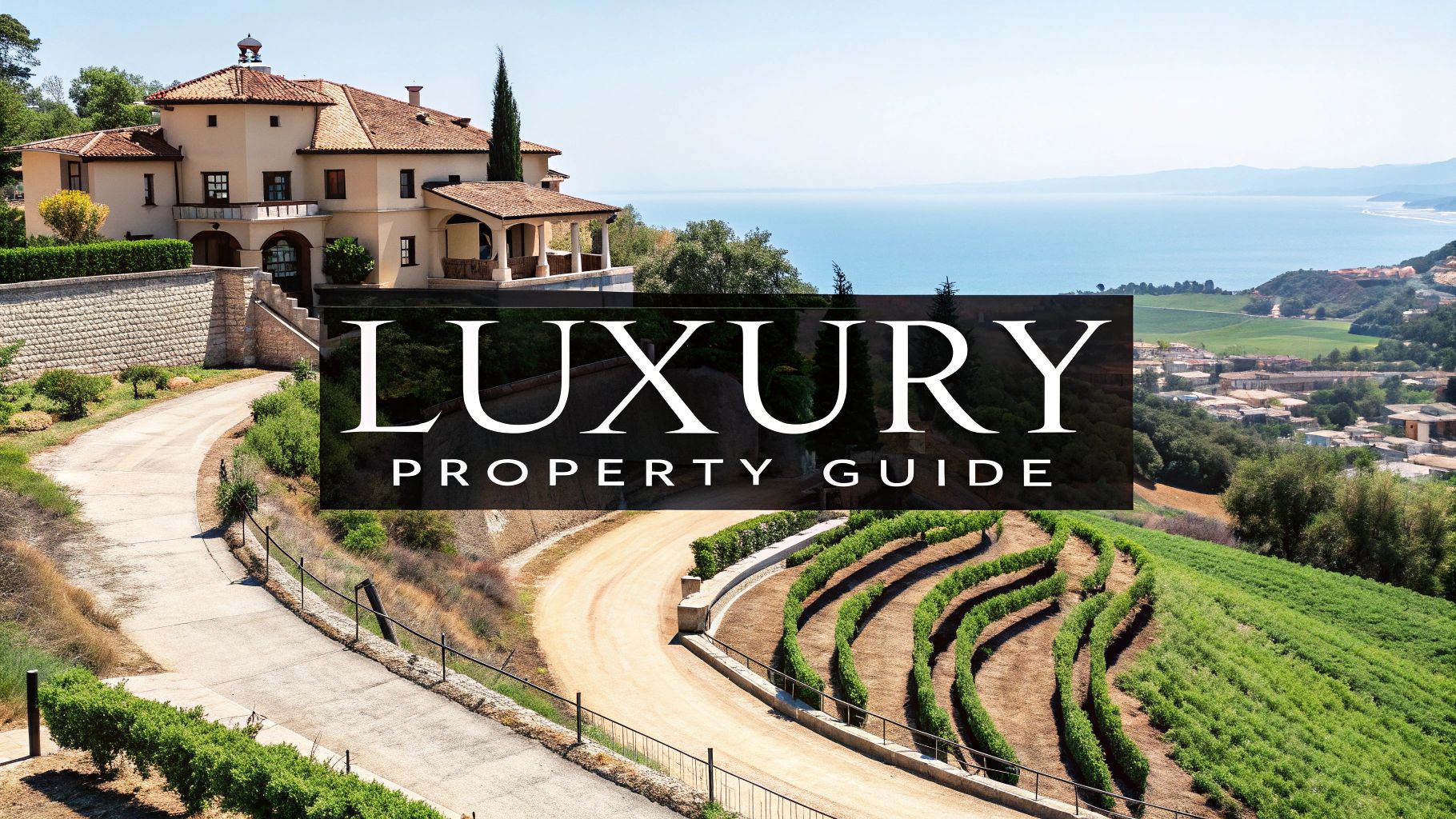
Acquiring a luxury property for sale in Europe is not merely a transaction; it is a strategic portfolio decision. This process demands a sophisticated understanding of nuanced market dynamics, cross-border legal frameworks, and the complex financing structures required for multi-million-euro assets. This guide moves beyond the fundamentals, delivering actionable intelligence for high-net-worth individuals and seasoned real estate professionals.
Navigating Your European Property Acquisition Journey
For discerning international investors, allocating capital to European real estate must align financial acumen with lifestyle aspirations. The path from initial market analysis to securing the keys is a multi-stage endeavour, where expert counsel and meticulous attention to detail are paramount.
"Current sentiment among international buyers is cautiously optimistic; they are seeking stable, legacy assets in proven locations, prioritising quality and long-term value over speculative gains."
— Nick Marr, Founder of EuropeanProperty.com
This insight underscores a critical market shift towards durable, high-quality investments. Investors are not just purchasing a residence; they are securing a tangible asset for generations. This long-term perspective must inform every step of your acquisition strategy.
Understanding the Acquisition Lifecycle
The journey of buying a luxury property for sale follows a distinct, albeit demanding, sequence. It commences with strategic market identification and culminates in the legal transfer of ownership. From the outset, familiarising yourself with premier luxury home design solutions can refine your search criteria, helping you identify the architectural and design elements that underpin premium value.
Once the preparatory groundwork is complete, the process of engaging with specific properties can begin.
This visual represents the tactical phase of your search. It deconstructs a complex operation into three core actions, each one built upon a foundation of robust research and strategic planning.
The Four Pillars of a Successful Purchase
To maintain clarity and focus, the entire acquisition journey can be structured around four critical pillars. Each phase has a distinct objective and a unique set of challenges to navigate for a seamless outcome. Mastering these provides a clear roadmap from initial concept to final possession of your new European property.
We will now delve into each of these pillars in greater detail.
To provide a high-level overview, the table below summarises the critical stages you will encounter. It is a strategic roadmap designed to help sophisticated buyers understand the broader picture before engaging with the specifics.
Key Stages in Your European Luxury Property Acquisition
| Phase | Primary Objective | Key Considerations |
|---|---|---|
| Market Research & Strategy | Identify the ideal country, region, and property type that align with your financial goals and lifestyle. | Local property laws for non-residents, tax implications, economic stability, and long-term appreciation potential. |
| Financing & Legal Groundwork | Secure the necessary funding and assemble a team of legal and financial advisors. | Mortgage pre-approval from European lenders, understanding cross-border wealth transfer, choosing a multilingual solicitor. |
| Property Search & Evaluation | Actively search for, visit, and conduct initial due diligence on shortlisted properties. | Working with a reputable agent, assessing renovation potential, verifying title deeds, and understanding local zoning. |
| Negotiation, Due Diligence & Closing | Make an offer, conduct in-depth legal and structural checks, and finalise the purchase. | Formal offer structure, engaging surveyors, finalising contracts (compromis de vente or equivalent), and transferring funds. |
Consider these stages not as a rigid checklist, but as a strategic framework. Each phase flows logically into the next, and meticulous preparation at every step is what distinguishes a successful acquisition from a fraught one.
Identifying Europe’s Prime Property Hotspots
Locating the right luxury property for sale in Europe is not about chasing fleeting trends; it is an exercise in rigorous market analysis. The most desirable locations, from the sun-drenched Mediterranean coast to historic capital cities, are defined by far more than a prestigious postcode.
True value is a confluence of economic resilience, lifestyle appeal, and demonstrable potential for capital appreciation.
Sophisticated investors understand the need to look beyond the headlines. They focus on key performance indicators such as prime price growth forecasts, luxury rental yield potential, and significant local infrastructure investment. These signals differentiate a temporary hotspot from a sound, long-term investment destination.
This analytical approach cuts through market noise, enabling a clear comparison between the investment dynamics of an established hub like Prime Central London and an emerging enclave such as Portugal's Silver Coast. One offers deep-rooted stability; the other presents an opportunity for higher growth.
Established versus Emerging Luxury Markets
Grasping the distinction between established and emerging markets is fundamental. Established markets—think the French Riviera or Tuscany—possess a proven track record of value preservation and offer a deep, liquid market. They are widely regarded as safe havens for capital.
Conversely, emerging luxury locations might be areas benefiting from new high-speed rail links, favourable tax regimes, or a surge in cultural cachet. While these markets can deliver superior capital appreciation, they often carry higher volatility. Your personal investment strategy and risk appetite will determine the appropriate fit.
A critical part of the process is leveraging market intelligence from respected sources. Reports from firms like Knight Frank, combined with government statistics, provide the empirical foundation needed to make data-backed decisions on any luxury property for sale.
However, raw data alone is insufficient. It must be paired with on-the-ground expertise. A well-connected local agent can interpret the subtle economic shifts and cultural nuances that quantitative reports often miss, providing an invaluable layer of real-world insight.
Analysing Market Stability and Growth Indicators
When vetting a potential location, several metrics demand your attention. Look beyond simple price trends for evidence of a healthy, diversified local economy that is not entirely dependent on tourism. This economic backbone is what underpins property values during global downturns.
Key indicators to assess include:
- Prime Price Resilience: How did the area's luxury market perform during past economic shocks? Markets that demonstrated stability or recovered quickly are typically the most sound long-term investments.
- Infrastructure Pipeline: Are there major public or private investments underway? New marinas, high-speed rail connections, or the arrival of international schools can transform a location's desirability.
- Rental Yields and Occupancy: For investment-focused buyers, strong demand in the high-end rental market is a powerful indicator. It confirms the location’s appeal and provides a potential income stream.
A Closer Look at Market Dynamics
Market dynamics are in constant flux, influenced by factors ranging from fiscal policy to global mobility patterns. The UK luxury property market, particularly in London, serves as a compelling case study. Following a period of price correction, the outlook is now complex.
A recent report from Knight Frank suggests that prices in Prime Central London (PCL) will likely remain flat this year. This follows a decade that saw an 18% decline in average prices. In contrast, prime outer London experienced a modest 1.2% price increase, indicating a clear shift in buyer focus.
Policy changes, such as the UK's abolition of its non-dom tax regime, have also tempered demand from certain international buyers. Nevertheless, the UK's stable legal framework helps it remain a relative safe haven.
Other markets possess their own unique characteristics. France, for example, offers an incredible spectrum of luxury options, from chic Parisian apartments to sprawling Provençal estates, each with its own set of market conditions and legal hurdles. Understanding these nuances is essential, which is why our guide to buying luxury property in France is an indispensable resource for anyone considering a purchase there.
Ultimately, a successful search for a luxury property for sale depends on this calibre of detailed, location-specific intelligence.
Structuring Finance for Your Luxury European Purchase
Financing a multi-million-euro asset is fundamentally different from a standard mortgage application. When acquiring a luxury property for sale, you require a bespoke financial strategy, meticulously crafted to align with your global wealth portfolio, residency status, and the specific regulations of your target country.
The funding landscape for high-net-worth international buyers is both flexible and complex. The optimal path depends entirely on your individual circumstances, balancing liquidity, tax efficiency, and speed of execution.
Private Banking Versus Specialised Brokers
For many, the first point of contact is their private bank. This is a logical step; leveraging an existing relationship can be highly efficient, as the institution already possesses a deep understanding of your financial standing. They can offer sophisticated solutions like Lombard loans, enabling you to borrow against your investment portfolio, often at highly competitive rates.
An alternative route is to engage a specialised international mortgage broker. These experts provide access to a much broader market of lenders, including niche banks that focus exclusively on high-value, cross-border transactions. They are invaluable for navigating the intricate due diligence required, from verifying your source of wealth to structuring the purchase in the most tax-advantageous manner.
A cash purchase always provides the strongest negotiating position—it signals serious intent and significantly simplifies the closing process. However, for cash-rich buyers, structuring a financing deal can be the more astute long-term strategy, as it preserves liquidity for other investment opportunities.
Navigating Cross-Border Lending Complexities
Lending criteria and loan-to-value (LTV) ratios vary dramatically across Europe. It is not a uniform market. For instance, lenders in conservative markets like Switzerland may offer lower LTVs compared to those in Spain or Portugal, reflecting different risk appetites. Our detailed analysis offers more insight into the dynamics of house prices in Switzerland and how they influence lending practices.
Your residency status is another critical factor, as is the ownership structure you choose—whether you buy in your personal name or through a corporate entity. Lenders will conduct rigorous due diligence, so having a comprehensive and transparent financial profile prepared from the outset is non-negotiable.
A Practical Financing Scenario
Let us consider a real-world context. Imagine you are acquiring a €10 million lakeside villa in Italy. A strategic approach might look as follows:
- Secure a Lombard Loan: You could pledge €5 million from your existing securities portfolio to your private bank, securing a loan for 50% of the property’s value. This is often a fast and flexible way to raise capital without liquidating assets.
- Arrange a Local Mortgage: Next, you might work with an international broker to secure a local Italian mortgage for another 20-30% of the value, taking advantage of potentially favourable local interest rates.
- Fund the Remainder with Cash: The final 20-30%, plus all transaction costs, would then be covered by your liquid cash reserves.
This blended approach optimises your borrowing costs, minimises your immediate capital outlay, and keeps your investment portfolio intact. It demonstrates that structuring the finance for a luxury property for sale is as much an art as it is a science. Securing expert guidance is not just advisable—it is essential to protect your wealth while acquiring the asset of your dreams.
Executing a Flawless Search and Vetting Process
Successfully acquiring a luxury property for sale depends on a search and vetting process that is as sophisticated as the asset itself. This is not about browsing online portals; it is an intelligence-led operation that begins with assembling the right team on the ground.
The first move is to engage a well-connected buyer’s agent. Their true value lies not just in market knowledge, but in their access to exclusive, off-market listings that are never publicly advertised. These are often the most desirable properties, reserved for a discreet network of serious buyers.
Beyond the Standard Survey
For a high-value asset, a standard structural survey is merely a starting point. True due diligence is an investigative process, designed to protect your investment from future complications and uncover the property's authentic character and potential.
This requires a forensic examination of several key areas. A property’s provenance, for instance, can reveal cultural significance that may bring prestige but also preservation restrictions, particularly with historic estates in regions like France or Italy.
A thorough investigation into local zoning laws is equally crucial. These regulations dictate everything from the feasibility of constructing a new infinity pool to the types of materials permitted for an extension. Overlooking these details can be a costly mistake.
The Art of the Viewing
When you step inside a potential luxury property for sale, you are looking for subtleties that signal its quality and long-term viability. It is a delicate balance—appreciating the lifestyle on offer while maintaining a critical investor’s perspective.
Your viewing checklist should be fluid, adapting to the property type. For a modern ski chalet in the Alps, you would focus on the quality of insulation, the efficiency of the heating systems, and the roof's capacity to handle heavy snowfall. For a historic lakeside estate on Lake Como, your attention would shift to signs of damp, the condition of original features, and the integrity of century-old retaining walls.
"Discerning buyers look past the staging. They check the water pressure, observe the quality of natural light at different times of day, and assess the ambient noise from the neighbourhood. It’s these small details that define daily life in a home and ultimately impact its long-term appeal."
— Nick Marr, Founder of EuropeanProperty.com
Practical Vetting Checklist
To keep your evaluation grounded, focus on these critical points during any viewing:
- Structural Nuances: Look for subtle clues—hairline cracks near windows or doors, uneven floors, or a musty smell that could indicate damp issues.
- Quality of Finishes: Examine the craftsmanship up close. Are fixtures from reputable brands? Is the joinery precise? These details are clear indicators of a high-quality, well-maintained build.
- Technological Infrastructure: Assess the property’s connectivity. Is high-speed internet available? Is the home fitted with modern security or smart home systems?
- Neighbourhood Amenities: Do not just inspect the house; explore the local area. Consider its proximity to fine dining, private schools, transport links, and other services that underpin a luxury lifestyle.
Balancing Lifestyle with Investment Potential
Ultimately, the decision to acquire a luxury property for sale blends emotional appeal with financial pragmatism. Allow data to inform your decision, but do not let it completely override your instinct. The key is to ensure the property's lifestyle benefits are supported by solid investment fundamentals.
Market trends provide the ideal context for this. For example, recent UK market reports revealed that despite economic shifts, buyer demand in the luxury sector rose 11% year-on-year, with agreed sales climbing 8%. Mortgage approvals also increased by 5.6%, pointing to robust financial confidence in high-value assets, particularly in prime postcodes where buyers seek move-in-ready homes. You can explore a detailed analysis of these property market trends to gain a clearer understanding of the current landscape.
This data confirms that well-located, high-quality properties are a resilient asset class. Your objective during the vetting process is to confirm that the specific property you are considering fits this profile, ensuring it will deliver both personal enjoyment and long-term value.
Mastering Negotiation and Closing the Deal
Finalising a high-value property transaction in a foreign jurisdiction is an art form, demanding a sophisticated blend of cultural awareness, strategic patience, and sharp commercial acumen. This final stage is where a favourable deal is secured on your terms—or where it can unravel due to unforeseen legal complexities.
Success hinges on a thorough understanding of the local rules of engagement.
The closing process is far from uniform across Europe. In civil law countries like France, Italy, and Spain, the notary (notaire, notaio, notario) is not merely an administrator; they play a central, quasi-judicial role, representing the state to guarantee the legality of the transfer. This contrasts sharply with the solicitor-led system in the UK and Ireland, where two legal teams represent the buyer and seller.
"Understanding the closing mechanism is as important as agreeing on the price. A buyer who appreciates the notary's role in France, for example, will approach the compromis de vente with a different strategy than someone accustomed to the British system of exchanging contracts."
Recognising these differences is your first strategic advantage.
Structuring a Compelling Offer
Your initial offer is more than a number; it is the opening move in a sophisticated dialogue. To make it effective, you must look beyond the asking price and understand the seller's motivations. Are they selling due to a life event and require a swift, clean transaction? Or are they financially secure and prepared to wait for their desired price?
This is where your agent’s on-the-ground intelligence is invaluable. A strong offer on a luxury property for sale can be enhanced with strategic conditions:
- Proof of Funds: Attaching a letter from your bank is a powerful signal of intent. It demonstrates your seriousness and financial capacity to close, immediately differentiating you from other potential buyers.
- Flexible Completion Date: Offering to accommodate the seller's preferred timeline can be a significant non-monetary concession.
- Minimal Contingencies: A 'clean' offer with few conditions (such as being subject to survey) is always more appealing. However, this increases your risk and should only be considered with robust expert advice.
Equally important is knowing when to withdraw. If a seller's price expectations are detached from market reality, a protracted negotiation is a waste of time and resources. Experience shows that luxury properties remaining on the market for over 180 days often sell at a significant discount, sometimes as much as 20% below the initial asking price.
Navigating the Key Closing Stages
Once your offer is accepted, the legal process begins. This typically involves a preliminary contract before the final deed transfer, but the specifics vary widely. In France, the compromis de vente is a highly binding agreement from the outset. In Spain, it is common to sign a private purchase contract (contrato privado de compraventa) before proceeding to the notary for the final public deed.
For a deeper analysis, our guide on buying property in Southern Spain for foreigners is packed with crucial regional insights.
During this interim period, your legal team will conduct exhaustive due diligence to uncover any latent issues. They will search for red flags such as unresolved planning permissions, undisclosed debts tied to the property, or unexpected tax liabilities. This is a non-negotiable step.
Finalising Financial Arrangements
As the closing date approaches, your focus must shift to the financial transfer. This involves more than simply wiring the purchase price. For international buyers, currency exchange is a significant factor. A sudden fluctuation in the FX market could materially alter the final cost of your property.
Do not leave this to chance. Work with a currency specialist to lock in a favourable exchange rate with a forward contract, providing certainty over the final figure you will pay in your home currency.
Finally, obtain a crystal-clear statement of all associated costs. This will include stamp duty or transfer tax, notary fees, legal fees, and agent commissions. Prompt payment of these is the final step in taking control of the process and officially concluding your search for that perfect luxury property for sale.
Post-Purchase Property Management: Protecting Your Asset
Securing the keys to your European residence is a significant milestone, but it marks the beginning of the ownership journey, not the end. The focus now transitions from acquisition to the practicalities of asset management—ensuring your new property is protected, profitable, and enjoyable for years to come.
For overseas owners, this means implementing a robust plan for property care, financial administration, and navigating local bureaucracy. The objective is to make owning a home from thousands of miles away a seamless experience.
Assembling Your Local Management Team
Your first priority is to establish a reliable team on the ground. A professional property management company is indispensable, particularly for a luxury property for sale that will not be your full-time residence. They act as your local representatives, handling everything from routine maintenance and security to managing rental agreements.
Beyond a management firm, you may need to engage dedicated staff such as housekeepers, gardeners, or a private concierge. Vet these individuals thoroughly; you are entrusting them with a valuable asset, so competence and trustworthiness are paramount.
Optimising Your Investment for the Long Term
Prudent post-purchase financial management is about protecting your investment and making it perform. This extends beyond paying bills to encompass strategic, long-term planning.
Key areas for your attention should include:
- Wealth and Inheritance Planning: This is critical. Consult with international tax advisors to structure your ownership in a manner that is both compliant and tax-efficient, particularly when considering cross-border inheritance laws.
- Rental Income Strategy: If the property is an investment, you need a plan to maximise its potential. This involves professional marketing, dynamic seasonal pricing, and ensuring the home is consistently presented to the high standards that luxury tenants expect.
- Proactive Maintenance and Upgrades: A proactive approach to maintenance prevents costly issues down the line. When planning improvements, think strategically. Understanding how specific features like skylights can impact property value is the kind of informed thinking that distinguishes a good investment from a great one.
This forward-looking mindset ensures your property not only retains its value but appreciates. Market trends are a valuable guide here. In the UK, for instance, forecasts indicate that prime luxury property prices are set to accelerate, with potential growth of nearly 18% by 2029. Following a recent period of flat performance, this points to a strong recovery, particularly for high-end country homes, proving the luxury segment is poised for significant growth.
Managing Administrative Essentials
Finally, effective ownership requires diligent management of administrative details. This includes setting up utilities, staying current with local property taxes, and handling any residency or visa paperwork linked to your purchase.
A local representative who is fluent in the language and understands the system is invaluable. They can navigate the bureaucracy efficiently, saving you considerable time and effort.
By establishing these structures early, you can relax and enjoy the benefits of owning a spectacular European home, confident that your investment is secure, well-managed, and positioned for future success.
Frequently Asked Questions
When navigating the acquisition of a luxury property for sale in Europe, pertinent questions will inevitably arise. Below are concise answers to the most common queries from discerning international buyers.
What are the typical transaction costs when buying a luxury European property?
Transaction costs vary significantly by country, but a prudent estimate is to budget between 7% and 15% of the property's purchase price to cover all associated expenses. This figure generally includes property transfer taxes (such as Stamp Duty in the UK or ITP in Spain), notary fees, legal charges, and agent commissions. For context, costs in France are often at the higher end of this range, typically landing between 7-10%. To avoid any surprises at closing, request a detailed cost breakdown from your legal advisor at the outset.
Is retaining a local legal representative essential?
Yes, it is non-negotiable. It is a common misstep to rely on the seller's representative or a shared notary. You require independent counsel whose sole priority is to protect your interests. The optimal approach is to engage an independent, multilingual solicitor who specialises in property law for international clients in your target country. They will conduct critical due diligence, safeguard your position in all contracts, and expertly navigate local property and tax laws. Their fee represents one of the most valuable investments you will make during the acquisition process.
Should I purchase in my personal name or through a corporate structure?
This is a strategic decision contingent on your personal financial circumstances, residency status, and the specific laws of the country of purchase. There is no one-size-fits-all answer.
A corporate structure, such as an SCI in France, can offer sophisticated advantages for inheritance planning and liability limitation. However, it can also introduce tax complexities. Purchasing in your personal name is more straightforward but lacks this flexibility. It is crucial to consult with a wealth manager and tax advisor with proven expertise in cross-border ownership before making a final decision.
About EuropeanProperty.com
EuropeanProperty.com is Europe’s longest-running luxury real estate platform, online since 1999. It connects luxury real estate agents, developers, and homeowners with high-net-worth buyers and international investors.
Looking for expert mortgage guidance? Get luxury property mortgage advice here:
👉 https://europeanproperty.com/luxury-overseas-mortgages/
Explore more overseas homes for sale at our global partner site:
👉 https://homesgofast.com/overseas-property/