

Buying a high-value property in Spain is a straightforward process, but it’s one that requires careful navigation. For a non-resident, the journey involves a few key steps: securing a mandatory tax identification number (the NIE), bringing an independent lawyer on board, and getting to grips with local property laws and taxes.
Success in the quest for how to buy luxury property in Spain as a foreigner really boils down to two things: meticulous due diligence and working with seasoned professionals who know the luxury market inside and out.
Your Guide to Spain’s Luxury Property Market
From its sun-drenched coastlines to its vibrant cultural hubs, Spain’s allure for high-net-worth individuals is undeniable. This guide tackles the core question of how to buy luxury property in Spain as a foreigner, giving discerning investors a clear and practical roadmap.
The market itself is a rich tapestry of opportunities. You’ll find everything from ultra-modern villas in Marbella to historic fincas tucked away in the Balearic Islands, each offering a completely different lifestyle and investment profile.
But today’s buyers are looking for more than just bricks and mortar; they’re investing in a lifestyle defined by an exceptional climate, security, and world-class amenities. Think of this guide as your essential walkthrough, designed to demystify the entire process. We’ll cover everything from the legal must-haves and financing options to post-purchase management, making sure you feel confident from start to finish.
A great first step is to simply explore the available Luxury Homes For Sale in Spain to get a feel for current market offerings and price points.
The Acquisition Journey
While it might seem complex at first glance, securing a luxury property follows a well-trodden path. We can break it down into three main stages: getting your legal groundwork sorted, arranging the finances, and finally, the purchase itself. This structured approach ensures every detail is covered, protecting your investment and paving the way for a smooth transaction.
The infographic below gives you a bird’s-eye view of these core phases, highlighting the critical legal, financial, and transactional milestones you’ll encounter.
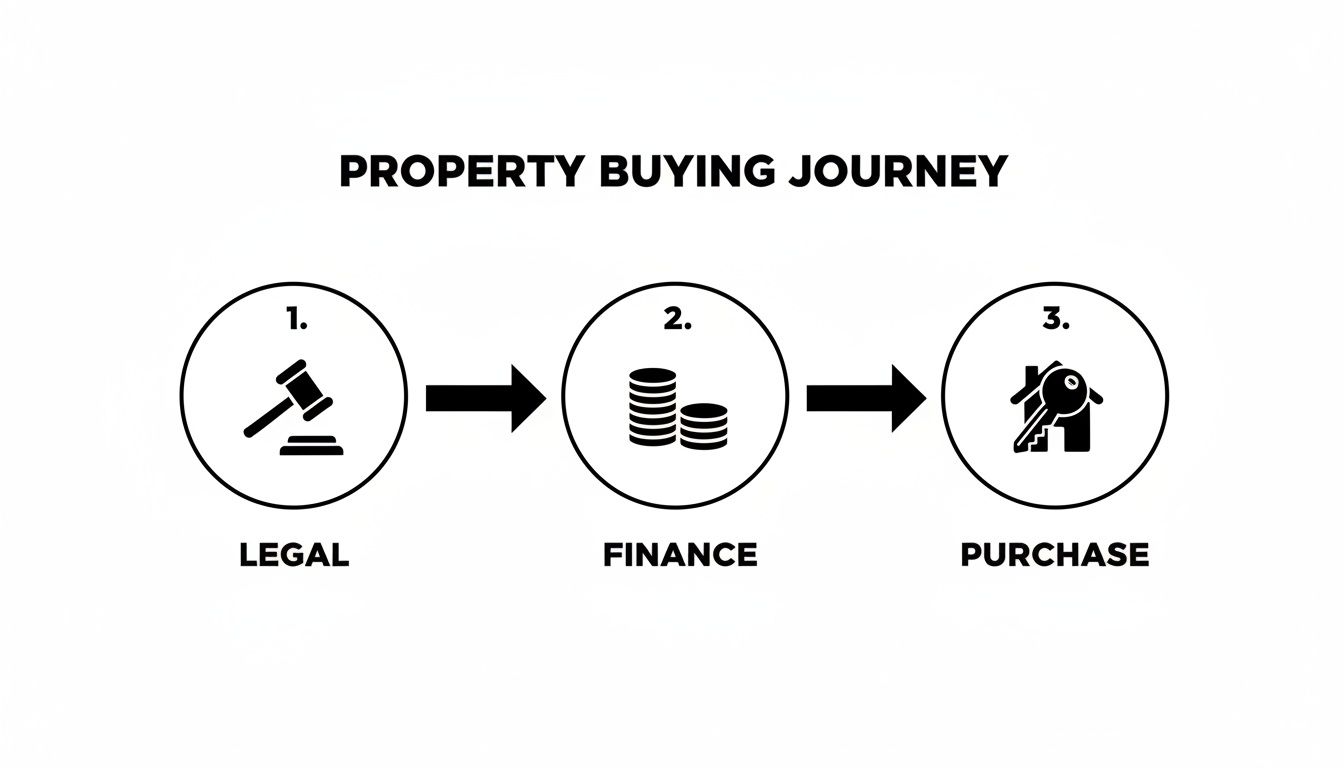
As you can see, a methodical approach is key. Getting the legal and financial preparations right from the start forms the bedrock of a successful purchase.
Nick Marr, founder of EuropeanProperty.com, notes that “Spain’s prime markets continue to attract buyers seeking lifestyle resilience and capital preservation. A successful acquisition is always underpinned by diligent preparation and expert local guidance.”
A High-Level Overview of the Key Stages
To give you an even clearer picture, the table below summarises the essential steps involved when a non-resident decides to buy luxury property in Spain as a foreigner.
This framework provides a high-level summary of the journey ahead, outlining what needs to be done at each stage and who the key professional is to help you get there. It’s a useful tool for planning your time and resources effectively.
Key Stages of Buying Luxury Property in Spain
A summary of the essential steps for non-resident buyers navigating the acquisition process.
| Stage | Primary Objective | Key Professional |
|---|---|---|
| Pre-Purchase & Legal Setup | To establish legal and financial readiness in Spain, including obtaining an NIE number and opening a bank account. | Independent Lawyer (Abogado) |
| Property Search & Due Diligence | To identify a suitable property and conduct thorough checks on its legal status, planning permissions, and any outstanding debts. | Real Estate Agent & Lawyer |
| Financing & Offer | To secure funding if required and make a formal offer, followed by signing a preliminary contract (‘contrato de arras’). | Mortgage Broker / Bank |
| Completion & Registration | To finalise the purchase by signing the public deed (‘escritura’) before a notary and registering the property in your name. | Notary (Notario) & Lawyer |
With this structure in mind, you can approach the process with confidence, knowing exactly what to expect as you move towards owning your dream home in Spain.
Getting to Grips with Spanish Legal Requirements
Before you even start dreaming about terraces with sea views, you need to understand the local legal framework. It’s the first real, practical step in your buying journey. For anyone figuring out how to buy luxury property in Spain as a foreigner, getting the legal side right isn’t just a box-ticking exercise—it’s the foundation of a secure investment.
The good news is that the Spanish system is well-defined and designed to protect everyone involved. As a non-resident, you have the exact same property rights as a Spanish citizen. Still, there are a few essential administrative tasks you must tackle before you can even think about making an offer. Getting these sorted early will save you a world of headaches later on.

First Up: Your NIE Number
Nothing happens in Spain without a Número de Identificación de Extranjero (NIE). Think of it as your unique tax ID number as a foreigner. It’s absolutely non-negotiable for buying property, opening a bank account, or even setting up utilities. You can’t move forward on any high-end property without one.
You have a couple of options for getting your NIE number for property purchase:
- Do it yourself in Spain: The quickest route is often applying in person at a designated police station (Comisaría de Policía) in the area you plan to buy. The catch? You have to be there physically.
- Apply from home: You can also apply through your nearest Spanish consulate or embassy. This method is notoriously slower, so start the process well before you get serious about your property search.
My best advice? Grant your Spanish lawyer Power of Attorney (Poder) to get the NIE for you. It’s by far the most efficient way to do it. They can handle all the paperwork and queues, leaving you free to focus on finding the right property.
Find a Truly Independent Lawyer
This is probably the most critical decision you’ll make. Your lawyer, or abogado, is your champion, working only for you to protect your investment. Whatever you do, don’t just use the lawyer recommended by the seller or the estate agent. You need someone with zero conflicts of interest.
Your abogado is responsible for the deep-dive due diligence that makes or breaks a safe luxury real estate investment in Spain. This is not a corner to cut.
Here’s what they’ll handle:
- Land Registry Checks: They’ll get a ‘Nota Simple Informativa’ from the Land Registry (Registro de la Propiedad). This crucial document confirms who legally owns the property, gives its official description, and—most importantly—flags any debts, mortgages, or legal claims (cargas) attached to it.
- Planning Permission Verification: Your lawyer will check with the local town hall (Ayuntamiento) to ensure the property was built with all the correct permits and has no outstanding legal issues or demolition orders. This is a lifesaver, especially for villas with pools or extensions added over the years.
- Contract Scrutiny: From the initial reservation agreement to the final deed of sale, they will draft and review every single legal document to make sure the terms are fair, legal, and in your best interest.
Open a Spanish Bank Account
While it’s not a strict legal requirement to finalise the purchase, opening a Spanish bank account is a practical must. All the taxes and fees tied to the sale have to be paid from a Spanish account.
It also makes life infinitely easier for managing ongoing costs, like:
- Utility bills (water, electricity, internet)
- Community fees (gastos de comunidad) for apartments or developments
- Annual property taxes, such as IBI (Impuesto sobre Bienes Inmuebles)
Setting this up early smooths out the entire financial side of the deal. Your lawyer can usually help you open an account as part of their service, making it a simple process even from abroad. Nail these legal steps, and you’ll know exactly how to buy luxury property in Spain as a foreigner with complete confidence.
Financing Your Spanish Property Investment
Figuring out how to fund your purchase is a critical step when you decide to buy luxury property in Spain as a foreigner. Whether you’re planning a straightforward cash purchase or need to arrange a mortgage, getting this part right will make the entire process smoother. Each route has its own pros and cons, and the best fit really comes down to your financial situation and what you’re trying to achieve with the investment.
Coming in with a cash offer is obviously the most direct path. It often puts you in a much stronger negotiating position and cuts through a lot of red tape. You get to skip the bank valuations and the long, drawn-out approval processes, which means you can close the deal much faster. That said, using a Spanish mortgage can be a very shrewd financial move, as it frees up your capital for other investments or for making upgrades to your new home.
Securing a Spanish Mortgage
For non-residents, getting a mortgage in Spain is a well-trodden path, but the terms are a bit different than they are for locals. Spanish banks will typically offer a loan-to-value (LTV) ratio of between 60% and 70% for foreign buyers.
What does this mean in real terms? You’ll need to come up with a deposit of at least 30-40% of the property’s price, plus another 10-15% on top to cover all the taxes and fees.
To get your application approved, Spanish lenders will want to see a comprehensive file of documents to prove your financial stability. Get ready to provide:
- Proof of Income: This usually means recent payslips, your tax returns from the last couple of years, or audited accounts if you’re self-employed.
- Credit History: A credit report from your home country (like Experian or Equifax) is almost always required.
- Existing Assets and Debts: The bank will want a complete picture of your financial health, both in and out of Spain.
- NIE Number: You can’t even start a mortgage application without your Spanish tax identification number. It’s non-negotiable.
Given how complex this can get, working with a specialist mortgage broker who really understands the Spanish mortgage for non-residents market is a game-changer. They already have relationships with various lenders and can navigate the system to find you the best possible terms.
Exploring Alternative Financing and Strategic Residency
If you’re a high-net-worth individual, you’re not limited to traditional mortgages. Private banking relationships can unlock more bespoke funding solutions. Think alternative financing strategies like portfolio-backed loans or more flexible arrangements that take your global assets into account. These options usually offer more discretion and are tailored to more complex financial profiles.
Another incredibly powerful tool to consider is Spain’s Golden Visa programme. For non-EU nationals, this residency-by-investment scheme is a strategic game-changer.
The Golden Visa offers a clear route to residency for anyone investing a minimum of €500,000 in Spanish real estate. This doesn’t just make the purchase easier; it grants you and your family the right to live, work, and travel freely across the entire Schengen Area.
To qualify, the initial €500,000 investment has to be made with your own funds—no mortgage allowed for that portion. However, any amount you spend above that threshold can be financed. The benefits are significant:
- Schengen Area Mobility: Enjoy visa-free travel across 27 European countries.
- Family Inclusion: The visa extends to your spouse, dependent children, and even dependent parents.
- Minimal Residency Requirement: You only have to visit Spain once a year to keep the permit active.
- Pathway to Citizenship: After several years of residency, it can lead to permanent residency and, eventually, Spanish citizenship.
Looking at your purchase through the lens of the Golden Visa transforms it from a simple lifestyle choice into a strategic investment in global mobility. This is an especially compelling angle for buyers from the USA, the Middle East, and other non-EU countries looking to establish a solid foothold in Europe. Planning your financing with this in mind is a core part of knowing how to buy luxury property in Spain as a foreigner effectively.
Finding and Securing Your Ideal Property
With your legal and financial foundations sorted, we get to the exciting part: finding your perfect Spanish home. This isn’t just about scrolling through listings; it’s about matching your lifestyle dreams to a specific place and property. This is where the whole process of how to buy luxury property in Spain as a foreigner really comes to life.

The Spanish luxury market is incredibly diverse. You could be drawn to the glamour of Marbella, the bohemian chic of Ibiza, the quiet elegance of Mallorca, or the buzz of Madrid. Each spot offers a completely different vibe and value, and understanding these nuances is the key to a smart purchase.
Defining Your Search Criteria
Before you even speak to an agent, get clear on your non-negotiables. Are you dreaming of a frontline golf villa? A secluded hillside estate with sweeping sea views? Or maybe a sleek, modern penthouse right in the city centre?
Think about these key factors:
- Lifestyle: Is this a family holiday home, a remote work base, or purely a rental investment? Your answer will determine whether proximity to international schools, marinas, or Michelin-starred restaurants is a priority.
- Architectural Style: Do you love classic Andalusian architecture, clean minimalist design, or a rustic finca?
- Privacy vs. Community: Are you after the total seclusion of a private estate, or do you prefer the amenities and security that come with a gated community?
Your personal taste will guide the search, but try to stay open-minded. I’ve often seen clients find their dream home in a property that was completely different from what they initially envisioned.
For a deeper look into what each region offers, our guide to the best places to buy in Spain is a great place to start.
Partnering with a Specialist Agent
In the high-end market, a standard estate agent just won’t cut it. You need a specialist—someone who lives and breathes luxury transactions for international clients. A well-connected agent can get you access to off-market properties and has an intimate, on-the-ground knowledge of what’s really happening in the market.
Think of your agent as a trusted advisor. They should give you candid feedback on build quality, local infrastructure, and potential resale value. These are the things that go far beyond glossy photos, and they are absolutely crucial when you’re managing the process from abroad.
Nick Marr, founder of EuropeanProperty.com, observes, “Today’s luxury buyer in Spain prioritises turn-key properties with exceptional build quality and smart-home integration. There’s a growing demand for homes that offer both privacy and seamless access to lifestyle amenities, a trend that is clearly shaping prime residential markets.”
The Viewing and Negotiation Process
Whether you’re viewing properties in person or virtually, learn to look beyond the wow factor. Pay close attention to the quality of the materials, the condition of the fixtures, and whether the layout actually makes sense. If you’re looking at a new build, do your homework on the developer’s track record—if possible, go and see their previous projects.
Once you’ve found the one, your agent will help you put together a formal offer. If it’s accepted, you’ll move on to the preliminary contract, known as the ‘contrato de arras’. This is a legally binding deposit agreement that secures the property and lays out all the terms of the sale.
This is the point where you’ll typically pay a 10% deposit. The contract includes a critical penalty clause: if you, as the buyer, back out, you lose your deposit. But if the seller pulls out, they are usually required to pay you back double the deposit amount. It’s a serious commitment that provides security for both sides as you head towards the finish line.
Understanding Who Is Buying Luxury Property in Spain
To get a real edge when you’re figuring out how to buy luxury property in Spain as a foreigner, you first need to know who you’re up against. Understanding the current mix of buyers gives you a powerful insight into market trends, what’s driving demand, and where things are headed.
For years, the Spanish luxury market danced to a predictable rhythm, dominated by a handful of European nationalities. But things are changing. The rise of remote work and a global search for a better quality of life are bringing new faces to the table and completely shaking up the old priorities.
Let’s take a look at the established players and the up-and-coming demographics defining Spain’s prime real estate scene today.
The British Are Still a Driving Force
British buyers have always been the bedrock of the Spanish property market, and that’s a trend that isn’t going away. Their long-standing presence has built a solid, familiar ecosystem in key luxury hotspots, especially along the coasts. It means there’s a reliable secondary market and you’ll find plenty of English-speaking professionals, from estate agents to lawyers.
The latest numbers back this up. In the first half of 2025 alone, British nationals snapped up 5,731 properties, making up 8.1% of all foreign purchases.
A Quick Look Back: While the market is far more diverse now, it’s worth remembering that back in 2015, British buyers accounted for nearly 25% of all international sales. Their influence runs deep.
Even with more nationalities in the mix, the absolute number of British buyers keeps climbing. They’re also spending more. Non-resident Brits are now paying an average of €2,869 per square metre—a 12.3% jump from the previous year. You can dive deeper into these figures by exploring some detailed statistics on Spanish property price history.
For anyone new to the market, this enduring relationship provides a welcome layer of security and familiarity.
A New Generation with New Priorities
Look beyond the usual suspects, and you’ll see a major generational shift happening. Younger, wealthy buyers—mostly Millennials and Gen Z—are entering the market, and they’re bringing a completely different wish list. Forget the traditional two-week holiday home; this crowd wants properties that support a flexible, high-quality, year-round lifestyle.
So, what’s pulling them in?
- Lifestyle and Climate: It’s simple but powerful. Spain’s incredible weather and outdoor-focused culture are a huge draw for anyone chasing a better work-life balance.
- The Remote Work Revolution: High-earning professionals are no longer tied to an office in London, Berlin, or New York. They can work from anywhere, and they’re choosing Spain for its superior quality of life.
- Thriving Digital Nomad Hubs: Cities are cottoning on and actively building communities to attract international talent with co-working spaces, fantastic connectivity, and a great social scene.
This shift is supercharging growth in specific cities and coastal towns. For instance, Luxury Homes For Sale in Malaga are seeing huge demand, with the city quickly becoming a top spot for younger international buyers. Valencia is another hotspot, attracting serious investment thanks to its perfect mix of affordability, culture, and coastal charm.
It’s not just about where people are buying, but what they’re buying. This new wave of investors is looking for contemporary design, sustainable features, and smart-home tech.
Closing the Deal and Post-Purchase Management
This is where all your careful planning comes together. The final steps to buy luxury property in Spain as a foreigner are all about making it official and transitioning smoothly into ownership. Spain’s process is transparent and heavily regulated, which is great for providing security and peace of mind.
The big moment is signing the final deed of sale, known as the escritura de compraventa. This isn’t just a casual signature; it has to be done in front of a public notary (notario). Think of the notario as a neutral state official whose job is to verify everyone’s identity, confirm the property’s legal status is clean, and ensure the entire transaction follows Spanish law to the letter. Once that deed is signed, the deal is legally locked in.
Right there at the notary’s office, you’ll make the final payment and, most excitingly, get the keys to your new Spanish home. From there, your lawyer will handle the last bits of admin, like registering your new ownership at the Land Registry.
Understanding the Final Costs
It’s absolutely critical to budget for the closing costs. A good rule of thumb is to set aside an extra 10-15% of the property price just for taxes and fees. These aren’t optional—they’re required to formalise your ownership.
The biggest chunk of this depends on whether you’re buying a new build from a developer or a resale property from a previous owner.
- Resale Properties: These are hit with Property Transfer Tax, or Impuesto de Transmisiones Patrimoniales (ITP). The rate isn’t fixed across the country; it varies by region, typically falling between 6% and 11%.
- New-Build Properties: For brand-new homes, you’ll pay VAT (IVA) at a flat rate of 10%. On top of that, there’s Stamp Duty (Actos Jurídicos Documentados or AJD), which usually adds another 0.5% to 2.5%.
You’ll also need to cover the notary fees, Land Registry fees, and your lawyer’s fees. Together, these usually total around 1% of the purchase price. For a more detailed look at every possible expense, check out our guide on the hidden costs when buying a property in Spain.
Managing Your New Spanish Asset
With the keys in your hand, the journey isn’t over—it’s just beginning. Good post-purchase management is key to protecting your investment and enjoying your new lifestyle without any hitches.
Here are your immediate priorities:
- Get the Utilities Set Up: You’ll need to transfer the electricity, water, and gas contracts into your name. It’s a fairly simple process that your lawyer or a local property management company can easily handle for you.
- Secure Comprehensive Insurance: A high-value home needs more than just basic insurance. You’ll want a specialist policy that covers not only the building itself but also its valuable contents.
- Know Your Ongoing Costs: Get familiar with the recurring expenses. This includes the annual council tax (Impuesto sobre Bienes Inmuebles or IBI) and, if your property is in a gated community or apartment complex, the community fees.
For non-residents, it’s also worth looking into Spain’s wealth tax (Impuesto sobre el Patrimonio). This might apply if your total net assets in the country go over a certain threshold, which is generally €700,000.
One final, crucial piece of advice: sort out your estate planning. We highly recommend creating a Spanish will. It makes the inheritance process for your heirs infinitely simpler and helps them avoid complicated, expensive, and stressful cross-border legal battles down the line.
FAQs: Buying Luxury Property in Spain
Can I buy a property in Spain after Brexit?
Yes, absolutely. British citizens can still buy property in Spain, and the process remains largely the same as for any other non-EU national. The primary difference is in residency rights; UK citizens no longer have the automatic right to live in Spain and will need to apply for a visa, such as the Golden Visa, for long-term stays.
What are the main differences between buying property in Spain as an EU vs. a non-EU citizen?
For the property purchase itself, there are no differences; ownership rights are identical for all foreigners. The main distinction lies in residency. EU citizens have the right to live and work in Spain automatically. Non-EU citizens need to secure a visa for long-term stays, and the purchase of property valued at over €500,000 can be a strategic route to obtaining Spain’s Golden Visa.
How much deposit is needed for a luxury property in Spain?
If you are a cash buyer, you will typically pay a 10% deposit upon signing the preliminary contract (contrato de arras). If you are securing a Spanish mortgage as a non-resident, banks usually require a deposit of 30-40% of the property’s value, as they will typically only lend 60-70% to foreign buyers.
Is Spain’s Golden Visa still available?
Yes, Spain’s Golden Visa programme is still active. It grants residency to non-EU nationals who make a qualifying investment, the most common of which is purchasing real estate worth at least €500,000. This provides a clear path to residency and visa-free travel within the Schengen Area for the investor and their family.
Why is an independent lawyer so important?
An independent lawyer (abogado) works exclusively for you, ensuring your interests are protected. They conduct essential due diligence, such as verifying property registration, checking for outstanding debts or liens, and confirming planning permissions are in order. Using a lawyer recommended by the seller or agent can create a conflict of interest, making independent counsel crucial for a secure investment.
Can I buy a Spanish property remotely from my home country?
Yes, it is entirely possible and increasingly common to purchase a property remotely. This is achieved by granting a Power of Attorney (Poder Notarial) to your Spanish lawyer, who can then act on your behalf to obtain your NIE number, open a bank account, sign the final purchase deed before a notary, and handle all legal formalities.
About EuropeanProperty.com
EuropeanProperty.com is a premium international real estate platform showcasing luxury homes, exclusive residences, and investment-grade property across Europe and select global markets. The platform connects discerning buyers with high-end villas, apartments, coastal homes, ski chalets, and lifestyle-led real estate opportunities.
Explore exclusive Luxury Property For Sale listings at
https://europeanproperty.com