

For seasoned global investors, exploring investment properties for sale in Central London is more than acquiring bricks and mortar; it is a strategic acquisition of a world-class asset. The market's magnetic pull stems from a powerful combination of unmatched resilience, persistent demand, and a famously constrained supply, cementing its role as an essential component in any serious international property portfolio.
The Enduring Allure of London's Prime Property Market
Central London’s property market often operates in its own microclimate, frequently shielded from the turbulence affecting other global markets. This is not by chance; it is the result of the city's unique position as a hub of finance, culture, and world-class education. For decades, it has served as a safe harbour for capital, attracting a consistent flow of investment from every corner of the globe.
The city’s standing as a premier financial centre guarantees a deep and affluent tenant pool. Top executives, entrepreneurs, and high-net-worth individuals are continually drawn to the capital, all seeking premium homes in the most desirable postcodes. This dynamic creates a reliable, high-yielding rental market for investors seeking consistent income alongside long-term capital growth.
A Foundation of Scarcity and Demand
At the heart of Central London's property value lies a simple yet powerful principle: scarcity. Strict planning laws and the preservation of historic buildings mean that new construction in the most sought-after districts is exceptionally rare. This structural undersupply ensures that demand consistently outstrips available stock, acting as a built-in engine for long-term value appreciation.
This dynamic renders London property a uniquely defensive asset. Even when global economic cycles cause sales volumes to dip, the underlying demand from a diverse international buyer base remains firm. This was recently demonstrated as rental prices climbed year-on-year, despite a marginal increase in available properties. It is why forecasts predict prime central London capital values are set to grow by 9.6% through 2029, reinforcing its status as a top-tier market for discerning investors. You can discover more insights into London's market resilience here.
"London's property market is a legacy investment. It's not about short-term trends; it's about securing a piece of a global city that has proven its ability to generate wealth across generations," observes Nick Marr, founder of EuropeanProperty.com.
To provide a concise overview, here is a snapshot of the key metrics currently driving the prime Central London market.
Central London Property Investment Snapshot
| Metric | Current Status / Forecast |
|---|---|
| Capital Value Growth | Forecasted to grow by 9.6% through 2029 |
| Rental Market | Strong demand from corporate and HNW tenants |
| Supply Constraints | Severe limitations on new builds in prime areas |
| Global Demand | Consistently high from a diverse international buyer base |
| Economic Driver | London's status as a leading global financial centre |
This combination of rising values and tight supply continues to make Central London a compelling proposition for those seeking both stability and growth.
The Pillars of London's Investment Appeal
What are the core factors that maintain this market's robustness? It distils down to a few key pillars that make it an essential part of any high-value property portfolio:
- Global Connectivity: With several major international airports and superb transport links, London is a true world city, effortlessly accessible for business, education, and leisure.
- Educational Excellence: The city is home to world-renowned universities like Imperial College, LSE, and UCL, attracting a steady stream of international students and academics who require high-quality housing.
- Cultural Capital: From West End theatres to world-class museums and Michelin-starred dining, London offers an unparalleled lifestyle. This cultural vibrancy makes properties here incredibly desirable.
- Legal and Financial Security: The UK’s transparent legal system and stable political environment provide a secure and reliable framework for property ownership, offering crucial peace of mind to overseas investors.
Exploring Central London's Premier Investment Hotspots
To successfully navigate the world of investment properties for sale in Central London, one must think beyond famous postcodes. While names like Mayfair and Knightsbridge are universally recognised, the real art lies in understanding the unique character and investor profile each one attracts. It is about matching capital not just to a building, but to a specific lifestyle and financial objective.
Consider the distinction: a sleek, modern penthouse overlooking Hyde Park and a classic Georgian townhouse in a quiet diplomatic quarter. One signifies contemporary luxury, appealing to a global executive. The other offers timeless, discreet elegance that attracts generational wealth. Grasping these nuances separates a good investment from a great one.
Mayfair: The Global Epicentre of Luxury
Mayfair is, without question, one of the most prestigious addresses on the planet. This is the London of hedge funds, exclusive art galleries, and Michelin-starred restaurants. Naturally, it commands some of the world's highest property values.
Investors here are seldom seeking simple rental yields; they are acquiring trophy assets that offer both status and solid capital preservation. The streets are lined with a mix of grand period conversions, ultra-exclusive new builds, and historic townhouses. Mayfair attracts a truly international crowd, from business magnates to royalty, all drawn by its unbeatable location and access to the very best London has to offer.
Knightsbridge And Belgravia: Elegance And Legacy
Adjacent to Hyde Park, Knightsbridge is a world-famous luxury retail hub, anchored by iconic department stores like Harrods and Harvey Nichols. Its residential streets are defined by grand red-brick mansion blocks and pristine garden squares. This area is a powerful magnet for international buyers seeking that quintessential London experience, and rental demand from corporate tenants and affluent families is consistently strong. For a closer look, feel free to explore our portfolio of luxury homes for sale in Knightsbridge, London.
Just next door, Belgravia offers an entirely different atmosphere. With its signature white stucco-fronted townhouses and quiet, embassy-lined streets, it exudes a more discreet, aristocratic feel. This neighbourhood appeals to investors who value privacy and are focused on preserving long-term family wealth. Properties here are often held for generations, meaning available stock is rare and highly sought-after—a scarcity that fuels its stable, long-term growth.
Choosing between Knightsbridge and Belgravia is really a choice between vibrant, high-profile living and serene, understated grandeur. Both promise exceptional long-term value, but they appeal to very different investor mindsets.
Kensington: The Family-Oriented Prime Address
Kensington presents a slightly different investment case, blending prime central prestige with a more village-like atmosphere. It is incredibly popular with families, drawn to its outstanding schools, beautiful green spaces—like Kensington Gardens and Holland Park—and cultural heavyweights such as the V&A Museum.
The property market here is wonderfully diverse, offering everything from large family homes to sophisticated lateral apartments. Investors favour Kensington for its strong, stable rental market, which is underpinned by a reliable tenant base of affluent British and international families. It represents a solid, defensive play.
- Investor Profile: Typically long-term holders seeking a blend of rental income and steady capital appreciation.
- Property Types: Classic Victorian and Georgian family houses, garden square apartments, and a handful of new luxury developments.
- Key Appeal: It combines the prestige of a prime London address with an exceptionally high quality of life, making it a perennially desirable and safe investment.
Each of these elite districts offers a unique investment thesis. Your final choice will depend on whether your primary goal is securing a world-class trophy asset, generating powerful rental yields, or acquiring a legacy property for generations to come.
Maximising Your Returns Through Yields and Growth
For anyone seriously considering investment properties for sale in Central London, the decision ultimately rests on the numbers. While the prestige of a prime London address is compelling, a prudent investment strategy requires a sharp focus on both immediate income and long-term growth. Central London is one of the few locations that delivers on both fronts, but understanding the mechanics is key to maximising returns.
A property's financial performance can be viewed as a two-sided coin: rental yields provide consistent cash flow, while capital growth builds significant wealth over time. A winning strategy must balance both.
The Dynamics of Rental Yields in a Prime Market
Rental income is the engine that drives a buy-to-let portfolio. In Central London, this engine is supercharged by relentless demand from top-tier tenants—corporate executives on multi-year contracts, international students at world-class universities, and wealthy individuals requiring a base in the capital. This constant demand places landlords in a strong position, making high occupancy rates and premium rents the norm.
However, not all yields are created equal. While the rental market is incredibly robust, gross rental yields typically fall between 3% and 6%. The most sought-after postcodes, where high-end properties are scarce, tend to command yields at the upper end of this range.
Recently, prime central London rents have climbed, particularly for luxury properties commanding over £4,000 per month. Year-on-year, rents have jumped significantly, with the average in prime central London now at £2,918 monthly. Forecasts even predict a 12.6% rental value growth by 2029—a rate that outpaces most other markets. You can explore the latest London rental yield data to delve deeper into the figures.
"Investors often focus too heavily on the headline yield percentage. In Central London, the quality and reliability of that yield are just as important. A slightly lower yield backed by a blue-chip corporate tenancy is often a far superior long-term asset," notes Nick Marr, founder of EuropeanProperty.com.
Unlocking Long-Term Capital Appreciation
While rent covers ongoing costs, the real wealth-building power of Central London property lies in its proven history of capital growth. This is not speculative; it is grounded in the simple economics of supply and demand that have held true for decades. The city has a chronic housing shortage, especially in prime areas where new development is almost impossible. This scarcity places a powerful safety net under property values.
This lack of supply, combined with London’s reputation as a safe haven for global capital, means property here is viewed as a store of value—much like gold or fine art. As global wealth grows, so does the number of buyers competing for a limited pool of elite properties. This is what has historically driven such consistent, long-term growth, shielding prime London property from the volatility seen in other investments.
To gain a true grasp of your potential profit, a solid guide on how to calculate ROI on rental property is essential reading. It breaks down key formulas like cash-on-cash return, which every serious investor should master.
The Dual-Return Advantage
It is the combination of rental yield and capital growth that makes Central London such a powerhouse investment. Here’s a simple breakdown of how these elements work in tandem:
- Steady Income: Your property generates a reliable annual income, covering mortgage, service charges, and other costs, leaving a net profit.
- Asset Growth: Simultaneously, the property's underlying value appreciates, driven by the market fundamentals discussed. Your equity grows year after year with no further action required.
- Strategic Leverage: As your equity builds, you can leverage it to fund your next acquisition, allowing you to scale your portfolio and compound your returns over time.
This powerful duo ensures your capital is working for you on two fronts, generating immediate cash flow while building substantial long-term wealth.
A Roadmap for Overseas Property Acquisition
Acquiring a high-value asset in another country may seem complex, but the UK property market is surprisingly straightforward and transparent. For international investors considering investment properties for sale in Central London, understanding this process is the first step towards a smooth and successful purchase. This roadmap breaks down the key stages, enabling you to move forward with confidence.
The system is designed to protect both buyer and seller, with key professionals in place to guide you at every turn. Your first move should be to assemble a reliable, UK-based team, typically including a trusted estate agent, a specialist mortgage broker (if financing is required), and a sharp solicitor to handle all legal details.
Securing Your Chosen Property
The journey begins once you have identified a suitable property. These initial steps are vital for laying the groundwork for a successful transaction.
- Making an Offer: Your offer, submitted through your estate agent, should be supported by a solid valuation and current market analysis. In a competitive market like London, a strong, well-researched offer stands out.
- Offer Acceptance: Once the seller accepts, the property is usually taken off the market and marked as "Sold Subject to Contract" (SSTC). This is not yet legally binding, but it signals a serious commitment from both parties to proceed.
- Appointing Professionals: Now is the time to formally instruct a solicitor to manage the legal transfer of ownership (a process known as conveyancing). If you are obtaining a mortgage, this is also when you will finalise your application with the lender.
The Legal Due Diligence Phase
With your team assembled, the crucial due diligence process commences. Your solicitor takes the lead here, meticulously checking every detail of the property to uncover any potential red flags before you are legally committed.
This phase involves conducting property searches with the local authority to check for planning issues or restrictions, reviewing the title deeds to confirm legal ownership, and raising enquiries with the seller’s solicitor to clarify any ambiguities. Concurrently, your mortgage lender will arrange their own independent valuation survey to ensure the property is worth the agreed price.
A thorough due diligence process is non-negotiable. It is the bedrock of a secure investment, protecting your capital from unforeseen issues and ensuring the asset you are acquiring is exactly as represented.
The flowchart below illustrates how rental income and capital growth combine to deliver your total return on investment.
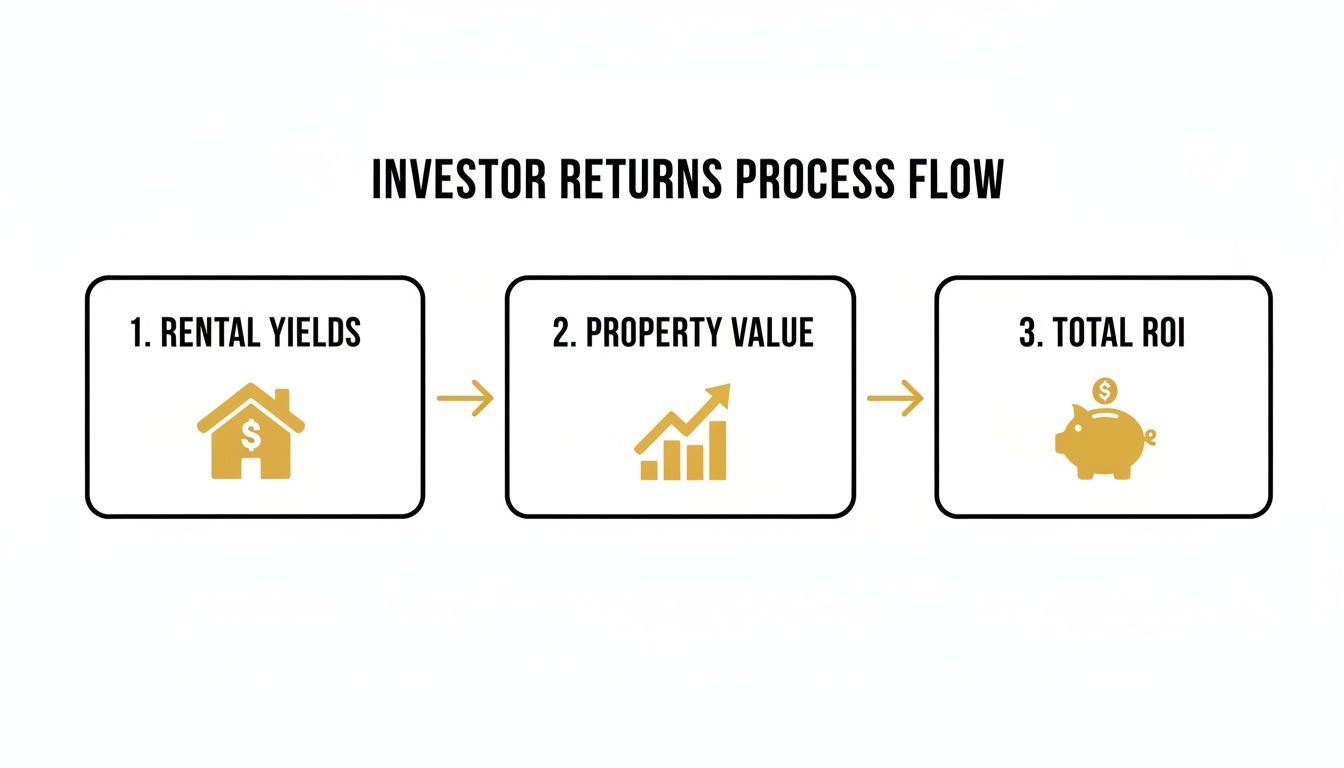
This process highlights how consistent rental yields and long-term property value growth combine to create a powerful total ROI.
Exchange and Completion
Once your solicitor is satisfied with all searches and enquiries, and your financing is officially in place, you proceed to the most critical stage: the exchange of contracts. This is the point of no return—the moment the deal becomes legally binding. You will sign the contract and pay a deposit, typically 10% of the purchase price.
Completion is the final step, usually occurring a few weeks after exchange on a mutually agreed date. On this day, the remaining funds are transferred to the seller’s solicitor, and legal ownership of the property officially passes to you. You receive the keys, and the property is finally yours.
For a more detailed look at the nuances of buying from abroad, you can review our comprehensive guide on how to buy property abroad.
Navigating UK Tax and Legal Obligations
Purchasing investment properties for sale in Central London involves more than finding the perfect postcode. Success requires a sharp understanding of the UK’s tax and legal landscape. For international investors, addressing this correctly from the outset is the difference between a profitable venture and a costly error.
Consider this a field guide, not formal financial advice. It is designed to help you anticipate costs, know who to hire, and make smarter decisions to protect your capital and enhance your long-term returns.
Understanding Stamp Duty Land Tax
The first cost you will encounter is Stamp Duty Land Tax (SDLT). This is a tax on property purchases in England, calculated in tiers, meaning different rates apply to different portions of the property's price.
For overseas investors, there are two crucial surcharges to factor in. First, a 2% non-resident surcharge applies to all residential purchases. Additionally, if this is an additional property for you (such as a buy-to-let), you will pay another 3% surcharge. These charges can significantly impact your initial budget, so ensure they are included in your calculations from the start.
Taxation on Rental Income and Capital Gains
Once your property is tenanted, the rental income is subject to UK income tax. As a non-resident landlord, you will need to register with HM Revenue & Customs (HMRC) and file a UK Self Assessment tax return each year.
The UK has a mechanism called the Non-Resident Landlord Scheme to ensure tax is collected smoothly. Your letting agent will typically deduct the basic rate of income tax from your rent before remitting it to you. The alternative is to obtain approval from HMRC to receive your rent in full and manage the tax yourself.
When you decide to sell, any profit is subject to Capital Gains Tax (CGT). For residential property, the rates are higher than for other assets. Since 2015, non-residents have been liable for CGT on UK property sales, calculated on the gain in value from that date (or the date of purchase, if later). This is why keeping meticulous records of your purchase price, stamp duty, legal fees, and any capital improvements is vital—they can all be deducted to lower your final tax bill.
For a deeper dive, our guide on navigating real estate taxes for investors offers a broader perspective.
Ownership Structures and Legal Compliance
A crucial early decision is how you will own the property. There are two primary routes:
- In Your Personal Name: This is the simplest method. It is quick to set up, but all rental profits are taxed at your personal income tax rate, which can be high. You also have full personal liability.
- Through a Limited Company: Holding property in a UK limited company, often a Special Purpose Vehicle (SPV), has become increasingly common. This can be more tax-efficient, as you will pay corporation tax instead of income tax, and all mortgage interest can be deducted as a business expense. The trade-off is the additional administration and accounting costs associated with running a company.
Beyond taxes, you must adhere to your legal duties as a landlord. This includes everything from tenancy agreements to understanding landlord safety obligations like the Gas Safe Certificate. Consulting with expert legal and tax advisors is not just recommended; it is essential for choosing the optimal structure for your objectives.
Who Is Buying in Central London Today?
To gain a real command of the market for investment properties for sale in Central London, you must understand the key players. The city's luxury property scene is not a local affair; it is a global arena populated by a diverse and evolving cast of international buyers. Understanding who is currently active provides a significant competitive edge by revealing precisely where demand originates.
The motivations for buying here are as varied as their passports. For many, it is about securing capital in a safe-haven asset, backed by London's unmatched political stability and a transparent legal system. Others are playing the currency markets, identifying a strategic moment to acquire prime real estate at a favourable exchange rate. And, of course, there is the undeniable allure of the London lifestyle—world-class schools, culture, and business hubs that act as a magnet for the global elite.
The Shifting Tides of Global Buyers
While Central London has always been a destination for the world's wealthy, the dominant nationalities have seen a recent shift. In a major development, US investors have surged to the forefront, now standing as the most prominent overseas buyers in the prime central market. It is a powerful signal of the city's enduring appeal to high-net-worth individuals from across the Atlantic.
Recent figures show American buyers accounted for 11.6% of all international purchases in prime central London, pulling ahead of both Chinese and Hong Kong investors. This is backed by solid market activity: transaction volumes in the area jumped 7.2% in a single quarter and are currently 14% above the ten-year average. This points to a healthy market recovery and a serious appetite for London's finest assets. You can get the full picture on the latest buyer trends here.
"We're seeing a clear vote of confidence from American buyers. The combination of a strong dollar and London's timeless appeal creates a compelling investment case that's hard to ignore," observes Nick Marr, founder of EuropeanProperty.com.
What’s Driving Today's Investors?
Looking beyond nationalities, a few key motivations unite the current wave of buyers in the Central London property market. For sellers or agents, understanding these drivers is crucial for positioning a property effectively.
- Wealth Preservation: For a significant number of buyers, a prime London property is not a short-term speculation. It is a rock-solid asset for safeguarding wealth and passing it down through generations in a stable, world-class city.
- The Education Factor: London’s prestigious universities are a massive draw. Families often purchase property as a base for their children during their studies, which subsequently becomes a shrewd long-term investment.
- Corporate Moves: As a global business capital, London constantly attracts top-tier executives and entrepreneurs who require premium accommodation. This keeps the high-end rental market buoyant and fuels demand for buy-to-let investments.
For agents and sellers, this market intelligence is invaluable. It helps you tailor your marketing to resonate with the right motivations—be it stability, lifestyle, or pure financial upside—that will connect with today's active buyers.
Your London Property Investment Questions, Answered
If you are an international investor considering investment properties for sale in Central London, you likely have several questions. Here are straightforward answers to the most common queries we receive.
How Long Does a UK Property Purchase Take?
Patience is essential. For an international buyer, the journey from offer acceptance to receiving the keys typically takes between three to six months.
This timeline is not fixed. It can vary depending on the complexity of the transaction, the efficiency of the solicitors, and whether a mortgage is involved. Cash buyers can often complete in under three months. A mortgage, however, adds several weeks for the lender's due diligence and valuation.
What Ongoing Costs Should I Expect?
The purchase price is just the starting point. To accurately project your returns, you must budget for the recurring costs of owning a London property.
- Service Charges: If you purchase a flat (apartment), you will pay these to cover the upkeep of communal areas, building insurance, and sometimes a concierge. In prime new-builds, these can be substantial.
- Ground Rent: This is an annual fee paid to the landowner (the freeholder) if your property is a leasehold.
- Letting Agent Fees: Essential for an overseas landlord. Expect to pay 10-15% of the monthly rent for a fully managed service where they handle all aspects of the tenancy.
- Maintenance and Repairs: It is prudent to maintain a contingency fund for unexpected repairs.
New-Build or Period Property: Which is the Better Buy?
This decision comes down to your investment strategy. There is no single correct answer when evaluating investment properties for sale in Central London, as each property type offers unique advantages.
A sleek new-build often attracts tenants seeking modern comforts, high energy efficiency, and a maintenance-free lifestyle. They typically come with guarantees, meaning fewer upkeep issues, making them an excellent hands-off investment.
Conversely, a classic period property—such as a grand Georgian townhouse or a converted Victorian flat—offers a different appeal. They possess character and are often located on London's most desirable streets. Their rarity can give them an edge in capital growth over time, but be prepared for higher maintenance requirements.
How Do I Choose the Right Letting Agent?
Selecting a competent letting agent is arguably the most important decision you will make post-purchase. They are your representatives on the ground, protecting your asset and ensuring consistent rental income.
The ideal choice is an agent who is a true local expert in your specific neighbourhood and has a proven track record of working with international landlords. Ensure they are a member of a professional body like ARLA Propertymark; it is a mark of quality and adherence to professional standards. Do not hesitate to ask for testimonials and question them on their tenant vetting process. You need an agent who finds reliable tenants, not just the first applicant.
Ready to explore prime investment opportunities in the heart of London? Browse exclusive listings on EuropeanProperty.com and find your next world-class asset today.
👉 https://europeanproperty.com
About EuropeanProperty.com
EuropeanProperty.com is Europe’s longest-running luxury real estate platform, online since 1999. It connects luxury real estate agents, developers, and homeowners with high-net-worth buyers and international investors.
Looking for expert mortgage guidance? Get luxury property mortgage advice here:
👉 https://europeanproperty.com/luxury-overseas-mortgages/
Explore more overseas homes for sale at our global partner site:
👉 https://homesgofast.com/overseas-property/