
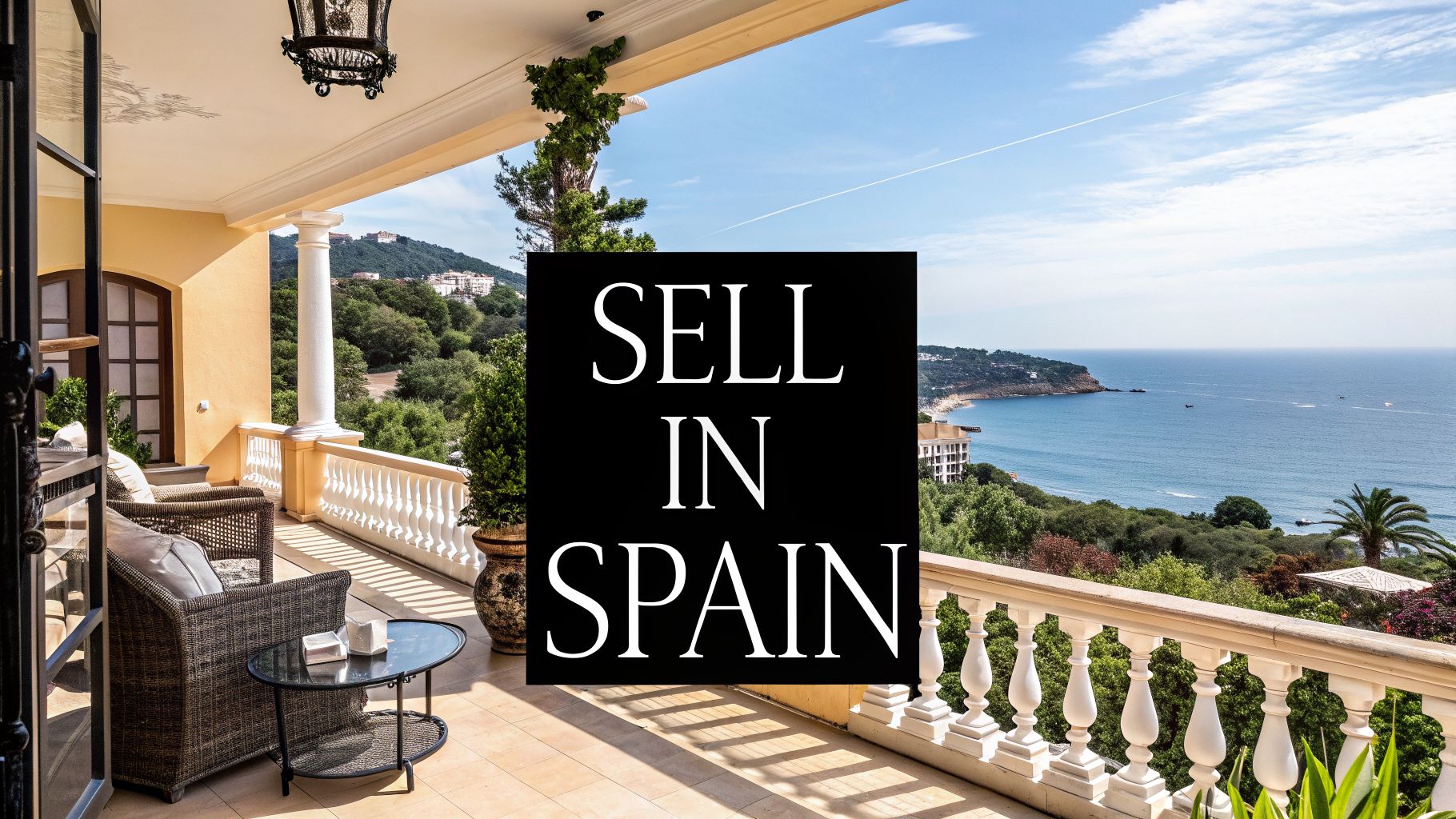
Selling a property in Spain, particularly a high-end residence, is a nuanced process demanding a sophisticated understanding of the luxury market, impeccable preparation, and precise legal execution. To achieve an optimal outcome, sellers require a curated strategy designed to attract discerning international buyers—from establishing an accurate valuation to navigating a flawless legal completion. Anything less introduces the risk of undervaluing a significant asset.
Understanding the Spanish Luxury Property Market
Before bringing a property to market, it is crucial to gain a clear perspective on the current landscape. Spain’s luxury real estate market continues to be a powerful magnet for international investors and lifestyle buyers, which creates a competitive—but highly rewarding—environment for sellers. This demand is not a fleeting trend; it is supported by several key factors that give the market its resilience and appeal.
High Demand from International Buyers
A significant proportion of Spain’s luxury property transactions is funded by foreign capital. Buyers from Northern Europe, the Middle East, and the USA are consistently drawn to the lifestyle, climate, and investment stability that prime Spanish locations offer. For sellers, this is excellent news. It means there is a deep pool of qualified, motivated buyers for well-presented homes, which helps sustain premium property values.
This is a very different picture from what we're seeing in other markets. Take the UK, for instance. Recent government data showed that UK annual house price growth had cooled, with average prices sitting around £270,000. While that market is seeing affordability pressures ease, the dynamics are far more moderate. Spain’s international appeal keeps its high-end market far more energised.
The Seller's Journey Outlined
Selling a premium property successfully means mastering several key stages. Executing these correctly positions you for a superior result.
Valuation and Strategic Pricing: It all starts here. You will need a formal tasación (valuation) combined with deep local market knowledge to set a price that is both competitive and ambitious.
Property Preparation and Presentation: This is where you sell the lifestyle. Professional staging and high-end photography are non-negotiable for showcasing the unique qualities your property offers.
Targeted Global Marketing: Your buyer could be anywhere. Reaching them requires a global outlook, using specialist platforms and tapping into elite agent networks.
Legal and Fiscal Compliance: The Spanish system is meticulous. You will need a qualified abogado (lawyer) to navigate all tax obligations, from Capital Gains to Plusvalía.
Seamless Completion: The final stretch involves moving from the preliminary contrato de arras (deposit contract) to the final signing of the Escritura (deed) at the Notary.
Understanding these steps provides a clear roadmap for selling a property in Spain efficiently and for the best possible price. The key is to treat each stage with the expert attention it deserves.
Preparing Your Property for an Elite International Audience

When you're selling a property in Spain to a high-end, international market, the first impression is not just important—it is everything. These buyers are not just looking for a building; they are investing in a lifestyle. Your home must sell that dream from the very first image they see online.
This is the stage where a successful sale is often made or lost. It all comes down to meticulous preparation and transforming your home into an asset that justifies a premium price.
The Power of Professional Presentation
In the luxury market, amateur photography is a critical misstep. High-net-worth buyers review dozens of listings daily, and only magazine-quality images will compel them to stop and engage. Professional photography and videography are not optional extras; they are essential investments to showcase your property’s light, space, and unique character.
Home staging is just as crucial. A skilled stager depersonalises the space, allowing buyers to envision their own lives there. They understand precisely how to arrange furniture and art to improve flow, highlight the best features, and create a sense of understated luxury. It is a strategic move that can drastically shorten your time on the market and often yields higher offers.
To truly stand out, a professionally produced video can make a significant difference. You can learn more about creating an immersive experience in our guide to virtual house tours.
Securing an Accurate Valuation
Before listing, you need a formal valuation—a tasación—from a certified appraiser in Spain. This is far more than an agent’s estimate; it is a legally recognised document that provides an objective, defensible price.
An accurate valuation helps you avoid the two biggest pricing traps: asking too much, which deters serious buyers and leaves your property lingering on the market, or asking too little and leaving capital on the table. A properly justified price gives buyers confidence and initiates negotiations on a professional footing.
Gathering Your Essential Documentation
A smooth, efficient sale depends on having your paperwork in order from day one. Gathering all your documents before you list shows you are a serious seller and prevents frustrating—and often costly—delays later on.
Your lawyer will require a complete file with the following:
- Escritura Pública (Title Deeds): The official document proving your ownership of the property.
- Nota Simple Informativa: A recent report from the Land Registry confirming the property’s legal status and any outstanding debts or charges.
- Certificado de Eficiencia Energética (CEE): The Energy Performance Certificate, which is mandatory for selling any property in Spain.
- Proof of IBI Tax Payment: Your receipts for the annual local property tax (Impuesto sobre Bienes Inmuebles).
- Community Fee Certificate: If you are in a community of owners, you will need a certificate from the administrator confirming all fees are paid up to date.
Having this folder ready immediately reassures buyers and their legal teams, signalling that this will be a transparent, well-managed sale.
High-Impact Upgrades for Maximum ROI
Full-scale renovations immediately before a sale rarely pay off. Instead, focus on targeted cosmetic upgrades that offer the best return on investment. The goal is a fresh, modern, and neutral aesthetic that appeals to a broad audience.
First impressions start at the entrance. You may wish to consider some game-changing curb appeal ideas to elevate the exterior. Simple refinements to the garden, outdoor lighting, or the entrance can make a substantial difference.
Inside, your priorities should be:
- A fresh coat of neutral paint.
- Updating old light fixtures, electrical sockets, and door handles.
- A deep, professional clean and decluttering of every space—including cupboards and storage rooms.
- Ensuring the terrace, pool, and garden look immaculate.
These small details add up to create a polished, cohesive presentation. When selling a property in Spain to a buyer who expects perfection, the details are paramount.
Navigating Spanish Property Taxes and Legal Obligations

Successfully selling a property in Spain comes down to correct legal and tax compliance. For international owners, this is not just a procedural exercise; it is fundamental to protecting your profit and ensuring the transaction is entirely legitimate. The Spanish system is thorough, and you absolutely need a specialist legal advisor, or abogado, who is an expert in property law for non-residents.
First, you will need your NIE (Número de Identidad de Extranjero). This is your unique foreigner's ID number, and it is non-negotiable for any financial transaction in Spain, especially paying taxes. If you own a property, you already have one—locate it and have it ready for your legal team. It is your link to the Spanish Tax Agency (Agencia Tributaria).
Hiring a good abogado is the single best investment you will make in this entire process. They do not just check documents; they calculate your tax liabilities, handle payments, and ensure every step is compliant, protecting you from unforeseen issues and financial penalties.
Understanding Capital Gains Tax (Ganancia Patrimonial)
Your main tax liability will arise from Capital Gains Tax, known in Spain as Ganancia Patrimonial. It is calculated on the profit you make from the sale—that is, the difference between the final sale price and the original acquisition cost (including purchase costs like taxes and notary fees).
The rate you pay depends entirely on your residency status. For non-residents of Luxury Homes For Sale in Spain, the tax is a flat 19% on the profit. For Spanish residents, it is a progressive scale:
- 19% on the first €6,000 of profit
- 21% on profit between €6,000 and €50,000
- 23% on profit between €50,000 and €200,000
- 27% on profit between €200,000 and €300,000
- 28% on any profit exceeding €300,000
While some exemptions exist for residents (such as being over 65 and selling a primary residence), these rarely apply to international owners selling a second home. Your abogado will provide a definitive calculation for your specific circumstances.
The Non-Resident 3% Retention (Retención)
This is a critical point for non-resident sellers. The buyer is legally required to withhold 3% of the declared sale price. They do not give this to you; they pay it directly to the Spanish Tax Agency on your behalf.
This 3% retention, or retención, acts as a security deposit against your final Capital Gains Tax bill. It's the tax authority's mechanism for ensuring non-resident sellers settle their obligations before transferring funds out of the country.
Once the sale is finalised, your lawyer will calculate your actual Capital Gains Tax liability. If the 3% withheld is more than you owe, you can claim a refund for the difference. If you owe more, you must pay the remaining amount. Claiming that refund is a precise process, and having a professional handle it is crucial to recovering your funds.
The Plusvalía Municipal Tax
Another key tax to budget for is the Plusvalía Municipal. This is a local tax charged by the town hall (ayuntamiento) and is calculated on the increase in the land's value (valor catastral del suelo) during the period of your ownership.
Typically, the seller pays this, though it can sometimes be negotiated. The calculation is notoriously complex, and recent legal changes have introduced new methods for its determination. Your lawyer will determine the most favourable method for you. Do not underestimate this cost; in a prime area like Luxury Homes For Sale in Marbella, the plusvalía can be a significant sum.
To help you get a clear overview, we've broken down the key financial responsibilities for sellers in the table below.
Key Seller Taxes and Fees in Spain
| Tax or Fee | Who Pays | Description and Typical Cost | Important Consideration |
|---|---|---|---|
| Capital Gains Tax | Seller | Tax on the profit from the sale. 19% for non-residents. | The 3% retention is a down payment on this. |
| 3% Retention | Buyer (on Seller's behalf) | 3% of the sale price is withheld by the buyer and paid to the tax office. | Non-negotiable for non-resident sellers. A refund can be claimed if you overpay. |
| Plusvalía Municipal | Seller | A local tax on the increase in land value. Highly variable cost. | Recent legal changes affect how this is calculated. Legal advice is essential. |
| Energy Performance Certificate (EPC) | Seller | A mandatory certificate rating the property's energy efficiency. Costs €100-€500. | You must have this certificate before you market the property. |
| Estate Agent Fees | Seller | Commission paid to the real estate agent. Typically 3%-6% (+VAT). | This is the largest single fee. Ensure the rate is agreed in your contract. |
| Legal Fees (Abogado) | Seller | Fees for legal representation and conveyancing. Around 1% (+VAT) of the sale price. | A vital cost for ensuring a smooth, compliant, and secure transaction. |
This table provides a snapshot, but always remember that professional legal and fiscal advice tailored to your personal situation is the only way to navigate the sale of your Spanish property with confidence.
Crafting a Global Marketing Strategy for Your Home
When you're selling a property in Spain to a high-net-worth international audience, your marketing must be global in ambition and laser-focused in its execution. Discerning buyers are not confined to a single location. Your ideal buyer might be reviewing listings from a penthouse in New York, a family office in Dubai, or a townhouse in London. Reaching them is not about local advertising; it is about crafting a compelling story and presenting it on the right platforms.
Choosing Your Global Representation
Your first major decision is who will represent your property on the world stage. A standard local agent may have excellent local knowledge, but selling a luxury asset often requires a much wider network.
You have two primary paths: a specialist luxury agency with an established international network, or a premium global property platform. A high-end agency offers a bespoke, hands-on service, tapping into private client lists and affiliate offices in key capital cities. A platform like EuropeanProperty.com, on the other hand, provides direct access to a curated audience of verified buyers and investors actively seeking premium European homes. The goal is to find a partner who understands how to position your property as a unique lifestyle and investment opportunity, not just another listing.
Building a Compelling Property Narrative
Luxury buyers are not just acquiring real estate; they are buying into a story and a lifestyle. Your marketing must transcend a simple list of features like bedrooms, bathrooms, and square metres. It needs to sell an aspiration.
- Define the Lifestyle: Is your home a tranquil coastal retreat for escaping the city? A glamorous hub for entertaining? Or a secure, private family compound? This core concept should drive all your marketing.
- Highlight Unique Selling Propositions: Focus on what makes your home impossible to replicate. It could be its architectural history, a show-stopping sea view, bespoke interior design, or its prime location near an exclusive marina or golf course.
- Professional Visuals are Key: As previously covered, magazine-quality photos and cinematic video tours are non-negotiable. They are the tools used to convey the emotion and prestige of the lifestyle you are selling.
This narrative is what captures a buyer's imagination and justifies a premium price, transforming your home from a property into a prized asset.
Executing a Targeted Digital Campaign
Once you have your story and stunning visuals, it is time for targeted exposure. A global marketing strategy requires specific strategies for the property industry designed to reach elite international buyers with surgical precision.
This could involve geo-targeted ad campaigns on social media platforms popular with high-net-worth individuals or featuring your property in exclusive digital magazines read by affluent audiences in key markets like the UK, Germany, and the Middle East.
For many sellers, the health of the UK market is a significant factor. The UK housing market from GOV.UK shows the average UK property value has reached £270,000, with a solid 2.4% annual rise, pointing to a resilient market. This financial stability often fuels European property purchases, making UK buyers a prime audience.
Nick Marr notes, "The most effective campaigns reach beyond broad advertising. They use data to identify and engage qualified buyers who have demonstrated a clear interest in a specific lifestyle or location, ensuring your marketing budget is spent connecting with the most relevant audience."
A successful global strategy for selling a property in Spain ultimately combines a powerful story with smart, data-driven distribution. To learn more about connecting with this exclusive audience, you may find our guide on how to promote overseas property listings to HNW buyers useful.
From Offer to Completion: Navigating the Spanish Conveyancing Process
Once your marketing attracts a serious buyer, you enter the final, most technical phase of the sale: the Spanish conveyancing process. This is a clear, legally-defined path that transfers your property’s ownership to the buyer. While it can feel complex, understanding the key milestones puts you in control.
Your abogado (lawyer) is your most important ally here. They will handle the fine print, manage the paperwork, and ensure every step is taken to protect your interests. The system is designed to be secure and transparent for all parties.
Handling Offers and Negotiations
A solid offer initiates the formal negotiation. In the high-end market, this is rarely just about the price. Buyers might want to negotiate the completion timeline, the inclusion of specific furniture, or other unique conditions. Your agent and lawyer are there to help you evaluate the offer, craft counter-offers, and secure a final agreement that meets your objectives.
Once terms are agreed, the process moves swiftly to the first formal legal step.
The Private Purchase Contract (Contrato de Arras)
This is the point of commitment. The next stage is signing a preliminary private purchase contract, known in Spain as the Contrato de Arras. It functions as a reservation or deposit contract and is a legally binding document outlining all agreed terms, locking both you and the buyer into the deal.
Typically, the Contrato de Arras will specify:
- Full identification details for both you (the seller) and the buyer.
- The official legal description of the property, matching the Land Registry record (Nota Simple).
- The final, agreed-upon purchase price.
- The deposit amount paid by the buyer.
- A target date for the final signing at the Notary’s office.
This process is the culmination of a successful marketing strategy, which starts with great representation and a compelling story.

When the Contrato de Arras is signed, the buyer pays a deposit—usually 10% of the purchase price. This money is held securely in a client or escrow account, not paid directly to you.
Key Takeaway: The Contrato de Arras has significant legal weight. If the buyer withdraws without a legitimate legal reason, they forfeit their 10% deposit. Conversely, if you (the seller) decide to pull out, you are legally obliged to pay them back double the deposit as a penalty.
The Completion Meeting at the Notary
The final stage of selling a property in Spain takes place at the office of a public Notary (Notario). The Notary is a government-appointed legal professional who acts as an impartial witness, verifying that the sale is fully legal before officially recording it. You and the buyer (or your legal representatives holding Power of Attorney) must both be present.
The meeting proceeds as follows:
- Signing the Final Deed (Escritura Pública de Compraventa): The Notary reads the final public deed of sale aloud to ensure both parties understand and agree to every clause. Once confirmed, all parties sign.
- Final Payment: The buyer provides proof of the final payment, almost always a Spanish banker's draft. The exchange of funds occurs under the Notary's supervision.
- Settling Debts: If you have a mortgage on the property, a representative from your bank will be present to receive the outstanding payment from the sale proceeds and officially cancel the loan.
- Handover of Keys: Once the Escritura is signed and payment is confirmed, you hand over the keys. At this moment, the property officially has a new owner.
After the signing, the Notary’s office sends the new deed to the Spanish Land Registry to formally update the ownership records. This meticulous, state-supervised system makes Spanish property transactions some of the safest in the world.
FAQs: Selling Your Spanish Property
How long does it take to sell a luxury property in Spain?
The timeline for selling a property in Spain depends on location, price, and current market conditions. For a well-marketed luxury home in a prime area like Luxury Homes For Sale in Ibiza, you can typically expect the process to take between 3 and 9 months from listing to completion. Unique or ultra-premium properties may require more time to find the right buyer.
Do I need to be in Spain for the final sale?
No, your physical presence is not required. The Spanish legal system facilitates remote transactions via a Power of Attorney (Poder Notarial). By granting this to your lawyer (abogado), you empower them to sign the final deed (Escritura) and handle all funds at the Notary's office on your behalf. This is a standard, secure, and efficient process for international sellers.
How does the 3% retention for non-residents work?
The 3% retention is a standard tax withholding for all non-resident sellers. It is not an additional tax but an advance payment on your Capital Gains Tax. The buyer withholds 3% of the purchase price and pays it directly to the Spanish Tax Agency. After the sale, your lawyer calculates your final Capital Gains bill. If the 3% retained is more than you owe, you can claim a refund. If you owe more, you pay the balance.
Can I sell my property if it still has a mortgage?
Yes, selling a property with an outstanding mortgage is a common and seamless process in Spain. At the completion meeting, your bank will provide a certificate stating the exact amount owed. This amount is deducted from the sale proceeds and paid directly to your bank, with the Notary overseeing the transaction to ensure the loan is cancelled and the property title is cleared for the new owner.
What are the main costs associated with selling?
The primary costs for a seller are estate agent commission (typically 3-6% + VAT), legal fees (around 1% + VAT), Capital Gains Tax (19% on the profit for non-residents), and the Plusvalía Municipal tax. You will also have smaller costs for obtaining documents like the Energy Performance Certificate.
How important is choosing the right estate agent?
Choosing the right representation is critical when selling a luxury property. A specialist agent or platform with a global reach and a network of high-net-worth clients is essential. They should understand how to market the unique lifestyle and investment attributes of your property to a discerning international audience, beyond just listing its features.
About EuropeanProperty.com
EuropeanProperty.com is a premium international real estate platform showcasing luxury homes, exclusive residences, and investment-grade property across Europe and select global markets. The platform connects discerning buyers with high-end villas, apartments, coastal homes, ski chalets, and lifestyle-led real estate opportunities.
Explore exclusive Luxury Property For Sale listings at
https://europeanproperty.com