
Buying a high-value home abroad isn't like getting a standard mortgage. It's a completely different ball game, one that calls for a financial strategy far beyond off-the-shelf lending. Luxury overseas mortgages for high-value homes aren't your typical loans; they are custom-built solutions designed for sophisticated investors with complex, global assets.
These financial products are specifically structured to handle much larger loan values, intricate wealth assessments, and personalised terms that take your entire financial world into account.
Securing Finance For Your Global Property Portfolio

When you’re purchasing a prime international residence, the financing process is fundamentally different. A typical mortgage is often a one-size-fits-all product, relying on simple income slips and a straightforward credit history.
In sharp contrast, arranging luxury overseas mortgages for high-value homes is like having a suit made on Savile Row. Every single detail is measured and cut to fit your unique financial profile perfectly. This specialist approach is essential because high-net-worth individuals rarely have finances that fit neatly into the high street bank's rigid boxes.
Understanding the Bespoke Nature of Luxury Finance
Lenders in this exclusive space—think private banks and specialist international brokers—don't just glance at your salary. They conduct a holistic review of your entire wealth portfolio. This means they'll look at a much bigger picture, which might include:
- Business profits and dividends from multiple countries
- Income generated from trusts and investment portfolios
- Assets under management (AUM) held with various financial institutions
- Your existing international property holdings
This comprehensive evaluation allows for far more flexibility and creativity in structuring the finance. An entrepreneur’s fluctuating income, for example, might be a red flag for a retail bank. But a private lender understands this world and can assess long-term profitability and asset strength instead. Our guide on how to buy property abroad covers the general process, which is a great starting point for any international buyer.
To put it in perspective, here's how these two worlds differ.
Key Differences Between Standard and Luxury Overseas Mortgages
This table gives a clear overview of the unique features you'll encounter when financing a high-value international property compared to a standard home loan.
| Feature | Standard Residential Mortgage | Luxury Overseas Mortgage |
|---|---|---|
| Loan Size | Capped based on local market values and salary multiples. | Typically starts at £1 million+, with no defined upper limit. |
| Client Profile | Primarily salaried employees with straightforward income streams. | High-net-worth individuals, entrepreneurs, and global investors with complex assets. |
| Underwriting Focus | Standard income verification (payslips, tax returns). | Holistic wealth review, including AUM, investment portfolios, and business profitability. |
| Loan Structure | Fixed or variable rates with standard repayment terms. | Highly flexible: interest-only options, Lombard loans, multi-currency facilities. |
| Lender Type | High street banks and mainstream lenders. | Private banks, specialist lenders, and international wealth managers. |
| Geographic Scope | Usually limited to the lender's country of operation. | Cross-border expertise, handling transactions in multiple jurisdictions and currencies. |
| Relationship | Transactional, focused on a single product. | Relationship-driven, often part of a broader wealth management strategy. |
As you can see, a luxury mortgage is far more than just a loan; it's a strategic financial tool.
The Role of Specialist Lenders and Brokers
Navigating this intricate landscape absolutely requires expert guidance. Private banks offer discretion and a deep, intuitive understanding of their clients' financial lives, often building lending solutions around an existing wealth management relationship.
"A luxury overseas mortgage is not merely a loan; it is a strategic component of a client's global wealth management. Lenders in this space act more like financial partners, crafting solutions that align with long-term investment goals and tax considerations."
Specialist mortgage brokers are just as critical. They provide access to a curated network of international lenders, many of whom you can't approach directly. Their real value lies in knowing how to package and present a complex financial case, negotiate the best possible terms, and manage the maze of cross-border legal and administrative hurdles.
Decoding Lender Requirements for High-Net-Worth Buyers
When you’re seeking a luxury overseas mortgage for high-value homes, forget everything you know about high street banking. Private banks and specialist lenders operate on a completely different plane. It's less about ticking boxes and more about understanding the full picture of your wealth.
They move far beyond simple income multiples. Instead, they conduct a holistic wealth assessment, scrutinising everything from your assets under management (AUM) and investment portfolios to offshore trusts and complex global business structures. It’s a sophisticated evaluation built for people whose finances don’t fit into a neat, conventional box.
A Holistic View of Wealth
At the heart of this world is the idea of 'total relationship banking'. This means a private bank looks at your entire financial ecosystem—your investments, your business interests, and your future earning potential—not just a monthly payslip. This approach allows for far greater flexibility, as they understand that a high-net-worth individual’s income can be complex and episodic.
Lenders in this space focus on:
- Assets Under Management (AUM): A healthy portfolio managed by a reputable firm is a powerful signal of financial stability.
- Diverse Income Streams: They have the expertise to verify income from dividends, rental portfolios, business profits, and trust distributions, often across multiple currencies.
- Global Asset Base: They’ll often factor in property, art, and other valuable assets held internationally as part of their overall assessment.
This comprehensive view allows them to structure bespoke lending solutions that a typical bank simply couldn't dream of offering. Even with this sophisticated approach, some fundamentals still apply. A key part of the financial puzzle involves understanding your Debt-to-Income (DTI) ratio, which remains a foundational metric.
The Critical Role of Documentation and Compliance
Be prepared for a deep dive into your paperwork. The documentation required for a luxury overseas mortgage for high-value homes is both extensive and meticulous. This isn’t just bureaucracy for the sake of it; it's about complying with stringent international Anti-Money Laundering (AML) and Know Your Customer (KYC) regulations.
Proving a legitimate source of wealth is arguably the most critical step in the entire process. Lenders must have a clear, auditable trail demonstrating how the funds for the deposit and repayments were generated legally.
You’ll be expected to provide detailed evidence, which might include:
- Business accounts and dividend statements going back several years.
- Tax returns from every jurisdiction you operate in.
- Paperwork related to the sale of a business or a significant inheritance.
- Statements for your global investment portfolios.
This rigorous due diligence is there to protect everyone—the lender, the borrower, and the integrity of the financial system. It ensures the transaction is transparent and fully compliant with global regulations.
Geopolitical and Residency Considerations
Finally, who you are and where you’re buying matters. A great deal. A lender’s decision can be swayed by your nationality, your country of tax residency, and the political stability of the country where the property is located. For instance, financing a villa in a stable nation like Luxury Homes For Sale in Portugal will likely face fewer hurdles than a purchase in a region with higher perceived risk.
Lenders are also well-versed in handling applications from expats and non-domiciled individuals. In fact, these buyers are driving a significant uptick in luxury UK mortgage applications, especially for properties over £3 million. Specialist brokers can offer clever solutions, like foreign currency loans compatible with offshore trusts, to help navigate complex tax and compliance rules.
For those whose residency status is tied to their investment, it's also worth reading our guide to Golden Visa programmes in Europe, as this can often intersect with your financing arrangements.
Finding the Right Finance for Your Overseas Home
Buying a multi-million-euro villa isn’t like getting a standard mortgage from your high-street bank. When you’re purchasing a high-value Luxury Property For Sale, the world of finance opens up, offering sophisticated solutions that go far beyond a simple loan. It’s a landscape filled with specialised players and unique financial tools, and knowing how to navigate it is key.
Choosing the right lender is the first and most critical step in structuring luxury overseas mortgages for high-value homes. The three main players—international private banks, specialist non-bank lenders, and local banks in your target country—all operate in fundamentally different ways.
Think of a private bank as a financial concierge, building a bespoke package around your entire global wealth. A local retail bank, on the other hand, is more like a scheduled tour with a fixed itinerary—its standardised products might not fit the complex needs of an international investor.
The Spectrum of Lenders
Each type of institution is geared towards a specific kind of client. Understanding where you fit is crucial.
- International Private Banks: This is the go-to for most high-net-worth individuals. They offer a relationship-based service, taking your entire global wealth portfolio into account. This holistic view allows them to create highly customised deals, often leveraging your assets under management for much better terms.
- Niche Non-Bank Lenders: These are the specialists. They focus exclusively on high-value and complex property finance, and their agility means they can often approve loans that traditional banks would turn down. They are a fantastic option if you have a unique property or unconventional income streams.
- Local Banks: While they can be less flexible, a local bank in your destination country, like a private bank for Luxury Homes For Sale in France, brings invaluable regional knowledge. They understand the local property laws and market quirks inside out, which can be a real advantage if you plan to build a significant financial presence there.
To help clarify the differences, here’s a breakdown of what each lender type typically offers.
Comparison of International Lender Types
| Lender Type | Typical Client Profile | Key Advantages | Potential Considerations |
|---|---|---|---|
| International Private Banks | High-Net-Worth (HNW) & Ultra-High-Net-Worth (UHNW) individuals with complex global assets. | Relationship-driven; highly bespoke terms; can leverage existing investments (AUM); holistic wealth view. | Higher entry thresholds for assets under management; primarily for existing bank clients. |
| Niche Non-Bank Lenders | Entrepreneurs, investors with non-standard income, or those buying unique or unconventional properties. | Speed and flexibility; experts in complex cases; often more agile than large banks. | Interest rates can be slightly higher; may focus purely on the property, not your wider portfolio. |
| Local Banks | Buyers establishing a local financial footprint or seeking straightforward financing in that specific country. | Deep knowledge of local laws and market conditions; may offer competitive rates for simpler profiles. | Often less flexible on international income/assets; may not understand complex global wealth structures. |
Choosing the right partner depends entirely on your financial picture and what you’re trying to achieve with the purchase.
Advanced Financing Structures
For sophisticated investors, the structure of the mortgage is a powerful strategic tool. It’s rarely about just a standard repayment loan; it's about choosing an instrument that aligns with broader goals like wealth preservation and maintaining liquidity.
One of the most popular options is the interest-only mortgage. This approach keeps monthly payments to a minimum, freeing up your capital to be deployed in other, higher-yield investments. The UK high-net-worth market has seen a huge rise in these loans, especially for prime London properties. According to one recent report, private bank mortgages ranging from £1 million to over £30 million are now commonplace, with interest-only being the top choice for clients who want to service debt from investment income without tying up their cash. You can dig deeper into these UK high-net-worth mortgage trends at Fox Davidson.
Leveraging Assets and Currencies
Another incredibly powerful tool is Lombard lending. This allows you to use your existing investment portfolio—stocks, bonds, funds—as collateral for the property loan. The genius of this is that you secure finance without having to sell profitable investments, which means you avoid triggering capital gains tax and can keep your market positions intact.
"For the global investor, a mortgage is more than debt; it's a strategic lever. Multi-currency facilities and asset-backed lending are not just financing tools—they are integral components of international wealth management and risk mitigation."
For anyone operating across borders, multi-currency mortgages are also essential. These facilities let you hold the loan in a currency different from the property's location. This is a savvy way to hedge against exchange rate swings, aligning your mortgage debt with your main currency of income and protecting your investment’s value in a volatile global market.
With this knowledge, you’re far better equipped to select a lending strategy that fits perfectly into your financial architecture.
The Mortgage Application Journey: What to Expect
Applying for a luxury overseas mortgage isn't like popping into your local high street bank. It's a highly detailed journey, far removed from the tick-box exercises of standard lending. Think of it less as an application and more as a strategic financial project that demands precision, exhaustive documentation, and careful coordination across borders.
Let's break down the key stages. This roadmap will turn what can feel like a daunting process into a clear, manageable plan.
Stage 1: Engage a Specialist Broker
Your first move—and arguably the most important—is to find a specialist mortgage broker. I’m not talking about a conventional mortgage adviser; you need someone who lives and breathes cross-border finance for high-net-worth individuals. These experts operate within a tight-knit network of private banks and niche lenders that you simply can't access directly.
Their job goes way beyond finding a good rate. They're your strategic partner. A true specialist will:
- Analyse your entire global financial picture to pinpoint the right lenders who understand your situation.
- Frame your application for success, knowing exactly how to present complex income streams and international assets to underwriters.
- Negotiate bespoke terms on your behalf, often securing conditions and rates you couldn't get on your own.
- Project manage the whole affair, coordinating lawyers, valuers, and bankers across different countries and time zones.
Stage 2: Build Your Financial Dossier
With your broker on board, it’s time to assemble your financial dossier. This is the bedrock of your application and there’s no room for ambiguity—full transparency is key. The paperwork required is extensive, designed to satisfy strict international Know Your Customer (KYC) and Anti-Money Laundering (AML) rules.
Typically, you'll need to provide:
- Proof of identity and residency for everyone involved.
- Detailed evidence of all global income, from company accounts and dividend statements to tax returns from various countries.
- A full schedule of your assets and liabilities, including property portfolios, investment statements, and other major holdings.
- And the big one: a crystal-clear, verifiable story explaining the Source of Wealth—where your deposit funds originally came from.
The lender you approach shapes the journey from here, as each has a slightly different process.
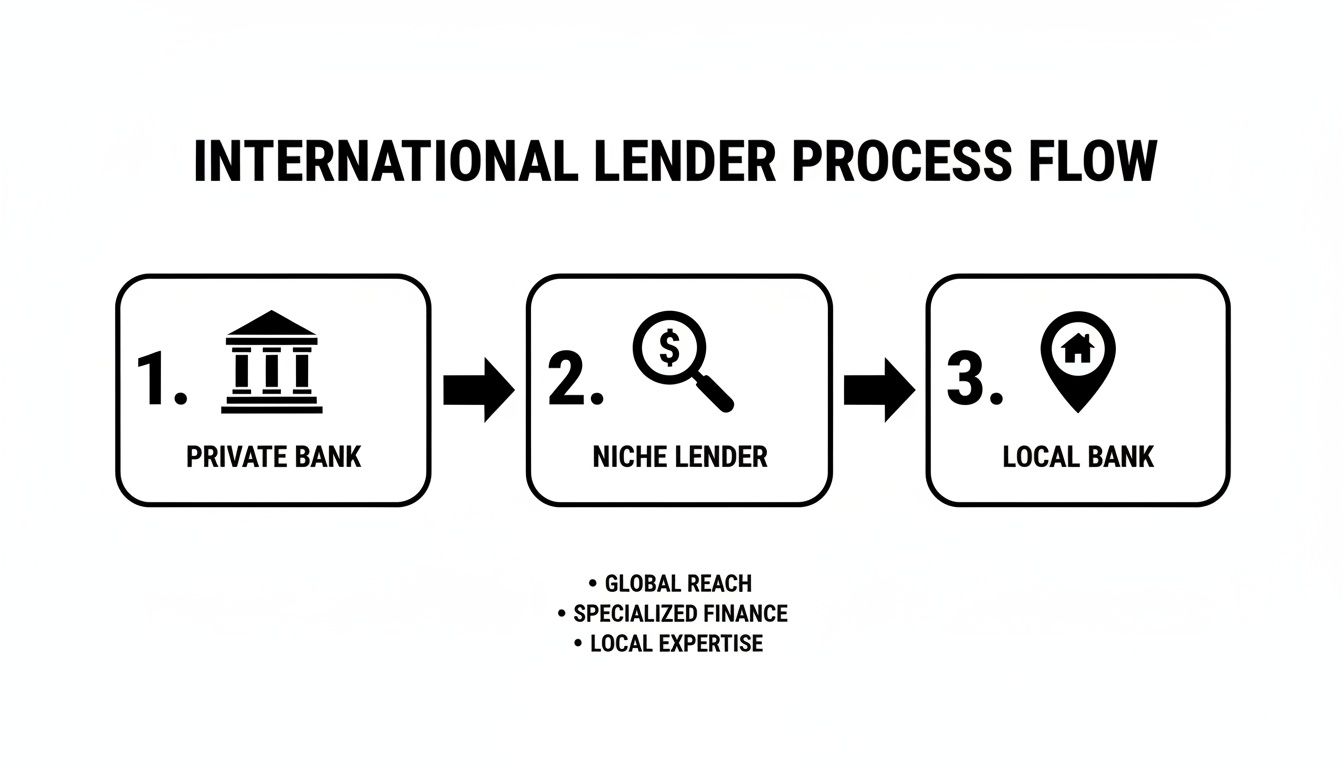
This diagram shows how different lenders—from private banks that prioritise relationships to more agile niche lenders—serve distinct corners of the high-net-worth market.
Stage 3: The Underwriting and Valuation Deep Dive
Once your dossier is in, the lender’s underwriting team starts its due diligence. This is an intense review where every single document is scrutinised. At the same time, the lender will instruct a specialist property valuation.
Forget the standard drive-by survey. For unique, high-value properties like a historic château or a modern villa in a prime spot like the Luxury Homes For Sale in Algarve, the valuer must be an expert in that specific luxury market. They’ll assess everything from architectural significance and local market trends to the property's appeal to an international buyer. A strong, positive valuation is a critical milestone for getting the final green light.
Stage 4: Tackling Cross-Border Legal Hurdles
The final leg of the journey is navigating the intricate legal process. This demands seamless coordination between your lawyers in your home country and their counterparts in the country where you’re buying.
"Securing a luxury overseas mortgage for high-value homes is as much a legal and logistical exercise as it is a financial one. Navigating two different legal systems simultaneously is where many delays occur, making expert legal counsel on both sides of the transaction non-negotiable."
The main challenge here is aligning the property transfer laws of the foreign country with the lender's security requirements. You’re often dealing with different languages, tax systems, and property registries. An experienced legal team is absolutely essential to ensure a smooth completion, protect your interests, and satisfy the lender's conditions without any last-minute hitches.
Managing Costs, Risks and Strategic Considerations

Successfully buying a high-value overseas property goes far beyond just getting the loan approved. To protect your investment and really make it work for you, you need a sharp, strategic overview of all the financial moving parts. The final price tag on a luxury overseas mortgage for high-value homes is a complex equation, and the property's sticker price is just the beginning.
Discerning buyers need to budget for the full spectrum of expenses. Think lender arrangement fees, broker commissions, international legal counsel, and the often-underestimated costs of currency conversion. Getting a handle on these from the outset is crucial to avoid any nasty surprises down the line.
Understanding the Full Cost of Acquisition
The initial purchase is just one piece of a much larger puzzle. For long-term success, you have to be crystal clear on the ongoing financial commitments, too.
Here are the key costs you need to factor into your financial planning:
- Lender Arrangement Fees: On multi-million-pound loans, these can be substantial, often calculated as a percentage of the total amount you’re borrowing.
- Specialist Broker Commissions: Expert guidance isn't free, but the value a good broker adds by navigating the market and negotiating better terms often pays for itself several times over.
- International Legal Expenses: You'll need lawyers in both your home country and the property's location, and each will have their own fee structure.
- Local Property Taxes: Every country has its version of stamp duty or property transfer tax. These can add a hefty percentage to the final bill, so getting a clear picture of these liabilities is a critical first step.
Mitigating Cross-Border Financial Risks
One of the biggest gambles in any international property deal is currency fluctuation. Even a small shift in exchange rates between agreeing on a price and finalising the purchase can add tens of thousands of pounds to your costs overnight.
Luckily, there are powerful tools to manage this risk. A forward contract lets you lock in an exchange rate for a future date, giving you certainty and shielding you from volatile market swings. Opening a foreign currency account in the country you're buying in can also simplify payments and cut down on conversion fees.
Advanced Ownership Structures
For high-net-worth individuals, smart thinking extends to how you own the property. Structuring the purchase through a corporate entity or a trust can offer huge advantages in tax efficiency, privacy, and long-term asset protection.
This level of financial structuring moves the purchase from a simple acquisition to a considered addition to your global wealth portfolio, ensuring it is optimised for preservation and growth.
This approach is especially important for anyone seeking residency through investment. For example, investors eyeing a long-term stay in the UAE must understand the Dubai Golden Visa requirements linked to real estate investment, as the ownership structure can directly affect your eligibility. Consulting with international tax advisors and legal experts isn’t just recommended—it's non-negotiable to ensure your chosen structure fits your personal and financial goals.
Expert Insights and Future Market Outlook
Navigating the world of high-value international property finance is about more than just understanding today's market; it’s about anticipating tomorrow’s. As we've seen, securing luxury overseas mortgages for high-value homes is a strategic game. In this arena, specialist advice and bespoke financing aren’t just helpful—they're absolutely essential.
The landscape is constantly shifting, influenced by everything from global economic tides to changing interest rate policies and geopolitical events. These aren't abstract concepts; they directly impact the cost, availability, and structure of finance for prime properties across Europe and beyond. Staying ahead of these curves is what separates a good investment from an exceptional one.
Emerging Trends in Prime European Markets
A few key trends are already shaping the future of luxury property finance. Lenders are now placing a huge emphasis on sustainability, with a growing number of private banks offering better terms for properties that meet high environmental standards. This "green premium" is fast becoming a major factor in how new developments are valued and financed.
At the same time, the very definition of 'luxury' is changing. Today's buyers are prioritising wellness, privacy, and turnkey convenience. This is driving huge demand for branded residences and modern, amenity-rich homes, often at the expense of traditional, high-maintenance country estates.
Nick Marr notes that Europe’s prime markets continue to attract buyers seeking lifestyle resilience and capital preservation.
Navigating Future Uncertainty
Of course, the road ahead isn't without its challenges. Volatile interest rates and evolving tax regulations, especially for non-domiciled residents in key hubs, will continue to be major factors in any investment strategy. This really brings home the importance of being agile and having expert counsel on your side.
A specialist broker can give you invaluable insight into how these big-picture economic shifts are playing out on the ground. They can connect you with lenders who are best equipped to handle the changing environment and find creative solutions.
Ultimately, your ability to read the market and structure your financing accordingly will be the key to long-term success. Making smart decisions today, with a clear eye on tomorrow, ensures your global property portfolio is built on a solid foundation of strategic foresight and financial strength.
FAQs
What is the typical loan-to-value for a luxury overseas mortgage?
For high-value overseas properties, lenders are generally more conservative. You can typically expect a Loan-to-Value (LTV) ratio between 50% and 70%. This reflects the additional complexities of cross-border lending, such as different legal systems and market fluctuations. The final LTV offered will depend on the property's location, your overall financial profile, and your existing relationship with the lender.
How long does the international mortgage application take?
Securing a luxury overseas mortgage for high-value homes is a detailed process and takes considerably longer than a standard domestic loan. You should budget for a timeline of three to six months from the initial consultation to completion. The extended timeframe is due to the comprehensive due diligence required, including international wealth verification and the coordination of legal teams in two different jurisdictions.
Can I use my investment portfolio as collateral?
Yes, this is a common and highly effective strategy known as Lombard lending or asset-backed financing. Private banks are very familiar with this approach, which allows you to secure a loan against your liquid assets (such as stocks and bonds). This can result in more favourable interest rates and terms, and it allows you to finance your property purchase without needing to liquidate profitable investments, thus avoiding potential capital gains tax.
What are the main advantages of using a specialist broker?
A specialist international mortgage broker provides three key advantages: access, expertise, and advocacy. They have established relationships with private banks and niche lenders that are not accessible to the public. They know how to structure and present a complex financial profile to meet underwriters' criteria. Finally, they act as your representative, negotiating bespoke terms and managing the entire process to secure a more strategic and favourable financing deal.
About EuropeanProperty.com
EuropeanProperty.com is a premium international real estate platform showcasing luxury homes, exclusive residences, and investment-grade property across Europe and select global markets. The platform connects discerning buyers with high-end villas, apartments, coastal homes, ski chalets, and lifestyle-led real estate opportunities.
Explore exclusive luxury property listings at
https://europeanproperty.com