


Think of luxury property syndication for agents in Europe not as a sales tactic, but as a complete shift in how you conduct business. Instead of the traditional one-buyer, one-property model, you are creating a sophisticated investment vehicle. It’s about pooling capital from multiple high-net-worth investors to close bigger, more complex deals and earn commissions on trophy assets that would otherwise be out of reach.
Why Syndication Is Your Next Big Move

The European high-end property market is a unique beast—it’s resilient, defined by scarcity, and demands serious capital. For ambitious agents, the classic sales model has its limits. You are often stuck in long sales cycles, completely dependent on the decisions of a single client.
Luxury property syndication for agents in Europe offers a powerful way out of that trap. It transforms you from a simple facilitator into a true deal architect.
By structuring a syndication, you empower a small group of investors to collectively acquire a high-value asset, whether that’s a historic château in Luxury Homes For Sale in France or a portfolio of prime apartments in Lisbon. This completely changes the dynamic of the transaction.
Diversify Client Risk and Expand Your Reach
Let's be honest: relying on one client's capital is risky. Syndication spreads that risk across a pool of investors.
For your clients, it’s a brilliant move. It gives them fractional ownership in a premium asset, granting them access to a tier of the market they might not be able to enter alone. For you, it means a much more robust deal that isn't going to fall apart because one person gets cold feet.
This model allows you to offer far more sophisticated investment opportunities, which in turn attracts a different calibre of client—someone focused on genuine portfolio growth, not just buying a holiday home. You are no longer just an agent; you are a strategic advisor delivering exclusive, often off-market, opportunities.
Unlock Access to Trophy Assets
Many of Europe’s most desirable properties—think sprawling Tuscan estates or waterfront villas on the Côte d'Azur—almost never hit the open market. Luxury property syndication for agents in Europe gives you the financial firepower to go after these trophy assets.
Nick Marr notes that Europe’s prime markets continue to attract buyers seeking lifestyle resilience and capital preservation. Syndication opens the door for agents to meet this demand with institutional-grade opportunities.
By pooling resources, you can approach sellers of ultra-prime real estate with a credible, fully-funded offer. This capability instantly elevates your professional standing and sets you apart in a very crowded field.
Build a Predictable and Scalable Business
Syndication creates a commission pipeline you can actually rely on. Instead of chasing individual multi-million-euro deals one by one, you can build a scalable business model around identifying assets, structuring syndicates, and managing your investor group.
Suddenly, you have multiple streams of revenue:
- Acquisition Fees: Earned for sourcing and securing the property.
- Asset Management Fees: Ongoing income for managing the property on behalf of the syndicate.
- Profit Sharing: A piece of the capital appreciation when the asset is eventually sold.
Ultimately, mastering luxury property syndication for agents in Europe isn’t just a new skill; it's a fundamental evolution of your business. It allows you to operate at an institutional level, build deeper and more meaningful investor relationships, and establish a commanding presence in the premier tier of the Luxury Property For Sale market.
Getting Inside the Head of Today's European Luxury Investor
Before you even think about structuring a syndication deal, you have to know your audience. Who are you actually selling to? The game has changed. Today’s high-net-worth (HNW) investors aren't just collecting properties; they're making calculated moves to preserve wealth and secure lifestyle assets. To succeed with luxury property syndication for agents in Europe, you have to speak their language.
Forget the flashy sales pitches. The modern European luxury investor is sharp, strategic, and acutely aware of risk. They aren't buying a property—they're acquiring a stake in a high-performing, tangible asset that promises stability in a world full of volatility. This kind of investor cares far more about long-term value, architectural quality, and an unbeatable location than they do about passing fads.
The Homegrown Investor is Back in the Driving Seat
There's a major shift happening in Europe's prime property markets. While money still flows in from all corners of the globe, domestic buyers are making a powerful comeback. They’re looking for stability and security closer to home. With all the geopolitical uncertainty and wild currency swings, many HNW individuals are bringing their capital back, parking it in high-value local markets they know and trust.
We're seeing this play out across the continent. In the UK's luxury market, for instance, homegrown buyers now make up a staggering 61% of all transactions as of early 2025. It's a clear sign that wealthy Europeans are confidently investing in their own backyards. For agents who can package attractive local investment deals, this is a golden opportunity.
So, What Actually Motivates This New Breed of Investor?
To craft a syndication pitch that lands, you need to get to the heart of what drives their decisions. It's no longer just about the potential return on investment. They're looking for a specific blend of security, exclusivity, and smart portfolio diversification.
Here’s what’s really on their minds:
- Wealth Preservation: In these uncertain economic times, prime European real estate is seen as one of the last true "safe-haven" assets. It’s a reliable way to shield wealth from inflation and market turbulence.
- Access to the Inaccessible: Syndication opens doors to off-market deals and trophy assets that are simply out of reach for most individual buyers. Think historic châteaux, entire floors of prime city-centre buildings, or boutique hotel developments that never hit the open market.
- Someone Else to Handle the Headaches: HNW investors are busy people. They place immense value on a professionally managed structure where an expert—that’s you—handles all the due diligence, acquisition, and ongoing management.
- Smarter, Safer Diversification: Why put all your eggs in one basket? Fractional ownership allows investors to spread capital across several high-value properties instead of sinking it all into one. It’s a savvy way to minimise risk while growing their portfolio.
For a deeper dive into current market dynamics, check out our guide on the European luxury property market in 2025.
How to Frame Your Syndication Offer to Win Them Over
When you present a deal, your language has to reflect this sophisticated mindset. Ditch the generic sales talk and get straight to the strategic advantages. Build your narrative around solid data, logic, and what makes this specific asset a uniquely compelling investment.
Your pitch for luxury property syndication for agents in Europe must directly answer their biggest concerns. Don't frame it as just another property purchase. Position it as a sophisticated financial instrument designed for intelligent capital growth.
Talk about shared risk, enhanced buying power, and the peace of mind that comes from knowing a professional is at the helm. This simple shift in framing elevates you from a mere broker to a trusted strategic partner. That's how you build the trust needed to bring high-calibre investors into your deals and keep them coming back. Your ability to articulate these benefits is what separates a standard agent from a truly successful syndicator.
How to Build Your Syndication Framework
Making the leap from agent to syndicator isn't just a change in title; it's about building a robust, legally sound investment vehicle from the ground up. This is where the concept becomes a reality. You're creating the entire architecture that protects you and your investors, ensuring the deal gets done professionally. Frankly, success in luxury property syndication for agents in Europe hinges on getting these foundations right from day one.
A solid framework is more than just a pile of legal documents. It's your entire operational blueprint. It defines how you find properties, structure the partnership, communicate with investors, and navigate compliance across different European jurisdictions.
Choosing the Right Legal Structure
Your first major decision is choosing the corporate entity that will actually own the property. This isn't a minor detail—it has huge implications for liability, tax, and management flexibility. While the specifics change from country to country, a few common structures are used all over Europe.
Most syndicators lean towards a Limited Liability Company (LLC) or its local equivalent, like a GmbH in Germany or a SARL in France. Why? Because they create a crucial firewall, separating investors' personal assets from the property's liabilities. It's a non-negotiable layer of protection.
Another popular route is a Limited Partnership (LP). In this setup, you, as the agent, become the 'General Partner' who actively manages the asset. Your investors are 'Limited Partners', and their liability is capped at whatever they put in. Simple and effective.
To give you a clearer picture, here’s a quick comparison of the most common structures you'll encounter.
Comparing Common Legal Structures for Property Syndication
This table offers a snapshot of the typical legal entities used for luxury property syndication in Europe, highlighting what matters most for agents and their investors.
| Structure Type | Liability Protection | Management Flexibility | Tax Implications | Best Suited For |
|---|---|---|---|---|
| Limited Liability Company (LLC/GmbH/SARL) | Excellent. Personal assets are shielded from business debts. | High. Can be managed by members or appointed managers. | Varies by country; often offers pass-through taxation. | Most syndication deals, especially with a diverse investor group. |
| Limited Partnership (LP) | Good. Limited partners' liability is capped at their investment. | Moderate. General partner has control; limited partners are passive. | Typically pass-through, with profits/losses reported on personal returns. | Syndicates where the agent takes a clear, active management role. |
| Corporation (SA/AG) | Excellent. Strongest liability shield available. | Low to Moderate. Governed by a board of directors; more rigid. | Often subject to double taxation (corporate and shareholder levels). | Very large, institutional-grade syndications with many investors. |
| Joint Venture (JV) | Varies. Depends on the underlying structure of the partners. | High. Defined by the JV agreement, allowing for custom roles. | Complex. Taxed at the individual partner level based on their entity type. | Partnerships between two or three experienced professionals on a single project. |
Ultimately, the right structure depends entirely on your specific deal, your investor profile, and the local laws. It's a critical decision that shapes everything that follows.
The legal structure you choose is the bedrock of your entire syndication. It needs to be tailored to the asset, the investors, and the tax laws of the property's location. Don't guess. Consulting with a specialist real estate lawyer isn't just a good idea; it's essential.
Sourcing and Vetting Prime Properties
Your reputation as a syndicator lives and dies by the quality of the assets you bring to the table. Sourcing for a syndicate is a different ball game than finding a home for a single buyer. You have to start thinking like an institutional investor, hunting for properties with obvious upside potential—whether that's through capital growth, rental yield, or a mix of both.
This means your due diligence has to be absolutely rigorous, going far beyond a standard property check. Your process should be bulletproof and include:
- Financial Deep-Dive: You need to tear apart the property's operating history, analyse every potential income stream, and create conservative projections for future returns. No room for optimism here.
- Market Vetting: This involves analysing regional economic trends, local planning rules, and comparable sales data to prove your investment case. For instance, a villa on the Costa del Sol requires a completely different analysis than a portfolio of apartments in a capital city.
- Physical Inspection: Bring in the experts. Get architects, surveyors, and engineers to identify any structural red flags or hidden costs lurking down the line.
The entire point is to uncover problems before investors put their money in. This is how you build a foundation of trust that lasts for years.
The infographic below shows the typical thought process of an investor. It starts with global uncertainty, leading them to focus on domestic or regional stability, and finally makes them receptive to group investments like syndication.
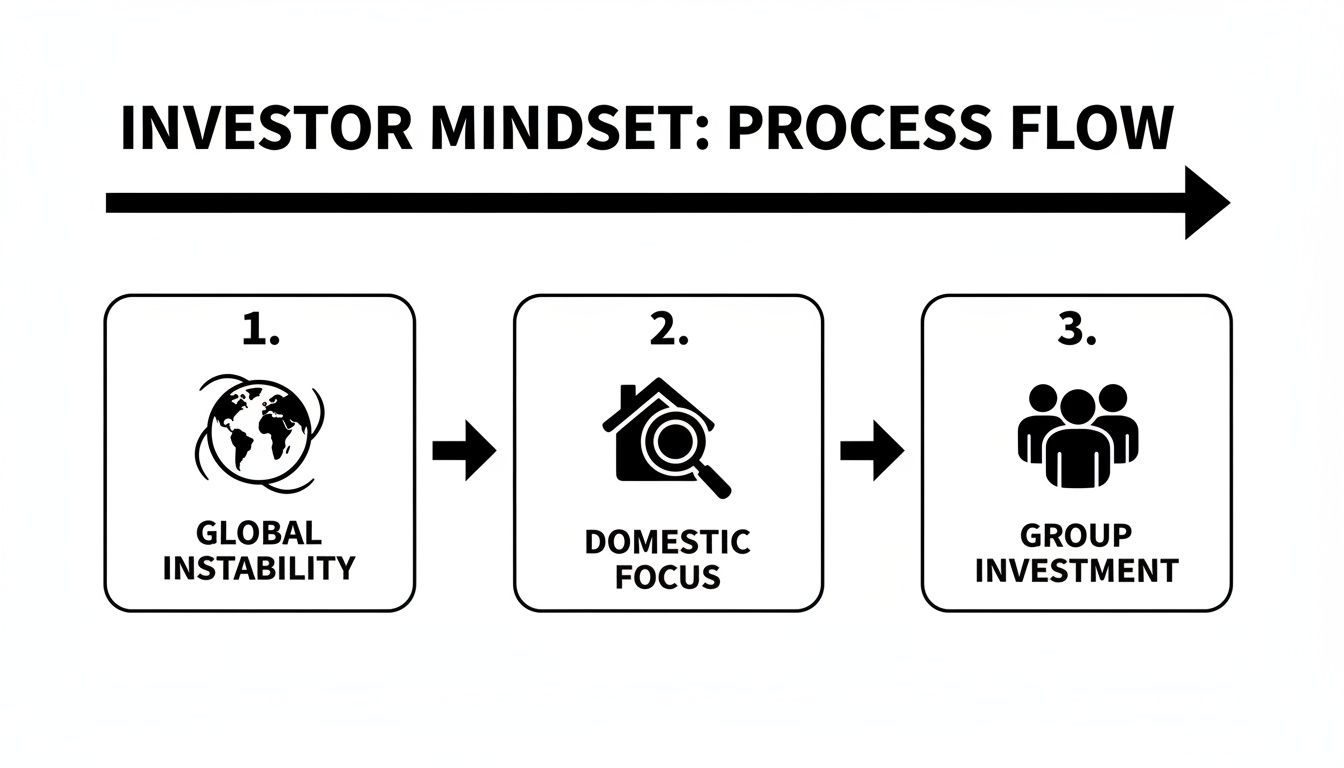
This shift is precisely why well-structured syndicated deals, which offer professional management and shared risk, are becoming so appealing to high-net-worth individuals right now.
Crafting the Investment Prospectus
Think of your investment prospectus (or offering memorandum) as the central pillar of your deal. It’s the one document that presents the entire opportunity to potential investors. It has to be professional, totally transparent, and compelling enough to get them to sign on. This is your number one tool for luxury property syndication for agents in Europe.
A top-tier prospectus must clearly lay out:
- The Executive Summary: A sharp, concise overview of the opportunity, the property, the market, and the projected returns. Get straight to the point.
- Property Details: Everything an investor needs to see. That means high-quality photography, floor plans, and a detailed description of the asset’s condition and features.
- Market Analysis: Data-driven proof of why this is a prime investment, right here, right now. Show them you've done your homework.
- The Business Plan: Your strategy for making money. Is it a renovation, a repositioning, or just a simple hold for appreciation? Spell it out.
- Financial Projections: The numbers, in detail. This means 5-10 year forecasts, cash flow projections, internal rate of return (IRR), and the equity multiple. Be conservative.
- The Syndication Structure: A full breakdown of the legal setup, the roles of all partners, and the distribution waterfall (the all-important explanation of how profits will be split).
- Risk Factors: Full transparency. Disclose every single potential risk associated with the investment, no matter how small.
This document is far more than a sales pitch; it's a legal and financial commitment. Nailing it proves your professionalism and sets the stage for a smooth and successful capital raise.
Pinpointing High-Potential Market Opportunities
Successful luxury property syndication for agents in Europe isn’t about just structuring a deal; it's about finding the right asset in the first place. You have to shift your mindset from agent to analyst, developing a sharp eye for market gaps and uncovering properties with real, untapped potential. Your investors are trusting you to see what everyone else misses.
The European property landscape is always in flux. What was a hotspot yesterday can easily become an oversaturated market tomorrow. The smartest agents are looking beyond the obvious, overcrowded city centres like London or Paris. Instead, they're zeroing in on high-potential regional hubs and exclusive suburban enclaves that promise better value and much stronger growth prospects.
Thinking Like an Investment Analyst
To spot the best opportunities, you need to learn how to read the market’s quieter signals. This goes way beyond looking at simple price trends. You have to dig into the data that tells the real story—analysing regional yields, tracking price adjustments, and really understanding the micro-dynamics of specific neighbourhoods.
For instance, an agent might notice that properties in Knightsbridge with slightly dated interiors are selling at a significant discount compared to newly refurbished ones, even with identical locations. That gap is a clear value-add opportunity, perfect for a syndication deal focused on a quick, high-impact refurbishment. The trick is to find assets where a strategic injection of cash can unlock a disproportionately higher value on exit.
Emerging Investor Priorities
Today’s investors are motivated by more than just profit margins. Sustainability, for example, has gone from a niche concern to a non-negotiable for many. Properties with high Energy Performance Certificate (EPC) ratings are no longer just a 'nice-to-have'—they are essential.
These eco-friendly properties often fetch higher rental income and attract a more stable, reliable tenant base, which directly boosts the asset's long-term performance. A savvy syndicator might spot a portfolio of well-located but poorly-rated properties, building a business plan around upgrading them to meet modern green standards.
The most compelling syndication opportunities are always backed by undeniable data. Presenting investors with a clear, evidence-based story on why a specific market or asset is primed for growth is the fastest way to build credibility and get the deal funded.
This data-first approach turns your pitch from a hopeful idea into a calculated investment strategy. That’s exactly what sophisticated investors want to see.
Uncovering Market Inefficiencies
Investor appetite across Europe is incredibly strong right now, creating fertile ground for syndication. Just look at the UK, where real estate investment hit a solid £12.8 billion in Q1 2025 alone—that's an 8% increase year-on-year. While a lot of that is commercial, it signals a massive flow of capital into tangible assets, which inevitably spills over into demand for high-end residential opportunities.
This flood of capital often follows predictable patterns, creating openings for agents who can anticipate where it's going next. By tracking these capital flows, you can pinpoint undervalued assets before they land on the mainstream radar.
On top of that, a solid grasp of residency-by-investment programmes can open up unique angles. For agents dealing with international investors, properties that qualify for these schemes are especially appealing. If you want to explore this further, take a look at our comprehensive guide to Golden Visa programmes in Europe.
Ultimately, the goal is to move beyond simply finding properties that are for sale. True success in luxury property syndication for agents in Europe comes from identifying a genuine market inefficiency, building a logical business case around it, and presenting it to your investor network as an irresistible, data-backed opportunity they won't find anywhere else.
Marketing Your Deal to High-Net-Worth Investors

Once you’ve structured a meticulous deal, the game shifts to attracting the right capital. Marketing a syndication to high-net-worth (HNW) investors is a world away from selling a single property. It requires discretion, professionalism, and a narrative that balances lifestyle appeal with solid financial logic.
Forget casting a wide net. The goal is to engage a select group of qualified individuals who understand and appreciate the opportunity you've built.
Success in luxury property syndication for agents in Europe is built on trust. Your marketing efforts are less about traditional advertising and more about cultivating relationships and demonstrating undeniable expertise.
Crafting a Persuasive and Polished Narrative
Your investment summary is your primary tool. It must be polished, persuasive, and completely transparent, articulating the investment thesis with absolute clarity. Whether the asset is a historic château in the Loire Valley or a modern villa in Marbella, the story has to resonate.
Focus the narrative on the unique value proposition. Is it an off-market deal? An undervalued asset in a rising location? A property with huge potential for capital appreciation through strategic improvements? This is the core of your pitch—it makes the investment tangible and compelling.
Your presentation should feel exclusive and be heavily data-driven, highlighting key metrics while telling the property’s story. This is your chance to showcase your deep market knowledge and prove you are a credible custodian for their capital.
Leveraging Professional Networks and Premium Platforms
The most effective way to find your first investors is through your existing professional network. Warm introductions from past clients, wealth managers, and financial advisors are invaluable. These individuals already trust your judgement, making them far more receptive to a structured investment opportunity.
But to scale, you have to look beyond your immediate circle. This is where targeted global exposure becomes essential.
Nick Marr notes, "Platforms with genuine international reach are essential for modern syndicators. They connect you with a qualified, global pool of discerning buyers who are actively seeking the kind of structured, high-value investment opportunities that syndication provides."
Using a premium platform like EuropeanProperty.com allows you to discreetly showcase your opportunity to an audience that is already vetted and actively searching for European property investments. It adds credibility and extends your reach into markets you couldn't otherwise access. For agents looking to sharpen their outreach, our guide on sophisticated real estate marketing strategies offers actionable advice.
The current market sentiment is highly favourable. With over 54% of UK property investors planning to expand their portfolios in 2025, there is significant capital waiting for the right opportunities. This demand is fuelling the growth of luxury syndication, creating the perfect conditions for expertly structured group investments.
Hosting Exclusive and Impactful Investor Briefings
For serious prospects, an exclusive briefing—either virtual or in-person—is a powerful next step. This isn’t a sales presentation; it's a strategic discussion among peers.
- Virtual Briefings: Offer a convenient way to connect with international investors. Use professional video conferencing tools and ensure your presentation is visually engaging and flawlessly delivered.
- In-Person Events: For local investors, a small, invitation-only gathering at a discreet venue can be highly effective. It allows for direct interaction and helps build personal rapport.
During these briefings, be ready for tough questions on due diligence, exit strategies, and your own financial stake in the deal. Full transparency is the key to building confidence and securing commitments.
Ultimately, marketing your deal is about fostering long-term relationships. Each successful syndication not only generates returns but also strengthens your reputation, making it easier to raise capital for the next opportunity. Your ability to combine a compelling narrative with professional execution is what will set you apart in the world of luxury property syndication for agents in Europe.
FAQs on Luxury Property Syndication
What are the main legal responsibilities for a syndicator?
As the syndicator, you take on significant legal responsibilities, primarily acting as a fiduciary for your investors. This means you must always act in their best financial interest. You are also responsible for complying with all relevant securities laws in the property's jurisdiction, which often involves preparing a detailed Private Placement Memorandum (PPM) that discloses all material facts and risks associated with the investment.
How is an agent’s compensation structured in a syndication?
Compensation is typically multi-layered. An agent can earn an acquisition fee (usually 1-2% of the purchase price) for sourcing the deal, an asset management fee for ongoing oversight, and a share of the profits, known as "carried interest" or a "promote." This profit share is paid out after investors have received their initial capital back plus a preferred return, aligning the agent's success directly with the investors' returns.
What is the ideal number of investors for a luxury property syndicate?
There is no single ideal number, but most luxury syndicates involve a small, curated group of 2 to 10 investors. This keeps the structure manageable and allows for more straightforward decision-making. The optimal number depends on the total capital required and the minimum investment amount you set. Keeping the group small fosters a sense of exclusivity and stronger personal relationships.
What are the key elements of a compelling investor prospectus?
A compelling prospectus must be transparent, data-driven, and professional. Key elements include a concise executive summary, detailed property information with high-quality visuals, a thorough market analysis, a clear business plan (e.g., value-add, hold strategy), conservative financial projections (including IRR and equity multiple), a breakdown of the legal structure and fees, and a transparent disclosure of all potential risks.
How are exit strategies typically handled in a syndication?
The exit strategy should be clearly defined in the initial syndication agreement. Common strategies include selling the property on the open market after a predetermined holding period (typically 5-7 years), allowing one investor to buy out the others, or refinancing the property to return initial capital to investors while retaining ownership. The agreement should outline the process for making the decision to sell, ensuring clarity for all partners.
About EuropeanProperty.com
EuropeanProperty.com is a premium international real estate platform showcasing luxury homes, exclusive residences, and investment-grade property across Europe and select global markets. The platform connects discerning buyers with high-end villas, apartments, coastal homes, ski chalets, and lifestyle-led real estate opportunities.
Explore exclusive luxury property listings at
https://europeanproperty.com