

Meta Description: Discover how to sell high-end real estate to foreign investors with our expert guide. Learn strategies for targeting HNW buyers, navigating legal complexities, and closing deals in Europe’s luxury property market.
Selling high-end real estate to foreign investors is a different game entirely. It’s not just about listing a property; it's about presenting a legacy asset or a complete lifestyle to a discerning international audience. Success comes down to razor-sharp targeting, building trust across borders, and confidently handling the complex legal and financial side of things.
Your Blueprint for Attracting International Property Investors

Engaging high-net-worth (HNW) individuals from abroad is a world away from traditional local sales. This is a highly specialised field that demands a proactive, multi-channel strategy. You need a solid game plan built on a few key pillars, each designed to grab attention, establish your credibility, and make the final transaction seamless, no matter the distance.
Your first step is to get a grip on modern marketing for real estate and then adapt those principles for a global, affluent clientele. This guide will walk you through the actionable strategies you need for every stage, from that first point of contact to closing the deal.
Establishing Your Foundational Strategy
Before you even think about a campaign, you need to know exactly who you're targeting and what makes your property stand out. Foreign buyers aren’t all the same; their motivations, tastes, and even how they prefer to communicate can vary wildly from one region to another. A tech entrepreneur from California might be focused on capital growth, while a family from the Middle East could be prioritising privacy and five-star amenities.
Get these initial steps right:
- Define Target Investor Profiles: Pinpoint your key geographical markets. Are you going after tech money from Silicon Valley, financiers from Singapore, or established families from the Gulf? Get specific.
- Craft a Unique Value Proposition: What makes your property or portfolio a must-have? Is it the world-renowned architect, the unbeatable location, or the potential for a ‘Golden Visa’?
- Assemble a Cross-Border Team: You absolutely cannot do this alone. A solid network of multilingual lawyers, international tax advisors, and currency specialists is non-negotiable.
"Today's foreign HNW buyers are often seeking legacy assets and lifestyle investments, not just financial returns," says Nick Marr, founder of EuropeanProperty.com. "Your approach must speak to their aspirations for security, exclusivity, and a quality of life that transcends borders.”
Understanding Buyer Motivations
To sell effectively, you need to get inside your buyer's head and understand their 'why'. While a good return is always part of the equation, the drivers in the luxury sector are often far more personal. Foreign buyers might only make up a small slice of the market—often just 3% to 5% of total home purchases in some prime spots—but their impact is huge at the top end.
These investors are typically looking for a few key things:
- Wealth Preservation: A safe place to park capital in a country that's politically and economically stable.
- Lifestyle Enhancement: Access to world-class culture, top-tier schools for their children, and exclusive leisure activities.
- Portfolio Diversification: Spreading their assets across different countries and currencies to minimise risk.
Once you grasp these core motivations, you can tailor your messaging perfectly. You’re not just selling a villa; you're offering the key to a new lifestyle or a secure pillar in a global asset portfolio. This insight is the foundation every successful international deal is built on.
Capturing Global Attention with a Sophisticated Digital Presence

In the elite world of international property, your website and social media presence act as your global storefront. It's a simple fact: affluent buyers from New York to Singapore will almost certainly begin their search online, making a polished digital ecosystem non-negotiable.
To sell high-end real estate to foreign investors, your online marketing must exude the same quality and exclusivity as the properties you represent. This is where many fall short. It means going far beyond standard listings and creating a compelling narrative around each property—one that sells a lifestyle, an aspiration, and a sound investment all at once. The goal is to make a potential buyer feel the magnetic pull of a property from thousands of miles away.
Crafting an Immersive Property Narrative
Your digital assets are the first, and often most important, point of contact. They must be flawless. A few grainy phone pictures or a shaky video can instantly devalue a multi-million-pound asset in the eyes of a discerning buyer.
You need to invest properly in these core visual components:
- Professional Photography: Hire an architectural photographer who truly understands light, space, and composition. Twilight shots, detailed close-ups of bespoke finishes, and sweeping aerial views are not optional extras; they are essential.
- Cinematic Video Tours: Forget a simple walkthrough. A professionally directed video should tell a story, showing how the property facilitates an extraordinary life. Think of a tour that flows from a morning coffee on a sun-drenched terrace to an evening entertaining in a grand dining room.
- Immersive 3D Walkthroughs: For international buyers who can't view the property in person right away, technologies like Matterport are invaluable. They provide a tangible sense of the property's layout and scale, which builds confidence and filters for genuinely serious interest.
These elements work together to transport the buyer, helping them envision themselves in the space long before they even think about booking a flight. It's about selling the experience, not just the bricks and mortar.
Precision Targeting on High-Value Platforms
Mass-market advertising is a complete waste of resources in this sector. To reach the right calibre of buyer, you have to place your message exactly where high-net-worth individuals spend their time online. This isn't about broad social media campaigns; the focus here is on surgical precision.
Consider platforms that cater specifically to a professional and affluent demographic:
- LinkedIn: An underrated tool for property marketing. You can target users by job title (think C-suite executives or partners at law firms), industry (finance, tech), and their geographic location. A campaign for a Swiss chalet could be aimed directly at finance professionals in London and New York.
- Financial Times & Wall Street Journal: Placing digital ads on these platforms positions your property alongside trusted global financial news. This lends it an air of authority and reaches an audience actively looking for international assets.
- Niche Luxury Portals: Platforms dedicated to luxury goods and real estate attract a pre-qualified audience. To get this right, explore our guide on how to advertise luxury property to international buyers for maximum impact.
A common mistake is treating digital marketing as a numbers game. In the luxury sector, it's a quality game. Reaching ten highly qualified potential buyers is infinitely more valuable than reaching ten thousand casual browsers.
Mastering SEO for Luxury Real Estate
Search Engine Optimisation (SEO) is just as crucial. Wealthy buyers use very specific, detailed search queries when hunting for high-end properties, and your website must be optimised to capture this high-intent traffic.
The key is to focus on long-tail keywords that reflect what a serious buyer would actually type into Google. Instead of a vague term like "luxury homes in Portugal," you need to aim for more specific phrases that signal a clear need.
Think about the difference. Good examples of effective long-tail keywords include:
- 'Sea-view villa with private mooring in the Algarve'
- 'Modernist penthouse with concierge service in Mayfair'
- 'Historic Tuscan farmhouse with olive grove for sale'
When you create content and property listings that specifically answer these detailed queries, you attract buyers who are much further along in their journey. This targeted approach cuts through the noise and connects you directly with prospects who know exactly what they want, leading to higher quality leads and a far more efficient sales process.
Navigating International Property Law and Finance
Selling a high-value property to an international buyer is more than just a transaction; it’s an exercise in expert orchestration. It requires you to move beyond the role of a salesperson and become a trusted conductor, bringing together a symphony of specialists to navigate the complex world of cross-border law and finance.
The maze of tax rules, ownership structures, and compliance checks can feel intimidating. But for the top agents, this is where the real value is created. By mastering this landscape and assembling the right team, you turn potential deal-breakers into opportunities to build unbreakable client trust.
Assembling Your Cross-Border Deal Team
Let's be clear: no agent can be a master of international tax law, foreign property regulations, and global finance all at once. Your true power lies in your network. Building a 'deal team' of elite professionals who live and breathe non-resident transactions is one of the most valuable assets you can have.
Your go-to team should always include:
- Multilingual Property Lawyers: A solicitor who not only speaks the client’s language but is an expert in property law for foreign nationals is absolutely non-negotiable. They are your front line for verifying titles and steering clear of local regulatory pitfalls.
- International Tax Advisors: These experts are worth their weight in gold. They provide the critical advice on tax-efficient purchasing, inheritance laws, and wealth structuring that can save your client a fortune and prevent headaches down the line.
- Specialist Mortgage Brokers: Sourcing finance for non-resident buyers is a highly specialised field. You need a broker with deep-rooted connections to private banks and international lenders who understand the unique challenges these clients face.
This team works in lockstep to shield your client’s interests, making sure every legal and financial detail is handled flawlessly from the first offer to the moment you hand over the keys.
Understanding Common Legal Structures
International investors don't always buy property in their own name. They often use specific legal structures to optimise for tax efficiency, ensure privacy, and simplify future estate planning. Having a working knowledge of these structures allows you to engage in intelligent, high-level conversations with your client and their advisors.
The most frequent approach is purchasing through a Special Purpose Vehicle (SPV). This is usually a limited company set up for the sole purpose of owning the property, offering a layer of liability protection and often significant tax benefits. Another common tool is a trust, which is especially useful for managing complex family assets and navigating inheritance laws that vary wildly between countries.
Thinking through the long-term financial picture is part of the service HNW clients expect, and this includes sophisticated high net worth tax strategies. Knowing the basics of these structures elevates you from agent to trusted advisor.
Mastering Due Diligence and Compliance
Rigorous due diligence is the foundation of any secure international property deal. Your job is to oversee this process with an eagle eye, ensuring every single detail is checked and double-checked. This goes far beyond a simple building inspection.
Key due diligence steps always include:
- Title Verification: Your legal expert must confirm, without a shadow of a doubt, that the seller has the clear right to sell and the property is free of any liens, debts, or legal claims.
- Understanding Local Laws: Inheritance laws, for instance, can be dramatically different from what your buyer is used to back home. Getting clarity on these rules from the start is vital for their long-term planning.
- Residency and Visa Implications: For many clients, buying a property is directly linked to their residency ambitions. Our guide to Golden Visa programmes in Europe is an excellent resource for understanding how real estate investment can open the door to European residency.
A crucial part of any modern deal is strict adherence to Anti-Money Laundering (AML) and Know Your Customer (KYC) regulations. These are not just bureaucratic hoops to jump through—they are serious legal requirements that ensure the legitimacy of funds and protect everyone involved.
Get ahead of this by gathering the necessary paperwork—proof of identity, address, and source of funds—as early as possible. Handling these compliance steps professionally and discreetly prevents last-minute scrambles, smoothes the path to closing, and cements your client's confidence in you and the entire process.
Building Trust and Delivering a Bespoke Client Experience

When you're selling high-end property to foreign investors, remember this: the home itself is only half the deal. The other, arguably more important, half is the relationship you build.
International HNW buyers aren’t just purchasing a building; they're investing in a new chapter of their lives. They need a guide they can trust implicitly, and that trust isn't won with glossy brochures. It's forged through impeccable service, cultural intelligence, and a genuine commitment to understanding their world. The so-called 'soft skills' are what really separate a decent agent from an elite international advisor.
Overcoming Cultural and Communication Barriers
Getting the nuances of cross-cultural communication right is fundamental. What comes across as polite negotiation in one culture might seem overly aggressive in another. A direct "no" can be deeply offensive in some parts of the world, where a softer, more indirect approach is the norm.
To bridge these gaps and ensure nothing gets lost in translation, you need a game plan.
- Bring in Professional Interpreters: Never, ever rely on a client’s family member or associate for translation during serious negotiations. A professional interpreter guarantees precision and keeps the atmosphere professional.
- Study Their Negotiation Style: Do your homework. Research the business etiquette of your client's home country. Knowing whether they prefer to build a relationship first or get straight to the data will give you a massive advantage.
- Practise Active Listening: Pay close attention not just to what is said, but how it's said. This lets you adapt your approach on the fly, building rapport and showing you respect their way of doing things.
Putting in this effort shows a level of care that high-calibre clients absolutely notice. It lays the groundwork for a solid, trusting relationship.
Hyper-Responsive Communication Across Time Zones
For a foreign investor, silence from their agent is unsettling. A lack of communication breeds anxiety, especially when there are millions of pounds on the table. Being hyper-responsive isn't just good service—it's a strategic necessity.
With time differences, you have to be structured. Using secure messaging apps like WhatsApp or Signal for quick, informal updates works wonders. A simple message—"Just confirming I've received your documents and will review them overnight"—provides immediate reassurance.
This constant, low-effort contact keeps the client looped in and demonstrates that you're proactively managing their investment, even while they're asleep on the other side of the world.
Creating a Bespoke Viewing Experience
The property viewing is your moment to turn a digital enquiry into a real commitment. The whole experience has to be flawless, frictionless, and tailored completely to the client. You're not just selling a property; you're selling the lifestyle that comes with the keys.
A truly bespoke viewing goes far beyond just unlocking the front door. It’s about the details:
- Private Transport: Arranging a luxury car to collect the client from their hotel or the airport sets a tone of exclusivity right from the start.
- Curated Local Guides: Provide a beautifully designed guide to the area. Don't just list shops—highlight Michelin-starred restaurants, exclusive clubs, top international schools, and private clinics. This shows you understand their entire lifestyle.
- Personalised Touches: If you know the client is an art collector, arrange a private viewing at a local gallery. If they're a keen golfer, book a tee time at the most prestigious course.
The ultimate goal is to move beyond the role of an agent and become a local concierge. Your value lies not just in your property knowledge, but in your ability to open doors and connect the client with the life they envision.
This concierge mindset is what makes you an indispensable local partner.
For example, imagine your client is a passionate golfer eyeing a villa near a world-renowned course. Arranging a private coffee with the club president is a power move. It does more than showcase the property; it demonstrates your influence and your commitment to integrating them into the local elite. It’s these unforgettable moments that seal the deal.
This final stretch—the closing and what comes after—is where truly exceptional agents separate themselves from the pack. Getting an international deal over the line isn't just about paperwork; it's about orchestrating a flawless finish that turns a complex, multi-continental transaction into a seamless experience for your client.
But the real magic happens after the keys are handed over. This is your chance to pivot from being a transaction manager to a lifelong property advisor. Get this right, and one deal can blossom into a pipeline of referrals and repeat business for years to come.
Orchestrating a Smooth International Closing
Coordinating a closing across different time zones, currencies, and legal systems can feel like a logistical nightmare. But with the right approach, it’s entirely manageable. Your job is to instil confidence by handling every detail, from signing documents to moving money, with absolute precision.
Here’s what you need to nail down:
- Secure Digital Signatures: Forget couriering documents across the globe. Modern platforms offer legally binding, encrypted signing from anywhere. Just make sure your legal team is using a reputable service that meets international standards. It’s a simple way to offer convenience without compromising security.
- Specialist Currency Transfers: Letting clients use their high street bank for an international transfer is a rookie mistake. A dedicated currency exchange specialist can save them tens of thousands of pounds by securing better exchange rates and lower fees. This is a quick win that demonstrates you’re actively looking out for their financial interests.
- A Pre-Closing Checklist: Ambiguity is the enemy of a smooth closing. A comprehensive checklist, shared with the client and their legal team well in advance, eliminates last-minute panic. It ensures every piece of paperwork, from ID verification to proof of funds, is ready to go, preventing costly delays.
Nick Marr, founder of EuropeanProperty.com, puts it perfectly: “The smoothness of the closing process leaves a lasting impression. When you make a complex international transaction feel effortless for the client, you don't just complete a sale—you earn their unwavering trust and future loyalty.”
A Pre-Closing Checklist for Foreign Investors
While the solicitors will handle the legal nitty-gritty, your role is to keep the entire process on track and your client in the loop. Think of yourself as the project manager.
A simple, shared checklist can make all the difference. It should track the status of key milestones:
- Finalised Contract Review: Confirmation from the buyer's legal counsel that all terms are agreed.
- AML/KYC Documentation: All anti-money laundering and identity verification documents submitted and approved.
- Proof of Funds: Verified documents confirming the source and availability of the purchase funds.
- Currency Transfer Plan: Agreement on the currency exchange provider and a timeline for the transfer.
- Insurance Arrangements: Confirmation that property insurance will be in place upon completion.
- Tax Advisor Sign-Off: Confirmation from their advisor that the purchase structure is sound.
This isn’t just about ticking boxes. This systematic approach demystifies the process for your client and cements your reputation as an organised, diligent professional. It’s a non-negotiable step when you sell high-end real estate to foreign investors.
The Art of the Post-Sale Relationship
The day of completion isn't the finish line; it’s the starting pistol for the next phase. For a foreign owner, their new property is more than an asset—it’s an anchor in a place they don’t yet know. By continuing to add value, you become their indispensable local expert.
It starts with a seamless handover and transitions into ongoing support.
- The Handover: First impressions matter. Ensure the property is immaculate. A thoughtful welcome package goes a long way—think local delicacies, a guide to the best nearby restaurants and services, and even a couple of pre-paid local SIM cards. It’s a small touch with a massive impact.
- Your Rolodex is Your Goldmine: The most valuable thing you can offer post-sale is your network. Provide a curated list of trusted professionals: property managers, interior designers, private security firms, international school liaisons, and even the best local doctor. You’re saving them hours of frustrating research.
- Stay in Touch (The Right Way): This isn't about pestering them for new business. Maintain periodic, value-driven contact. Send them a concise market update for their neighbourhood, a heads-up about a major local cultural event, or a simple happy new year message. This keeps you top-of-mind as a helpful advisor, not just another agent from their past.
This isn't just good service; it's smart business. This long-term strategy transforms one-off transactions into a powerful, self-sustaining pipeline of high-net-worth clients.
Why the UK Luxury Market Is a Prime Target for Foreign Capital
While Europe has plenty of luxury property hotspots, the United Kingdom has consistently held its own as a global magnet for foreign capital. For anyone looking to sell high-end real estate to foreign investors, understanding what drives this relentless trend is a serious competitive edge. The UK isn’t just another country on the map; it’s a global benchmark for stability, liquidity, and preserving wealth long-term.
This deep-rooted appeal creates a uniquely competitive and diverse pool of buyers for prime assets. Unlike markets that rely heavily on local interest, the UK draws in wealth from every corner of the globe—from North American financiers to Middle Eastern family offices, all wanting a foothold in one of the world's most resilient economies. For sellers with trophy homes in London, Surrey, or other prime hubs, this means you’re not just talking to a domestic audience. You're commanding global attention and, with it, global prices.
The Unwavering Flow of International Investment
Recent market data from CoStar's analysis tells a very clear story. In just the first half of this year, overseas investors poured a staggering £12.2 billion into UK real estate. That figure accounted for an incredible 64% of all investment activity. Let that sink in. It’s a massive vote of confidence in the market’s fundamentals.
When you look closer, the numbers are even more telling. North American buyers were especially bullish, deploying £8 billion, which works out to 42% of the total UK real estate investment. This isn't just casual interest; it's a deep-seated, strategic allocation of capital from one of the world's largest economic powerhouses.
The sheer volume of foreign capital flowing into UK property isn’t an accident. It's proof of its safe-haven status. For sellers, this translates into a highly liquid market where premier assets are met with strong, qualified demand from multiple international sources.
UK vs. US Foreign Real Estate Investment H1 Comparison
To put the UK's appeal into perspective, it's useful to see how it stacks up against another global giant, the United States. This table highlights just how much foreign capital is drawn to the UK market.
| Market | Foreign Capital Inflow (H1) | Share of Total Investment (H1) |
|---|---|---|
| UK | £12.2 billion | 64% |
| US | $13.5 billion (£10.6 billion) | 9% |
Note: US data from the National Association of Realtors (NAR) for a comparable period.
While the total value is similar, the concentration of foreign investment in the UK is dramatically higher, showing just how central it is to global real estate strategies.
A Stable Hub in a Volatile World
So, what’s really fuelling this consistent demand? Beyond the impressive numbers, the UK offers a unique blend of attributes that high-net-worth individuals value above all else. These are the pillars that keep it at the top of their lists.
Key drivers include:
- Legal and Political Stability: The UK's transparent legal system and long-standing political stability create a secure environment for big-ticket investments. Property rights are fiercely protected, offering a level of assurance that’s hard to find elsewhere.
- World-Class Education: For countless international families, getting their children into the UK's elite schools and universities is a top priority. Buying a home in London or the Home Counties is often a strategic part of that plan.
- Global Financial Centre: London’s status as a global financial hub means many investors already have business interests in the city. Owning property here simply aligns their personal and professional portfolios, giving them a prestigious and convenient base of operations.
These factors create a powerful story for potential buyers. When you’re talking to an international client, you’re not just selling a property; you’re offering them a stake in a globally significant and stable ecosystem.
This diagram illustrates the straightforward, three-stage process we typically see when finalising a cross-border deal.
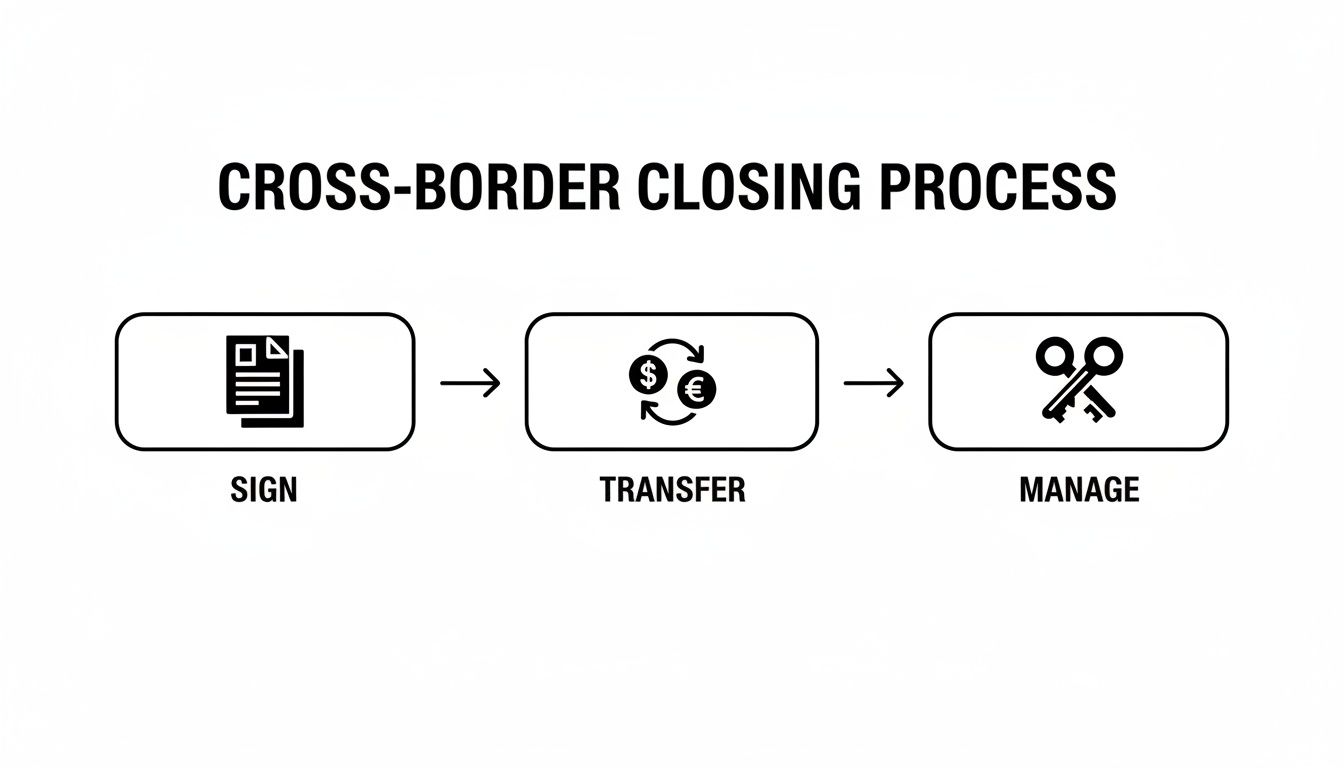
From signing the legal agreements to transferring funds and managing the new asset, having a structured approach gives buyers clarity and confidence every step of the way.
Tapping into a Liquid and Competitive Market
For sellers, the practical takeaway is simple: the UK market gives you unmatched access to a diverse and highly motivated international buyer base. This is a huge advantage, especially at the top end of the market where the pool of potential domestic buyers can be quite limited.
For a deeper dive into the specific opportunities, you can read our comprehensive guide on investing in luxury real estate in the UK.
By positioning a property to appeal to this global audience—whether that’s highlighting its proximity to international schools, its value as a stable asset, or the lifestyle it offers—you can tap into a much larger and more competitive market. Ultimately, it’s this global demand that supports stronger valuations and provides greater liquidity for high-value assets, cementing the UK's position as a prime target for foreign capital.
About EuropeanProperty.com
EuropeanProperty.com is Europe’s longest-running luxury real estate platform, online since 1999. It connects luxury real estate agents, developers, and homeowners with high-net-worth buyers and international investors.
Looking for expert mortgage guidance? Get luxury property mortgage advice here:
👉 https://europeanproperty.com/luxury-overseas-mortgages/
Explore more overseas homes for sale at our global partner site:
👉 https://homesgofast.com/overseas-property/